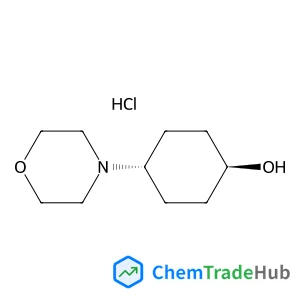
trans-4-(4-Morpholinyl)cyclohexanol hydrochloride (1:1)
CAS Number:
1588441-09-1
Molecular Formula:
C10H20ClNO2
Richard C. Remsing, Igor D. Petrik, Zhiwei Liu, Guillermo Moyna
A graphical abstract is available for this content
Daniel T. Allen, Yussif Saaka, Luis Carlos Pardo, M. Jayne Lawrence, Christian D. Lorenz
DOI: 10.1039/C6CP05714D
Salvatore Mamone, Mónica Jiménez-Ruiz, Mark R. Johnson, Stéphane Rols, Anthony J. Horsewill
DOI: 10.1039/C6CP06059E
Mikhail N. Uvarov, Edward J. Reijerse
DOI: 10.1039/C6CP05389K
S. F. Bychkov, M. P. Popov
DOI: 10.1039/C6CP05435H
Kan Zhang, Shansheng Yu, Baoming Jv, Weitao Zheng
DOI: 10.1039/C6CP03987A
Kazuki Furukawa, Norifumi Yamamoto, Kazuyuki Hino, Hiroshi Sekiya
DOI: 10.1039/C6CP04322D
Xia-chao Chen, Ke-feng Ren, Jia-yan Chen, Jing Wang, He Zhang, Jian Ji
DOI: 10.1039/C6CP05419F
Lu Yan
DOI: 10.1039/C6CP06536H
Anand Narayanan Krishnamoorthy, Johannes Zeman, Christian Holm, Jens Smiatek
DOI: 10.1039/C6CP05909K
Daniela Trogolo, J. Samuel Arey
DOI: 10.1039/C6CP90261H
Ethyl 4-chlorothieno[2,3-b]pyridine-5-carboxylate (CAS: 59713-58-5) can be synth...
5-Methyl-1H-indole-3-carbaldehyde (CAS: 52562-50-2) is subject to various regula...
(1,3-Dimethyl-2,4-dioxo-1,2,3,4-tetrahydro-5-pyrimidinyl)boronic acid is a white...
Waste containing Sulfocostunolide A (CAS: 1016983-51-9) should be handled with c...
When handling Murraxocin (CAS: 88478-44-8), ensure proper personal protective eq...
Formvar (CAS: 63148-64-1) is an alkyd resin characterized by a high molecular we...
(S)-4-benzyl-2-((benzyloxy)methyl)morpholine is generally safe when handled with...
Methyl 1-(5-bromo-2-pyrimidinyl)cyclopropanecarboxylate (CAS: 1447607-69-3) is p...
2-Methyl-1-phenyl-1-propanamine hydrochloride (CAS: 24290-47-9) is generally con...
3-(4-Bromophenyl)-2-methylpropanoic acid is synthesized through a multi-step pro...

Physical Chemistry Chemical Physics (PCCP) is an international journal co-owned by 19 physical chemistry and physics societies from around the world. This journal publishes original, cutting-edge research in physical chemistry, chemical physics and biophysical chemistry. To be suitable for publication in PCCP, articles must include significant innovation and/or insight into physical chemistry; this is the most important criterion that reviewers and Editors will judge against when evaluating submissions. The journal has a broad scope and welcomes contributions spanning experiment, theory, computation and data science. Topical coverage includes spectroscopy, dynamics, kinetics, statistical mechanics, thermodynamics, electrochemistry, catalysis, surface science, quantum mechanics, quantum computing and machine learning. Interdisciplinary research areas such as polymers and soft matter, materials, nanoscience, energy, surfaces/interfaces, and biophysical chemistry are welcomed if they demonstrate significant innovation and/or insight into physical chemistry. Joined experimental/theoretical studies are particularly appreciated when complementary and based on up-to-date approaches.