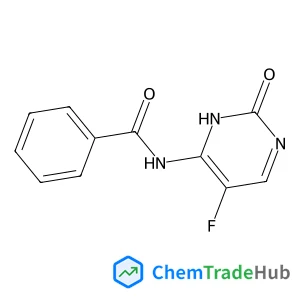
N-(5-Fluoro-2-oxo-2,3-dihydro-4-pyrimidinyl)benzamide
CAS Number:
10357-07-0
Molecular Formula:
C11H8FN3O2
Al'ona Furmanchuk, Oleg V. Shishkin, Olexandr Isayev, Jerzy Leszczynski
The correlation between hydration of Nucleic Acid Bases (NABs) and their conformational flexibility was analyzed based on the results of Car–Parrinello Molecular Dynamics (CPMD) simulations of NABs in bulk water environment. Correlations with quantum chemical results were drawn whenever it was possible. Statistical analysis confirmed that hydration causes bond length alteration in NABs and formation of zwitter-ionic resonance structures. In contrast to the gas phase, bulk hydration results in restricted mobility of amino group and increase in population of its planar-like conformations. At the same time, rings of all NABs become almost equally flexible in the dynamic aqueous environment. Therefore, each NAB possesses a non-planar effective conformation of pyrimidine ring despite the fact that planar geometry corresponds to minimum on the potential energy surface.

Journal of the Chinese Chemical Society

Chemistry of Natural Compounds

Australian Journal of Chemistry

Journal of the American Chemical Society

Chemical Reviews

Chemistry of Heterocyclic Compounds

Chemical & Pharmaceutical Bulletin

Cement and Concrete Research

Advances in Colloid and Interface Science

Carbon
Elizabeth Glogowski, Jinbo He, Thomas P. Russell, Todd Emrick
DOI: 10.1039/B503670D
Peter B. Hitchcock, Gareth J. Rowlands, Rakesh Parmar
DOI: 10.1039/B507394D
Hui Hong, Tim Stinear, Paul Skelton, Jonathan B. Spencer, Peter F. Leadlay
DOI: 10.1039/B506835E
Kazunori Nakashima, Tatsuo Maruyama, Noriho Kamiya, Masahiro Goto
DOI: 10.1039/B505479F
Steven Dickson, Darrell Dean, Robert. D. Singer
DOI: 10.1039/B508400H
Makeba B. Murphy-Jolly, Lesley C. Lewis, Andrew J. M. Caffyn
DOI: 10.1039/B507752D
Chunling Fu, Jing Li
DOI: 10.1039/B508069J
Waste containing N-Methoxy-N-methyl-1,3-thiazole-5-carboxamide (CAS: 898825-89-3...
N-(4-Biphenylyl)dibenzo[b,d]furan-4-amine should be stored in a tightly sealed c...
The market for 3-Acetamido-5-amino-2,4,6-triiodobenzoic acid (CAS: 1713-07-1) is...
Benzyl 2-O-acetyl-3,4,6-tri-O-benzyl-beta-D-galactopyranoside (CAS: 61820-03-9) ...
2-Ethylpiperazine dihydrochloride (CAS: 438050-52-3) is regulated under the Glob...
1,1'-[1,3-Phenylenebis(methylene)]bis(3-methyl-1H-pyrrole-2,5-dione) (CAS: 11946...
Several alternatives can be used in the synthesis of 5-Fluoro-2-(1-pyrrolidinyl)...
Proper personal protective equipment (PPE) must be worn when handling this compo...
When handling 6-Bromoimidazo[1,2-a]pyridin-8-amine, it is important to wear appr...
Alternatives to (2S,4R)-4-(4-Nitrobenzyl)pyrrolidine-2-carboxylic acid hydrochlo...

Physical Chemistry Chemical Physics (PCCP) is an international journal co-owned by 19 physical chemistry and physics societies from around the world. This journal publishes original, cutting-edge research in physical chemistry, chemical physics and biophysical chemistry. To be suitable for publication in PCCP, articles must include significant innovation and/or insight into physical chemistry; this is the most important criterion that reviewers and Editors will judge against when evaluating submissions. The journal has a broad scope and welcomes contributions spanning experiment, theory, computation and data science. Topical coverage includes spectroscopy, dynamics, kinetics, statistical mechanics, thermodynamics, electrochemistry, catalysis, surface science, quantum mechanics, quantum computing and machine learning. Interdisciplinary research areas such as polymers and soft matter, materials, nanoscience, energy, surfaces/interfaces, and biophysical chemistry are welcomed if they demonstrate significant innovation and/or insight into physical chemistry. Joined experimental/theoretical studies are particularly appreciated when complementary and based on up-to-date approaches.
![4-Chloro-2-{[(2-chlorophenoxy)acetyl]amino}benzoic acid structure](https://static.chemtradehub.com/structs/351/351424-20-9-9467.webp "4-Chloro-2-{[(2-chlorophenoxy)acetyl]amino}benzoic acid structure")