












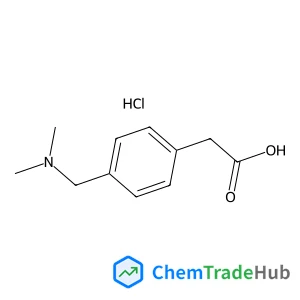
4-(Dimethylaminomethyl)phenylacetic acid hydrochloride
CAS Number:
99985-52-1
Molecular Formula:
C11H16ClNO2
Cuong M. Nguyen, Marie-Françoise Reyniers, Guy B. Marin
The adsorption of C1–C4 primary alcohols at the Al12–O24(H)–Si12 intersection site in H-ZSM-5 is investigated using periodic density functional theory (DFT) calculations and adding a damped interatomic potential to the DFT results to account for dispersive van der Waals interactions (DFT-D). A good agreement between predicted and experimentally available adsorption enthalpies for C1–C3 alcohols is obtained. The effect of the H-ZSM-5 framework is sampled for adsorption of the C1–C4 alcohols in the straight and the zigzag channel. A variety of possible geometries, including hydrogen-bonded (physisorbed) and protonated (chemisorbed) complexes, are located as stable minima indicating that the potential energy surface connecting them is broad and very shallow. Experimental infrared (IR) spectra of the C1–C4 alcohols are interpreted based on harmonic frequency calculations for the most stable physisorbed and chemisorbed complexes. The stability of the adsorbed alcohols is governed by an interplay between their intrinsic basicity, van der Waals dispersive interactions and steric constraints exerted by the zeolite framework. In essence, steric constraints destabilize local hydrogen bonding and/or Coulomb alcohol-Brønsted acid site interactions while dispersive van der Waals interactions enhance the stability of physisorbed and chemisorbed complexes. Due to the prevalence of van der Waals interactions over steric constraints, C1–C4 alcohols adsorb preferentially in the more compact zigzag channel than in the straight channel. Both the physisorption and chemisorption energies increase linearly with 13 to 15 kJ mol−1 per carbon atom in the straight and the zigzag channel, respectively.
Rizalina T. Saragi, Marcos Juanes, Gang Feng, Alberto Lesarri
DOI: 10.1039/D1CP00997D
S. Carniato, R. Püttner, J. B. Martins, D. Céolin, R. Feifel
DOI: 10.1039/D1CP00607J
C. E. Ekuma, T. C. Chibueze, L. A. Fomin, I. V. Malikov, L. Zadeng, D. P. Rai
DOI: 10.1039/D1CP00418B
Sandrine Denis-Quanquin, Alessio Bartocci, Florence Szczepaniak, Francois Riobé, Olivier Maury, Nicolas Giraud
DOI: 10.1039/D0CP06570F
Jin Feng, Mengdi Cui, Huining Liu, Fengjie Zhou, Siwei Bi, Dapeng Zhang
DOI: 10.1039/D1CP00347J
Slavko Radenković, Slađana Đorđević
DOI: 10.1039/D1CP00784J
M. Pietrow, R. Zaleski, A. Wagner, P. Słomski, E. Hirschmann, R. Krause-Rehberg, M. O. Liedke, M. Butterling, D. Weinberger
DOI: 10.1039/D1CP00755F
Xiaoqian Qiu, Yiren Wang, Yong Jiang
DOI: 10.1039/D1CP00156F
Rizcky Tamarany, Dong Yun Shin, Sukho Kang, Hyangsoo Jeong, Jun Kim, Dong-Hee Lim
DOI: 10.1039/D1CP00236H
Kaiyi Luo, Wenyu Hu, Jiaxuan Wei, Qiuping Zhang, Zhonghao Wu, Dongyang Li, Feng Miao, Yi Huang, Min Xu, Jian Ma, Gang Chen, Xudong Cui, Pierre Ruterana
DOI: 10.1039/D0CP06649D
Waste containing N-Methoxy-N-methyl-1,3-thiazole-5-carboxamide (CAS: 898825-89-3...
N-(4-Biphenylyl)dibenzo[b,d]furan-4-amine should be stored in a tightly sealed c...
The market for 3-Acetamido-5-amino-2,4,6-triiodobenzoic acid (CAS: 1713-07-1) is...
Benzyl 2-O-acetyl-3,4,6-tri-O-benzyl-beta-D-galactopyranoside (CAS: 61820-03-9) ...
2-Ethylpiperazine dihydrochloride (CAS: 438050-52-3) is regulated under the Glob...
1,1'-[1,3-Phenylenebis(methylene)]bis(3-methyl-1H-pyrrole-2,5-dione) (CAS: 11946...
Several alternatives can be used in the synthesis of 5-Fluoro-2-(1-pyrrolidinyl)...
Proper personal protective equipment (PPE) must be worn when handling this compo...
When handling 6-Bromoimidazo[1,2-a]pyridin-8-amine, it is important to wear appr...
Alternatives to (2S,4R)-4-(4-Nitrobenzyl)pyrrolidine-2-carboxylic acid hydrochlo...

Physical Chemistry Chemical Physics (PCCP) is an international journal co-owned by 19 physical chemistry and physics societies from around the world. This journal publishes original, cutting-edge research in physical chemistry, chemical physics and biophysical chemistry. To be suitable for publication in PCCP, articles must include significant innovation and/or insight into physical chemistry; this is the most important criterion that reviewers and Editors will judge against when evaluating submissions. The journal has a broad scope and welcomes contributions spanning experiment, theory, computation and data science. Topical coverage includes spectroscopy, dynamics, kinetics, statistical mechanics, thermodynamics, electrochemistry, catalysis, surface science, quantum mechanics, quantum computing and machine learning. Interdisciplinary research areas such as polymers and soft matter, materials, nanoscience, energy, surfaces/interfaces, and biophysical chemistry are welcomed if they demonstrate significant innovation and/or insight into physical chemistry. Joined experimental/theoretical studies are particularly appreciated when complementary and based on up-to-date approaches.
![tert-Butyl 6-chloro-4-oxospiro[chroman-2,4'-piperidine]-1'-carboxylate structure](https://static.chemtradehub.com/structs/101/1011482-37-3-88a5.webp "tert-Butyl 6-chloro-4-oxospiro[chroman-2,4'-piperidine]-1'-carboxylate structure")
![[5-fluoro-2-(morpholine-4-carbonyl)phenyl]boronic acid structure](https://static.chemtradehub.com/structs/121/1217501-26-2-505c.webp "[5-fluoro-2-(morpholine-4-carbonyl)phenyl]boronic acid structure")
![4-Chloro-2-{[(2-chlorophenoxy)acetyl]amino}benzoic acid structure](https://static.chemtradehub.com/structs/351/351424-20-9-9467.webp "4-Chloro-2-{[(2-chlorophenoxy)acetyl]amino}benzoic acid structure")





