












Nitrogen dioxide reactions with atomic lanthanide cations and their monoxides: gas-phase kinetics at room temperature
Literature Information
Publication Date
2010-03-05
DOI
10.1039/B925576A
Impact Factor
3.676
Authors
Michael J. Y. Jarvis, Voislav Blagojevic, Gregory K. Koyanagi, Diethard K. Bohme
View Original
Abstract
Results of experimental investigations are reported for the gas-phase kinetics of chemical reactions between nitrogen dioxide (NO2) and 14 different atomic cations of the lanthanide series, Ln+ (Ln = La–Lu, excluding Pm), and their monoxides, LnO+. Measurements were taken with an inductively-coupled plasma/selected-ion flow tube (ICP/SIFT) tandem mass spectrometer in helium buffer-gas at a pressure of 0.35 ± 0.01 Torr and at 295 ± 2 K. The atomic lanthanide cations were produced at ca. 5500 K in an ICP source and allowed to decay radiatively and to thermalize by collisions with Ar and He atoms prior to reaction with NO2. The atomic ions were observed to react rapidly with NO2 with large rate coefficients, k > 2 × 10⁻¹⁰ cm3 molecule−1 s−1, and almost exclusively by oxygen-atom abstraction to produce lanthanide-oxide LnO+ cations. In contrast to results of previous studies with many other molecules, the reaction efficiency exhibits essentially no dependence upon the energy required to promote an electron to achieve a d1s1 excited electronic configuration, in which two non-f electrons are available to Ln+ for chemical bonding. Apparently the radical character of NO2 (X 2A1) leads to the efficient formation of LnO+ by the end-on abstraction of an oxygen atom by Ln+. In the reactions with La+, Ce+, Pr+ and Gd+ an additional minor channel (less than 2%) leads to the formation of NO+. The LnO+ product ions participate in various secondary and higher order reactions with NO2 resulting in the formation of ions of the type LnOx(NO)y(NO2)z+ with x = 1–2, y = 0–2, and z = 0–2, as well as the ions NO+ and NO2+.
Related Literature
Double asymmetric induction as a mechanistic probe: conjugate addition for the asymmetric synthesis of a pseudotripeptide
Stephen G. Davies, Gesine J. Hermann, Miles J. Sweet, Andrew D. Smith
2004-04-08
Communication
DOI: 10.1039/B401293C
Oxy-peptide nucleic acid with a pyrrolidine ring that is configurationally optimized for hybridization with DNA
Mizuki Kitamatsu, Masanori Shigeyasu, Tomoyuki Okada, Masahiko Sisido
2004-04-23
Communication
DOI: 10.1039/B401057D
Soluble μ-Fi bridged niobium clusters: synthesis and crystal structures of (Et4N)6[Nb6Fi6Bri6(NCS)a6]Br2 and Cs1.6K2.4[Nb6Fi6Ii6(NCS)a6]
Nikolaï G. Naumov, Stéphane Cordier, Christiane Perrin
2004-04-07
Communication
DOI: 10.1039/B400668B
Novel biocompatible hydrogel-based amperometric sensor for nitric oxide gas detection: towards a non-invasive device
Corinne Wartelle, Fethi Bedioui
2004-05-07
Communication
DOI: 10.1039/B402735C
Washing-free electrochemical DNA detection using double-stranded probes and competitive hybridization reaction
Kyuwon Kim, Haesik Yang, Se Ho Park, Dae-Sik Lee, Sung-Jin Kim, Yong Taik Lim, Youn Tae Kim
2004-05-28
Communication
DOI: 10.1039/B402914C
Inter- and intra-molecular H-bonds induced different nanostructures from a multi-H-bonding (MHB) amphiphile: nanofibers and nanodisks
Chuanlang Zhan, Lizhu Liu, Yanbiao Zhou, Minghua Liu
2004-04-27
Communication
DOI: 10.1039/B402956A
Semi-quantitative estimation by IR of framework, extraframework and defect Al species of HBEA zeolites
Isabelle Gener, Philippe Ayrault, Michel Guisnet
2004-09-01
Communication
DOI: 10.1039/B409964H
A new series of sodium cobalt oxyhydrates
Donna C. Arnold, Chris J. Nuttall, Alexandros Lappas
2004-09-21
Communication
DOI: 10.1039/B405907G
A novel, stereoselective and convergent synthesis of aryltetralins
Steven M. Miles, Stephen P. Marsden, Robin J. Leatherbarrow, William J. Coates
2004-09-01
Communication
DOI: 10.1039/B409528F
Ring-closing metathesis in biphasic BMI·PF6ionic liquid/toluene medium: a powerful recyclable and environmentally friendly process
Hervé Clavier, Nicolas Audic, Marc Mauduit, Jean-Claude Guillemin
2004-08-25
Communication
DOI: 10.1039/B407964G
You might also like
Compound Q&A
What precautions should be taken when handling 2-Chloro-1,2-bis(4-methylphenyl)ethanone (CAS: 71193-32-3)?
When handling 2-Chloro-1,2-bis(4-methylphenyl)ethanone (CAS: 71193-32-3), it is ...
71193-32-32-Chloro-1,2-bis(4-m...
Compound Q&A
What industries use 4-Ethoxy-3-(5-methyl-4-oxo-7-propyl-1,4-dihydroimidazo[5,1-f][1,2,4]triazin-2-yl)benzenesulfonyl chloride (CAS: 224789-26-8)?
4-Ethoxy-3-(5-methyl-4-oxo-7-propyl-1,4-dihydroimidazo[5,1-f][1,2,4]triazin-2-yl...
224789-26-84-Ethoxy-3-(5-methyl...
Compound Q&A
How should Methyl 3-Oxo-4-Androsten-17-Carboxylate (CAS: 2681-55-2) be stored?
Methyl 3-Oxo-4-Androsten-17-Carboxylate (CAS: 2681-55-2) should be stored in a c...
2681-55-2Methyl 3-Oxo-4-Andro...
Compound Q&A
What are the main uses of (R)-3-Amino-4-(3-hexylphenylamino)-4-oxobutylphosphonic acid (CAS: 909725-61-7)?
(R)-3-Amino-4-(3-hexylphenylamino)-4-oxobutylphosphonic acid is primarily used i...
909725-61-7(R)-3-Amino-4-(3-hex...
Compound Q&A
What regulatory guidelines apply to 2-Methyl-2-propanyl 3-amino-3-carbamoyl-1-azetidinecarboxylate (CAS: 1254120-14-3)?
2-Methyl-2-propanyl 3-amino-3-carbamoyl-1-azetidinecarboxylate (CAS: 1254120-14-...
1254120-14-32-Methyl-2-propanyl ...
Compound Q&A
Are there alternatives to (E)-4-(tert-Butoxy)-4-oxobut-2-enoic acid (CAS: 135355-96-3) in synthesis?
There are alternative reagents that can be used in synthesis instead of (E)-4-(t...
135355-96-3(E)-4-(tert-Butoxy)-...
Compound Q&A
What are the physical and chemical properties of [2-(3-Chlorophenyl)-1,3-thiazol-4-yl]methanol (CAS: 121202-20-8)?
[2-(3-Chlorophenyl)-1,3-thiazol-4-yl]methanol (CAS: 121202-20-8) is a crystallin...
121202-20-8[2-(3-Chlorophenyl)-...
Compound Q&A
What is the market or research trend for Methyl (2S)-[(4S)-2,2-dimethyl-1,3-dioxolan-4-yl]{[(4-methylphenyl)sulfonyl]oxy}acetate (CAS: 166249-17-8)?
The market and research trends for Methyl (2S)-[(4S)-2,2-dimethyl-1,3-dioxolan-4...
166249-17-8Methyl (2S)-[(4S)-2,...
Compound Q&A
What is the market or research trend for 1-Bromo-2-isocyanatoethane (CAS: 42865-19-0)?
The market for 1-Bromo-2-isocyanatoethane (CAS: 42865-19-0) is driven by its use...
42865-19-01-Bromo-2-isocyanato...
Compound Q&A
What are the main uses of 4-Nitro-D-phenylalanine hydrochloride (CAS: 147065-06-3)?
4-Nitro-D-phenylalanine hydrochloride (CAS: 147065-06-3) is primarily used in re...
147065-06-34-Nitro-D-phenylalan...
Source Journal
Physical Chemistry Chemical Physics

CiteScore:
5.5
Self-citation Rate:
10.3%
Articles per Year:
3036
Physical Chemistry Chemical Physics (PCCP) is an international journal co-owned by 19 physical chemistry and physics societies from around the world. This journal publishes original, cutting-edge research in physical chemistry, chemical physics and biophysical chemistry. To be suitable for publication in PCCP, articles must include significant innovation and/or insight into physical chemistry; this is the most important criterion that reviewers and Editors will judge against when evaluating submissions. The journal has a broad scope and welcomes contributions spanning experiment, theory, computation and data science. Topical coverage includes spectroscopy, dynamics, kinetics, statistical mechanics, thermodynamics, electrochemistry, catalysis, surface science, quantum mechanics, quantum computing and machine learning. Interdisciplinary research areas such as polymers and soft matter, materials, nanoscience, energy, surfaces/interfaces, and biophysical chemistry are welcomed if they demonstrate significant innovation and/or insight into physical chemistry. Joined experimental/theoretical studies are particularly appreciated when complementary and based on up-to-date approaches.
Recommended Compounds
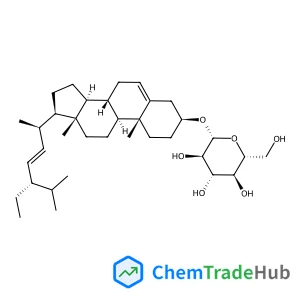
(3beta,22E)-Stigmasta-5,22-dien-3-yl beta-D-glucopyranoside
CAS Number:
19716-26-8
Molecular Formula:
C35H58O6
Recommended Suppliers





Disclaimer
This page provides academic journal information for reference and research purposes only. We are not affiliated with any journal publishers and do not handle publication submissions. For publication-related inquiries, please contact the respective journal publishers directly.
If you notice any inaccuracies in the information displayed, please contact us at support@chemtradehub.com. We will promptly review and address your concerns.