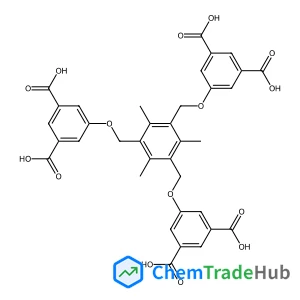
5,5',5''-(((2,4,6-Trimethylbenzene-1,3,5-triyl)tris(methylene))tris(oxy))triisophthalic acid
CAS Number:
1159974-70-5
Molecular Formula:
C36H30O15
Shu-Hao Wen, Wei-Qiao Deng, Ke-Li Han
The intermolecular electronic coupling (transfer integral) and the intramolecular vibronic coupling (reorganization energy) are key parameters determining the transport properties of organic electronic materials. Using quantum mechanism calculations, we revealed the correlation between the reorganization energies and the partial charge difference values on the conjugated acene backbone, which can be used to evaluate the reorganization energies for acene and acene derivative systems with the same conjugated backbone but different substitutional groups. We used rigorous quantitative functions to investigate the electronic coupling oscillation behavior in slipped-cofacial stacking acene and acene derivative molecules, and revealed characteristic parameters in the electronic coupling oscillation. We suggest using a similar strategy to establish the quantitative structure–activity relationship database for different families of organic semiconducting materials.

CrystEngComm

European Journal of Organic Chemistry

Journal of Enzyme inhibition and Medicinal Chemistry

Environmental Toxicology and Pharmacology

Physical Chemistry Chemical Physics

Advanced Engineering Materials

Mini-Reviews in Medicinal Chemistry

Coloration Technology

Foundations of Chemistry

Photochemical & Photobiological Sciences
Jiafang Xu, Liwen Li, Jinxiang Liu, Xiaopu Wang, Youguo Yan, Jun Zhang
DOI: 10.1039/C8CP00010G
Alexander M. Khenkin, Irena Efremenko, Jan M. L. Martin, Ronny Neumann
DOI: 10.1039/C7CP08610E
Sayyed Jalil Mahdizadeh, Golnoosh Akhlamadi
DOI: 10.1039/C8CP02820F
DOI: 10.1039/C7CP07730K
F. Meyer, M. Blum, Y. L. Jeyachandran, R. G. Wilks, W. Yang, M. Bär, F. Reinert, M. Zharnikov
DOI: 10.1039/C7CP07885D
Jinjin Wang, Zhanyu Wang, R. J. Zhang, Y. X. Zheng, L. Y. Chen, Chia-Chin Tsoo, Hung-Ji Huang
DOI: 10.1039/C8CP02624F
Nirmali Prabha Das, Brigitta Müller, Ágota Tóth, Dezső Horváth, Gábor Schuszter
DOI: 10.1039/C8CP01798K
M. G. S. Costa, Y. F. Silva, P. R. Batista
DOI: 10.1039/C7CP07073J
Zicheng Wang, Shuzhou Li, Yaping Zhang, Huaizhe Xu
DOI: 10.1039/C7CP07960E
Eduardo Gomez, Mario Gutiérrez, Miquel Moreno, Ichiro Hisaki, Schoichi Nakagawa, Abderrazzak Douhal
DOI: 10.1039/C7CP06819K
Waste containing N-Methoxy-N-methyl-1,3-thiazole-5-carboxamide (CAS: 898825-89-3...
N-(4-Biphenylyl)dibenzo[b,d]furan-4-amine should be stored in a tightly sealed c...
The market for 3-Acetamido-5-amino-2,4,6-triiodobenzoic acid (CAS: 1713-07-1) is...
Benzyl 2-O-acetyl-3,4,6-tri-O-benzyl-beta-D-galactopyranoside (CAS: 61820-03-9) ...
2-Ethylpiperazine dihydrochloride (CAS: 438050-52-3) is regulated under the Glob...
1,1'-[1,3-Phenylenebis(methylene)]bis(3-methyl-1H-pyrrole-2,5-dione) (CAS: 11946...
Several alternatives can be used in the synthesis of 5-Fluoro-2-(1-pyrrolidinyl)...
Proper personal protective equipment (PPE) must be worn when handling this compo...
When handling 6-Bromoimidazo[1,2-a]pyridin-8-amine, it is important to wear appr...
Alternatives to (2S,4R)-4-(4-Nitrobenzyl)pyrrolidine-2-carboxylic acid hydrochlo...
Physical Chemistry Chemical Physics (PCCP) is an international journal co-owned by 19 physical chemistry and physics societies from around the world. This journal publishes original, cutting-edge research in physical chemistry, chemical physics and biophysical chemistry. To be suitable for publication in PCCP, articles must include significant innovation and/or insight into physical chemistry; this is the most important criterion that reviewers and Editors will judge against when evaluating submissions. The journal has a broad scope and welcomes contributions spanning experiment, theory, computation and data science. Topical coverage includes spectroscopy, dynamics, kinetics, statistical mechanics, thermodynamics, electrochemistry, catalysis, surface science, quantum mechanics, quantum computing and machine learning. Interdisciplinary research areas such as polymers and soft matter, materials, nanoscience, energy, surfaces/interfaces, and biophysical chemistry are welcomed if they demonstrate significant innovation and/or insight into physical chemistry. Joined experimental/theoretical studies are particularly appreciated when complementary and based on up-to-date approaches.