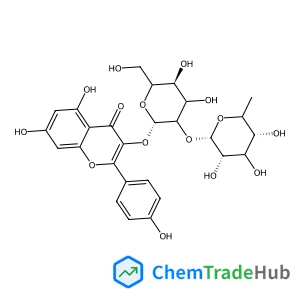
5,7-Dihydroxy-2-(4-hydroxyphenyl)-4-oxo-4H-chromen-3-yl 2-O-(6-deoxy-alpha-L-mannopyranosyl)-beta-D-glucopyranoside
CAS Number:
32602-81-6
Molecular Formula:
C27H30O15
Giacomo Saielli, Alessandro Bagno
We have investigated the preferential solvation of four carbohydrates, namely α- and β-glucose and α- and β-talose, in mixtures of water and acetonitrile. The structure of the solvation shell, obtained by means of molecular dynamics simulation, has been analyzed using radial and spatial distribution functions. In agreement with available experimental data, water is found to preferentially solvate the sugars. The micro-heterogeneity of the mixture, with clusters of hydrogen-bonded water molecules and clusters of dipole–dipole interacting acetonitrile molecules, favours the solvation of the carbohydrates by the water clusters. This, in turn, causes a stronger intermolecular NOE of the alkyl sugar protons with water than with acetonitrile.
A. Hult Roos, J. Andersson, M. Wallner, R. J. Squibb, R. Feifel
DOI: 10.1039/C9CP01415B
Marat R. Talipov, Esther Steiner
DOI: 10.1039/C9CP02271F
Baozeng Zhou, Zheng Li, Jiaming Wang, Kangqiang Wang
DOI: 10.1039/C9CP01146C
Josep M. Anglada, Marilia T. C. Martins-Costa, Joseph S. Francisco, Manuel F. Ruiz-López
DOI: 10.1039/C9CP01105F
Paul Smith, Robert M. Ziolek, Elena Gazzarrini, Dylan M. Owen, Christian D. Lorenz
DOI: 10.1039/C9CP01532A
Di Wang, Fusheng Yang, Zhen Wu, Le Wu, Zaoxiao Zhang
DOI: 10.1039/C9CP01467E
Qing Wan, Bing Zhang, Jialin Tong, Yin Li, Haozhong Wu, Han Zhang, Yuyu Pan
DOI: 10.1039/C9CP01706B
Martin Rabe, Cigdem Toparli, Ying-Hsuan Chen, Olga Kasian
DOI: 10.1039/C9CP00911F
Takahisa Omata, Satoshi Tsukuda, Tomohiro Ishiyama, Junji Nishii, Toshiharu Yamashita, Hiroshi Kawazoe
DOI: 10.1039/C9CP01502G
When handling 2-Chloro-1,2-bis(4-methylphenyl)ethanone (CAS: 71193-32-3), it is ...
4-Ethoxy-3-(5-methyl-4-oxo-7-propyl-1,4-dihydroimidazo[5,1-f][1,2,4]triazin-2-yl...
Methyl 3-Oxo-4-Androsten-17-Carboxylate (CAS: 2681-55-2) should be stored in a c...
(R)-3-Amino-4-(3-hexylphenylamino)-4-oxobutylphosphonic acid is primarily used i...
2-Methyl-2-propanyl 3-amino-3-carbamoyl-1-azetidinecarboxylate (CAS: 1254120-14-...
There are alternative reagents that can be used in synthesis instead of (E)-4-(t...
[2-(3-Chlorophenyl)-1,3-thiazol-4-yl]methanol (CAS: 121202-20-8) is a crystallin...
The market and research trends for Methyl (2S)-[(4S)-2,2-dimethyl-1,3-dioxolan-4...
The market for 1-Bromo-2-isocyanatoethane (CAS: 42865-19-0) is driven by its use...
4-Nitro-D-phenylalanine hydrochloride (CAS: 147065-06-3) is primarily used in re...

Physical Chemistry Chemical Physics (PCCP) is an international journal co-owned by 19 physical chemistry and physics societies from around the world. This journal publishes original, cutting-edge research in physical chemistry, chemical physics and biophysical chemistry. To be suitable for publication in PCCP, articles must include significant innovation and/or insight into physical chemistry; this is the most important criterion that reviewers and Editors will judge against when evaluating submissions. The journal has a broad scope and welcomes contributions spanning experiment, theory, computation and data science. Topical coverage includes spectroscopy, dynamics, kinetics, statistical mechanics, thermodynamics, electrochemistry, catalysis, surface science, quantum mechanics, quantum computing and machine learning. Interdisciplinary research areas such as polymers and soft matter, materials, nanoscience, energy, surfaces/interfaces, and biophysical chemistry are welcomed if they demonstrate significant innovation and/or insight into physical chemistry. Joined experimental/theoretical studies are particularly appreciated when complementary and based on up-to-date approaches.