












Reactivity of crotonaldehyde and propene over Au/Pd(111) surfaces
Literature Information
Publication Date
2010-01-27
DOI
10.1039/B921669C
Impact Factor
3.676
Authors
James Naughton, Adam F. Lee, Sarah Thompson, C. P. Vinod, Karen Wilson
View Original
Abstract
The surface chemistry of crotonaldehyde and propene, primary and secondary reaction products in the aerobic selective oxidation of crotyl alcohol, has been studied by temperature-programmed reaction over Au/Pd(111) surface alloys. Gold strongly promotes desorption versus reaction at mole fractions ≥0.3 (crotonaldehyde) and ≥0.8 (C3H6); only ∼5% of the chemisorbed aldehyde or alkene react over Au-rich alloys. Surprisingly, co-adsorbed oxygen strongly suppresses crotonaldehyde decomposition over both clean Pd(111) and alloy surfaces, while C3H6 combustion, an important undesired side-reaction over unpromoted Pd(111), is also moderated by Au.
Related Literature
Stanene on a SiC(0001) surface: a candidate for realizing quantum anomalous Hall effect
2019-04-30
Paper
DOI: 10.1039/C9CP01509D
Understanding the interdependence of operating parameters in microbial electrosynthesis: a numerical investigation
Mobolaji Shemfe, J. Annie Modestra, S. Venkata Mohan
2019-05-14
Paper
DOI: 10.1039/C9CP01288E
Red-shifted delayed fluorescence at the expense of photoluminescence quantum efficiency – an intramolecular charge-transfer molecule based on a benzodithiophene-4,8-dione acceptor
Stephanie Montanaro, Alexander J. Gillett, Sascha Feldmann, Emrys W. Evans, Felix Plasser, Richard H. Friend, Iain A. Wright
2019-05-06
Paper
DOI: 10.1039/C9CP02186H
Molecular dynamics simulation study of the fracture properties of polymer nanocomposites filled with grafted nanoparticles
2019-05-10
Paper
DOI: 10.1039/C8CP07668E
Ferroelectric field manipulated nonvolatile resistance switching in Al:ZnO/Pb(Mg1/3Nb2/3)0.7Ti0.3O3 heterostructures at room temperature‡
Shasha Liu, Chao Jin, Dongxing Zheng, Xin Pang, Yuchen Wang, Ping Wang, Wanchao Zheng, Haili Bai
2019-05-03
Paper
DOI: 10.1039/C9CP01809C
Thermodynamics, kinetics and electronic properties of point defects in β-FeSi2
Jun Chai, Chen Ming, Xiaolong Du, Pengfei Qiu, Yi-Yang Sun, Lidong Chen
2019-04-18
Paper
DOI: 10.1039/C9CP00755E
Relative extent of triple Auger decay in CO and CO2
A. Hult Roos, J. Andersson, M. Wallner, R. J. Squibb, R. Feifel
2019-04-17
Paper
DOI: 10.1039/C9CP01415B
Response of adhesive polymer interfaces to repeated mechanical loading and the spatial variation of diffusion coefficient and stresses in a deforming polymer film
Jeeno Jose, Narasimhan Swaminathan
2019-04-29
Paper
DOI: 10.1039/C9CP00576E
DEER distance measurements on trityl/trityl and Gd(iii)/trityl labelled proteins
Angeliki Giannoulis, Yin Yang, Yan-Jun Gong, Xiaoli Tan, Akiva Feintuch, Raanan Carmieli, Thorsten Bahrenberg, Yangping Liu, Xun-Cheng Su, Daniella Goldfarb
2019-02-27
Paper
DOI: 10.1039/C8CP07249C
You might also like
Compound Q&A
What precautions should be taken when handling 2-Chloro-1,2-bis(4-methylphenyl)ethanone (CAS: 71193-32-3)?
When handling 2-Chloro-1,2-bis(4-methylphenyl)ethanone (CAS: 71193-32-3), it is ...
71193-32-32-Chloro-1,2-bis(4-m...
Compound Q&A
What industries use 4-Ethoxy-3-(5-methyl-4-oxo-7-propyl-1,4-dihydroimidazo[5,1-f][1,2,4]triazin-2-yl)benzenesulfonyl chloride (CAS: 224789-26-8)?
4-Ethoxy-3-(5-methyl-4-oxo-7-propyl-1,4-dihydroimidazo[5,1-f][1,2,4]triazin-2-yl...
224789-26-84-Ethoxy-3-(5-methyl...
Compound Q&A
How should Methyl 3-Oxo-4-Androsten-17-Carboxylate (CAS: 2681-55-2) be stored?
Methyl 3-Oxo-4-Androsten-17-Carboxylate (CAS: 2681-55-2) should be stored in a c...
2681-55-2Methyl 3-Oxo-4-Andro...
Compound Q&A
What are the main uses of (R)-3-Amino-4-(3-hexylphenylamino)-4-oxobutylphosphonic acid (CAS: 909725-61-7)?
(R)-3-Amino-4-(3-hexylphenylamino)-4-oxobutylphosphonic acid is primarily used i...
909725-61-7(R)-3-Amino-4-(3-hex...
Compound Q&A
What regulatory guidelines apply to 2-Methyl-2-propanyl 3-amino-3-carbamoyl-1-azetidinecarboxylate (CAS: 1254120-14-3)?
2-Methyl-2-propanyl 3-amino-3-carbamoyl-1-azetidinecarboxylate (CAS: 1254120-14-...
1254120-14-32-Methyl-2-propanyl ...
Compound Q&A
Are there alternatives to (E)-4-(tert-Butoxy)-4-oxobut-2-enoic acid (CAS: 135355-96-3) in synthesis?
There are alternative reagents that can be used in synthesis instead of (E)-4-(t...
135355-96-3(E)-4-(tert-Butoxy)-...
Compound Q&A
What are the physical and chemical properties of [2-(3-Chlorophenyl)-1,3-thiazol-4-yl]methanol (CAS: 121202-20-8)?
[2-(3-Chlorophenyl)-1,3-thiazol-4-yl]methanol (CAS: 121202-20-8) is a crystallin...
121202-20-8[2-(3-Chlorophenyl)-...
Compound Q&A
What is the market or research trend for Methyl (2S)-[(4S)-2,2-dimethyl-1,3-dioxolan-4-yl]{[(4-methylphenyl)sulfonyl]oxy}acetate (CAS: 166249-17-8)?
The market and research trends for Methyl (2S)-[(4S)-2,2-dimethyl-1,3-dioxolan-4...
166249-17-8Methyl (2S)-[(4S)-2,...
Compound Q&A
What is the market or research trend for 1-Bromo-2-isocyanatoethane (CAS: 42865-19-0)?
The market for 1-Bromo-2-isocyanatoethane (CAS: 42865-19-0) is driven by its use...
42865-19-01-Bromo-2-isocyanato...
Compound Q&A
What are the main uses of 4-Nitro-D-phenylalanine hydrochloride (CAS: 147065-06-3)?
4-Nitro-D-phenylalanine hydrochloride (CAS: 147065-06-3) is primarily used in re...
147065-06-34-Nitro-D-phenylalan...
Source Journal
Physical Chemistry Chemical Physics

CiteScore:
5.5
Self-citation Rate:
10.3%
Articles per Year:
3036
Physical Chemistry Chemical Physics (PCCP) is an international journal co-owned by 19 physical chemistry and physics societies from around the world. This journal publishes original, cutting-edge research in physical chemistry, chemical physics and biophysical chemistry. To be suitable for publication in PCCP, articles must include significant innovation and/or insight into physical chemistry; this is the most important criterion that reviewers and Editors will judge against when evaluating submissions. The journal has a broad scope and welcomes contributions spanning experiment, theory, computation and data science. Topical coverage includes spectroscopy, dynamics, kinetics, statistical mechanics, thermodynamics, electrochemistry, catalysis, surface science, quantum mechanics, quantum computing and machine learning. Interdisciplinary research areas such as polymers and soft matter, materials, nanoscience, energy, surfaces/interfaces, and biophysical chemistry are welcomed if they demonstrate significant innovation and/or insight into physical chemistry. Joined experimental/theoretical studies are particularly appreciated when complementary and based on up-to-date approaches.
Recommended Compounds

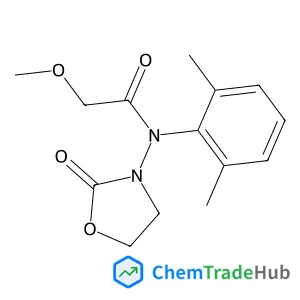
N-(2,6-Dimethylphenyl)-2-methoxy-N-(2-oxo-1,3-oxazolidin-3-yl)acetamide
CAS Number:
77732-09-3
Molecular Formula:
C14H18N2O4
Recommended Suppliers




Disclaimer
This page provides academic journal information for reference and research purposes only. We are not affiliated with any journal publishers and do not handle publication submissions. For publication-related inquiries, please contact the respective journal publishers directly.
If you notice any inaccuracies in the information displayed, please contact us at support@chemtradehub.com. We will promptly review and address your concerns.