












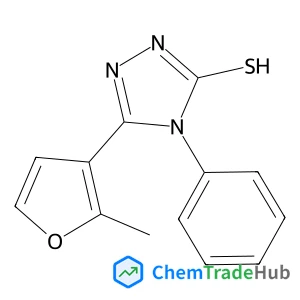
5-(2-Methyl-3-furyl)-4-phenyl-2,4-dihydro-3H-1,2,4-triazole-3-thione
CAS Number:
346464-59-3
Molecular Formula:
C13H11N3OS
Palathurai Subramaniam Mohan, Chang Su Lim, Yu Shun Tian, Won Young Roh, Jun Han Lee, Bong Rae Cho
A two-photon fluorescent probe (ACaL) is reported that can be excited by 780 nm fs pulses, shows high photostability and negligible toxicity, and can visualize near-membrane Ca2+ in live cells and deep inside live tissues by two-photon microscopy.
Anna Chrobok, Karolina Matuszek, Dorota Neugebauer, Rafał Bielas, Sylwia Golba, Mateusz Dulski
DOI: 10.1039/C6PY01274D
Federica Cavalli, Sven O. Steinmueller
DOI: 10.1039/C7PY00812K
Yuxiang Li, Tack Ho Lee, Song Yi Park, Mohammad Afsar Uddin, Taehyo Kim, Sungu Hwang, Jin Young Kim, Han Young Woo
DOI: 10.1039/C6PY00674D
Hui Zhou, Xiaobai Wang, Ting Ting Lin, Jing Song, Ben Zhong Tang
DOI: 10.1039/C6PY01358A
D. R. Garcia, N. Lavignac
DOI: 10.1039/C6PY01771A
Yinan Cui, Xiuyu Jiang, Chun Feng, Guangxin Gu, Jie Xu, Xiaoyu Huang
DOI: 10.1039/C6PY00489J
When handling lithium chloride hydrate (1:1:1) (CAS: 16712-20-2), it is importan...
4-(4H-1,2,4-Triazol-4-yl)piperidine is generally considered safe for use in phar...
Waste containing 1,3-Thiazole-2-carboxamide (CAS: 16733-85-0) should be collecte...
5-(Difluoromethyl)-2-fluorobenzonitrile (CAS: 934175-58-3) is subject to regulat...
Methyl 3-acetamido-2-thiophenecarboxylate can be synthesized by the reaction of ...
4-Isoquinolinecarbonitrile is a chemical compound with the CAS number 34846-65-6...
Store Methyl 1H-1,2,3-triazole-4-carboxylate (CAS: 877309-59-6) in a cool, dry p...
6-Bromo[1,3]thiazolo[5,4-b]pyridin-2-amine (CAS: 1160791-13-8) is subject to the...
(2S,3S)-2-Ammonio-3-(3,4-dihydroxyphenyl)-3-hydroxypropanoate (CAS: 23651-95-8) ...
7-Bromo-3-methyl-3,4-dihydroquinazolin-4-one is a solid with a crystalline form....

ChemComm publishes urgent research which is of outstanding significance and interest to experts in the field, while also appealing to the journal’s broad chemistry readership. Our communication format is ideally suited to short, urgent studies that are of such importance that they require accelerated publication. Our scope covers all topics in chemistry, and research at the interface of chemistry and other disciplines (such as materials science, nanoscience, physics, engineering and biology) where there is a significant novelty in the chemistry aspects. Major topic areas covered include: Analytical Chemistry Catalysis Chemical Biology and medicinal chemistry Computational Chemistry and Machine Learning Energy and sustainable chemistry Environmental Chemistry Green Chemistry Inorganic Chemistry Materials Chemistry Nanoscience Organic Chemistry Physical Chemistry Polymer Chemistry Supramolecular Chemistry
![6-(Benzyloxy)-8-(2-bromoacetyl)-2H-benzo[b][1,4]oxazin-3(4H)-one structure](https://static.chemtradehub.com/structs/926/926319-53-1-2287.webp "6-(Benzyloxy)-8-(2-bromoacetyl)-2H-benzo[b][1,4]oxazin-3(4H)-one structure")





