












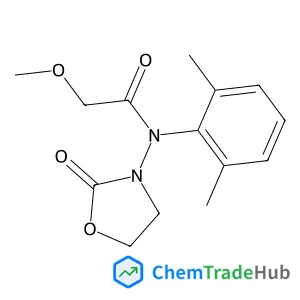
N-(2,6-Dimethylphenyl)-2-methoxy-N-(2-oxo-1,3-oxazolidin-3-yl)acetamide
CAS Number:
77732-09-3
Molecular Formula:
C14H18N2O4
Erik I. Tellgren, Trygve Helgaker, Alessandro Soncini
By means of non-perturbative ab initio calculations, it is shown that paramagnetic closed-shell molecules are characterized by a strongly non-linear magnetic response, whose main feature consists of a paramagnetic-to-diamagnetic transition in a strong magnetic field. The physical origin of this phenomenon is rationalised on the basis of an analytical model based on molecular orbital theory. For the largest molecules considered here, the acepleiadylene dianion and the corannulene dianion, the transition field is of the order of 103 T, about one order of magnitude larger than the magnetic field strength currently achievable in experimental settings. However, our simple model suggests that the paramagnetic-to-diamagnetic transition is a universal property of paramagnetic closed-shell systems in strong magnetic fields, provided no singlet–triplet level crossing occurs for fields smaller than the critical transition field. Accordingly, fields weaker than 100 T should suffice to trigger the predicted transition for systems whose size is still well within the (medium–large) molecular domain, such as hypothetical antiaromatic rings with less than one hundred carbon atoms.
Guoxiang Xu, Matthew A. Tarr
DOI: 10.1039/B316121H
Marcin Drąg, Adam Jezierski, Pawel Kafarski
DOI: 10.1039/B401633E
Russell J. Cox, Frank Glod, Deirdre Hurley, Colin M. Lazarus, Thomas. P. Nicholson, Brian A. M. Rudd, Thomas J. Simpson, Barrie Wilkinson, Ying Zhang
DOI: 10.1039/B411973H
Rajan Venkatesh, Bastiaan B P Staal, Bert Klumperman
DOI: 10.1039/B403342F
Wuping Liao, Jörg von Appen, Richard Dronskowski
DOI: 10.1039/B408647C
Houjin Huang, Masafumi Ata, Yoko Yoshimoto
DOI: 10.1039/B402196G
Yasuo Iida, Kyuichi Yasui, Toru Tuziuti, Manickam Sivakumar, Yoshishige Endo
DOI: 10.1039/B410015H
Myroslav O. Vysotsky, Anca Bogdan, Leyong Wang, Volker Böhmer
DOI: 10.1039/B402719A
Zhiyong Wang, Gang Zou, Jie Tang
DOI: 10.1039/B401511H
Corinne Wartelle, Fethi Bedioui
DOI: 10.1039/B402735C
When handling 2-Chloro-1,2-bis(4-methylphenyl)ethanone (CAS: 71193-32-3), it is ...
4-Ethoxy-3-(5-methyl-4-oxo-7-propyl-1,4-dihydroimidazo[5,1-f][1,2,4]triazin-2-yl...
Methyl 3-Oxo-4-Androsten-17-Carboxylate (CAS: 2681-55-2) should be stored in a c...
(R)-3-Amino-4-(3-hexylphenylamino)-4-oxobutylphosphonic acid is primarily used i...
2-Methyl-2-propanyl 3-amino-3-carbamoyl-1-azetidinecarboxylate (CAS: 1254120-14-...
There are alternative reagents that can be used in synthesis instead of (E)-4-(t...
[2-(3-Chlorophenyl)-1,3-thiazol-4-yl]methanol (CAS: 121202-20-8) is a crystallin...
The market and research trends for Methyl (2S)-[(4S)-2,2-dimethyl-1,3-dioxolan-4...
The market for 1-Bromo-2-isocyanatoethane (CAS: 42865-19-0) is driven by its use...
4-Nitro-D-phenylalanine hydrochloride (CAS: 147065-06-3) is primarily used in re...

Physical Chemistry Chemical Physics (PCCP) is an international journal co-owned by 19 physical chemistry and physics societies from around the world. This journal publishes original, cutting-edge research in physical chemistry, chemical physics and biophysical chemistry. To be suitable for publication in PCCP, articles must include significant innovation and/or insight into physical chemistry; this is the most important criterion that reviewers and Editors will judge against when evaluating submissions. The journal has a broad scope and welcomes contributions spanning experiment, theory, computation and data science. Topical coverage includes spectroscopy, dynamics, kinetics, statistical mechanics, thermodynamics, electrochemistry, catalysis, surface science, quantum mechanics, quantum computing and machine learning. Interdisciplinary research areas such as polymers and soft matter, materials, nanoscience, energy, surfaces/interfaces, and biophysical chemistry are welcomed if they demonstrate significant innovation and/or insight into physical chemistry. Joined experimental/theoretical studies are particularly appreciated when complementary and based on up-to-date approaches.

![(1R)-3-Bromo-1,7,7-trimethylbicyclo[2.2.1]heptan-2-one structure](https://static.chemtradehub.com/structs/102/10293-06-8-dd8a.webp "(1R)-3-Bromo-1,7,7-trimethylbicyclo[2.2.1]heptan-2-one structure")






