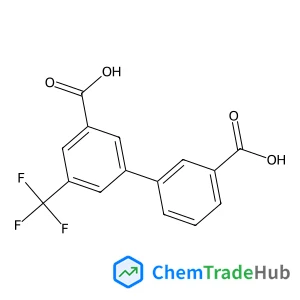
3-(3-Carboxyphenyl)-5-(trifluoromethyl)benzoic acid
CAS Number:
1261930-96-4
Molecular Formula:
C15H9F3O4
Juan Soto, Daniel Peláez, Juan Carlos Otero, Francisco José Avila, Juan Francisco Arenas
The photodissociation reactions of methyl nitrate CH3ONO2 starting at the 193 and 248 nm photolytic wavelengths have been studied with the second-order multiconfigurational perturbation theory (CASPT2) by computation of numerical energy gradients for stationary points. In addition, energy profiles of reaction paths and vertical excitations have been investigated with the multistate extension of the multiconfigurational second-order perturbation theory (MS-CASPT2). It is found that excitation at 193 nm yields three reaction paths: (i) the so-called slow channel CH3ONO2→ CH3O + NO2→ CH3O + NO + O; (ii) the fast channel CH3ONO2→ CH3O + NO2; and (iii) CH3ONO2→ CH3ONO + O. The slow channel starts at the S4 surface, in contrast, the population of the S3 state can lead to the fast channel or to direct atomic oxygen extrusion. The rather high relative yield of the channel leading to oxygen extrusion from methyl nitrate is explained on the basis of an S3/S2 conical intersection that transfers the initial excitation localized in the nπ* S3 state to the σπ* S2 state with a consequent weakening of the N–O bond. With respect to photolysis at 248 nm, it was not possible to unambiguously distinguish between S1 and S2 as the populated state, however, the S2 state is suggested as mainly responsible for dissociation at this excitation energy.
Ajay Sharma, Satyendra Kumar Pandey
DOI: 10.1039/D3OB01750H
Yue Wang, Jinzan Feng, Er-Qing Li, Zhenhua Jia, Teck-Peng Loh
DOI: 10.1039/D3OB01679J
Ichiro Hayakawa, Tomoki Isogai, Jun Takanishi, Shihori Asai, Chika Ando, Tomohiro Tsutsumi, Kenji Watanabe, Akira Sakakura, Yuta Tsunematsu
DOI: 10.1039/D3OB01850D
Akrti Sharma, Gurpreet Kaur, Mangalampalli Ravikanth
DOI: 10.1039/D3OB01886E
Zhiqiang Xie, Yuchen Yang, Dejun Ma
DOI: 10.1039/D3OB01838E
Harish B. Musale, Vivek T. Humne
DOI: 10.1039/D3OB01882B
Sam Forshaw, Jeremy S. Parker, Neelam Tiwari, Samson M. Oladeji, Andrew C. Stevens, Jami Reber, Guy J. Clarkson, Mohan K. Balasubramanian, Martin Wills
DOI: 10.1039/D3OB01712E
Yunhui Wan, Huaimo Wu, Linhao Xia, Song Liu, Yi Ren, Hongxi Xu, Changwu Zheng
DOI: 10.1039/D3OB01840G
Sribash Das, Rama Karn, Mohit Kumar, Soumya Srimayee
DOI: 10.1039/D3OB01826A
Deepak Gautam, Puneet Singh Gahlaut, Shristi Pathak, Barun Jana
DOI: 10.1039/D3OB01526B
4-Amino-3-bromophenol (CAS: 74440-80-5) falls under the classification of a haza...
(17beta)-3-Oxoestr-4-en-17-yl acetate should be stored in a cool, dry place away...
2-[(2,2-Diethoxyethyl)disulfanyl]-1,1-diethoxyethane (CAS: 76505-71-0) is a colo...
The market and research for 1-(β-D-ribofuranosyl)-1H-imidazo[4,5-c]pyridin-4-ami...
Waste containing Conjugated Estrogen (CAS: 12126-59-9) should be collected and d...
The market for Bis(2,2,2-trifluoroethyl) (methoxycarbonylmethyl)phosphonate (CAS...
There are several alternatives to 3,4'-Di-O-methylellagic acid (CAS: 57499-59-9)...
2-Chloro-N,N-dimethylpyridin-4-amine (CAS: 59047-70-0) is regulated under the Gl...
Cerium(3+);oxygen(2-);vanadium(5+) (CAS: 13597-19-8) is a complex inorganic comp...
7-Chloro-1-iodoisoquinoline (CAS: 1203579-27-4) is generally considered safe whe...

Physical Chemistry Chemical Physics (PCCP) is an international journal co-owned by 19 physical chemistry and physics societies from around the world. This journal publishes original, cutting-edge research in physical chemistry, chemical physics and biophysical chemistry. To be suitable for publication in PCCP, articles must include significant innovation and/or insight into physical chemistry; this is the most important criterion that reviewers and Editors will judge against when evaluating submissions. The journal has a broad scope and welcomes contributions spanning experiment, theory, computation and data science. Topical coverage includes spectroscopy, dynamics, kinetics, statistical mechanics, thermodynamics, electrochemistry, catalysis, surface science, quantum mechanics, quantum computing and machine learning. Interdisciplinary research areas such as polymers and soft matter, materials, nanoscience, energy, surfaces/interfaces, and biophysical chemistry are welcomed if they demonstrate significant innovation and/or insight into physical chemistry. Joined experimental/theoretical studies are particularly appreciated when complementary and based on up-to-date approaches.