












Mesoscopic and microstructural characterization of liposomes formed by the lipooligosaccharide from Salmonella minnesota strain 595 (Re mutant)
Literature Information
Publication Date
2009-02-10
DOI
10.1039/B816248D
Impact Factor
3.676
Authors
Alba Silipo, Antonio Molinaro, Rosa Lanzetta
View Original
Abstract
Large unilamellar liposomes formed by the Re LPS (from here below named LOS) from Salmonella enterica serotype minnesota strain 595 (Re mutant) have been prepared by the extrusion techniques. The physico-chemical investigation of these systems has been performed by a combined experimental strategy, which has allowed a characterization at different observation scales, from the morphological to the micro-structural level. Particularly, dynamic light scattering (DLS) measurements have revealed the formation of liposomes with a narrow dimension distribution; small-angle neutron scattering (SANS) measurements have led to an estimation of the thickness of the LOS bilayer, which is consistent with an extended conformation of the acyl chains; electron paramagnetic resonance (EPR) measurements have allowed to investigate the bilayer fluidity, as determined by LOS acyl chain conformation and packing; Pulsed-field-gradient stimulated echo nuclear magnetic resonance (PGSTE-NMR) measurements have shown that water permeability through the LOS bilayer is low. The effect of temperature has been considered. Liposome dimension does not change; however, centered at 30–35 °C, a progressive transition of the acyl chain self-organization from a gel to a liquid crystalline phase is detected. Above this temperature, the water permeability through the bilayer increases. The effect of introducing the zwitterionic phospholipid dilauroyl phosphatidylcholine (DLPC) in the liposome formulation have been also analysed. A comparative analysis of the results points out a clear relation between the microstructure of LOS molecules in the bilayer and liposome functional properties.
Related Literature
Glycosylation of n-pentenyl glycosides using bromodiethylsulfonium salt as an activator: interception of the glycosyl intermediate by chloride ion transfer
Supanat Buntasana, Panuwat Padungros
2023-11-23
Paper
DOI: 10.1039/D3OB01618H
A sequential reaction of picolinamide with benzaldehydes promoted by Pd(TFA)2: rapid access to 4,5-disubstituted 2-(pyridin-2-yl)oxazoles in n-octane
Taku Nakayama, Sayaka Fujiki, Tomokatsu Enda, Shoko Kikkawa, Hidemasa Hikawa, Isao Azumaya
2023-12-19
Paper
DOI: 10.1039/D3OB01815F
Theoretical investigation of tautomerism of 2- and 4-pyridones: origin, substituent and solvent effects
Marija Baranac-Stojanović, Jovana Aleksić, Milovan Stojanović
2023-11-29
Paper
DOI: 10.1039/D3OB01588B
Diastereoselective allylation-based asymmetric total synthesis of 1,10-seco-guaianolides
Rodney A. Fernandes, Ravikant S. Ranjan
2023-12-19
Paper
DOI: 10.1039/D3OB02013D
Synthesis of mixed phosphorotrithioates via thiol coupling with bis(diisopropylamino)chlorophosphine and sulphenyl chloride
2023-12-01
Communication
DOI: 10.1039/D3OB01668D
Electro-oxidative coupling of Bunte salts with aryldiazonium tetrafluoroborates: a benign access to unsymmetrical sulfoxides
Saurabh Kumar, Shiv Chand, Krishna Nand Singh
2023-12-15
Paper
DOI: 10.1039/D3OB01955A
Synthesis of functionalized tetrahydrodibenzo[b,g][1,8]naphthyridin-1(2H)-ones through base-promoted annulation of quinoline-derived dipolarophiles and cyclic enaminones
Wenjun Luo, Xinghua Zheng, Fanglian Zhang, Qiuya Luo, Wen-Ting Deng, Lipeng Long, Daohong Yu, Zhong-Xia Wang, Zhengwang Chen
2023-11-16
Communication
DOI: 10.1039/D3OB01547E
Development of a light-activated STING agonist
Steven E. Caldwell, Chasity P. Janosko
2023-11-22
Paper
DOI: 10.1039/D3OB01578E
Microbial alcohol dehydrogenases: recent developments and applications in asymmetric synthesis
Anju Chadha, Santosh Kumar Padhi, Selvaraj Stella, Sowmyalakshmi Venkataraman, Thangavelu Saravanan
2023-12-05
Review Article
DOI: 10.1039/D3OB01447A
You might also like
Compound Q&A
What regulatory guidelines apply to 4-Amino-3-bromophenol (CAS: 74440-80-5)?
4-Amino-3-bromophenol (CAS: 74440-80-5) falls under the classification of a haza...
74440-80-54-Amino-3-bromopheno...
Compound Q&A
How should (17beta)-3-Oxoestr-4-en-17-yl acetate (CAS: 1425-10-1) be stored?
(17beta)-3-Oxoestr-4-en-17-yl acetate should be stored in a cool, dry place away...
1425-10-1(17beta)-3-Oxoestr-4...
Compound Q&A
What are the physical and chemical properties of 2-[(2,2-Diethoxyethyl)disulfanyl]-1,1-diethoxyethane (CAS: 76505-71-0)?
2-[(2,2-Diethoxyethyl)disulfanyl]-1,1-diethoxyethane (CAS: 76505-71-0) is a colo...
76505-71-02-[(2,2-Diethoxyethy...
Compound Q&A
What is the market or research trend for 1-(β-D-ribofuranosyl)-1H-imidazo[4,5-c]pyridin-4-amine?
The market and research for 1-(β-D-ribofuranosyl)-1H-imidazo[4,5-c]pyridin-4-ami...
6736-58-91-(beta-D-Ribofurano...
Compound Q&A
How should waste containing Conjugated Estrogen (CAS: 12126-59-9) be handled?
Waste containing Conjugated Estrogen (CAS: 12126-59-9) should be collected and d...
12126-59-9Conjugated Estrogen
Compound Q&A
What is the market or research trend for Bis(2,2,2-trifluoroethyl) (methoxycarbonylmethyl)phosphonate?
The market for Bis(2,2,2-trifluoroethyl) (methoxycarbonylmethyl)phosphonate (CAS...
88738-78-7Bis(2,2,2-trifluoroe...
Compound Q&A
Are there alternatives to 3,4'-Di-O-methylellagic acid (CAS: 57499-59-9) in synthesis?
There are several alternatives to 3,4'-Di-O-methylellagic acid (CAS: 57499-59-9)...
57499-59-93,4'-Di-O-methylella...
Compound Q&A
What regulatory guidelines apply to 2-Chloro-N,N-dimethylpyridin-4-amine (CAS: 59047-70-0)?
2-Chloro-N,N-dimethylpyridin-4-amine (CAS: 59047-70-0) is regulated under the Gl...
59047-70-02-Chloro-N,N-dimethy...
Compound Q&A
What is cerium(3+);oxygen(2-);vanadium(5+) (CAS: 13597-19-8)?
Cerium(3+);oxygen(2-);vanadium(5+) (CAS: 13597-19-8) is a complex inorganic comp...
13597-19-8cerium(3+);oxygen(2-...
Compound Q&A
Is 7-Chloro-1-iodoisoquinoline (CAS: 1203579-27-4) safe?
7-Chloro-1-iodoisoquinoline (CAS: 1203579-27-4) is generally considered safe whe...
1203579-27-47-Chloro-1-iodoisoqu...
Source Journal
Physical Chemistry Chemical Physics

CiteScore:
5.5
Self-citation Rate:
10.3%
Articles per Year:
3036
Physical Chemistry Chemical Physics (PCCP) is an international journal co-owned by 19 physical chemistry and physics societies from around the world. This journal publishes original, cutting-edge research in physical chemistry, chemical physics and biophysical chemistry. To be suitable for publication in PCCP, articles must include significant innovation and/or insight into physical chemistry; this is the most important criterion that reviewers and Editors will judge against when evaluating submissions. The journal has a broad scope and welcomes contributions spanning experiment, theory, computation and data science. Topical coverage includes spectroscopy, dynamics, kinetics, statistical mechanics, thermodynamics, electrochemistry, catalysis, surface science, quantum mechanics, quantum computing and machine learning. Interdisciplinary research areas such as polymers and soft matter, materials, nanoscience, energy, surfaces/interfaces, and biophysical chemistry are welcomed if they demonstrate significant innovation and/or insight into physical chemistry. Joined experimental/theoretical studies are particularly appreciated when complementary and based on up-to-date approaches.
Recommended Compounds
![4-[(2-Fluoro-4-methylphenyl)amino]-6-[4-(2-hydroxyethyl)-1-piperazinyl]-7-methoxy-3-cinnolinecarboxamide structure](https://static.chemtradehub.com/structs/104/1041852-85-0-fb1c.webp "4-[(2-Fluoro-4-methylphenyl)amino]-6-[4-(2-hydroxyethyl)-1-piperazinyl]-7-methoxy-3-cinnolinecarboxamide structure")
4-[(2-Fluoro-4-methylphenyl)amino]-6-[4-(2-hydroxyethyl)-1-piperazinyl]-7-methoxy-3-cinnolinecarboxamide
CAS Number:
1041852-85-0
Molecular Formula:
C23H27FN6O3
![2-[1-(4-Chlorobenzyl)-1H-indol-3-yl]-2-oxo-N-(6-quinolinyl)acetamide structure](https://static.chemtradehub.com/structs/501/501921-61-5-756a.webp "2-[1-(4-Chlorobenzyl)-1H-indol-3-yl]-2-oxo-N-(6-quinolinyl)acetamide structure")
2-[1-(4-Chlorobenzyl)-1H-indol-3-yl]-2-oxo-N-(6-quinolinyl)acetamide
CAS Number:
501921-61-5
Molecular Formula:
C26H18ClN3O2
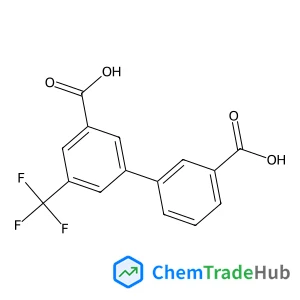
3-(3-Carboxyphenyl)-5-(trifluoromethyl)benzoic acid
CAS Number:
1261930-96-4
Molecular Formula:
C15H9F3O4
Recommended Suppliers




Disclaimer
This page provides academic journal information for reference and research purposes only. We are not affiliated with any journal publishers and do not handle publication submissions. For publication-related inquiries, please contact the respective journal publishers directly.
If you notice any inaccuracies in the information displayed, please contact us at support@chemtradehub.com. We will promptly review and address your concerns.