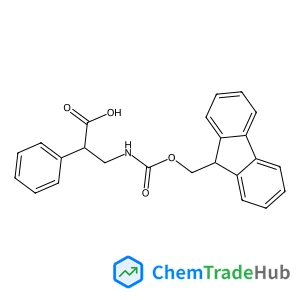
(S)-3-((((9H-Fluoren-9-yl)methoxy)carbonyl)amino)-2-phenylpropanoic acid
CAS Number:
1217663-60-9
Molecular Formula:
C24H21NO4
Suresh Babu Kalidindi, Amit Ashok Vernekar, Balaji R. Jagirdar
Co–Co2B and Ni–Ni3B nanocomposites were synthesized by the reduction of Co2+ and Ni2+ ions using ammonia–borane in methanol. The Co–Ni–B nanocomposite was synthesized by the co-reduction of Co2+ and Ni2+ ions. The catalytic activities of these metal nanocomposites were studied for the dehydrogenation of ammonia–borane in methanol. Three moles of H2 were liberated in 2.5 min and 4.2 min in case of Co–Co2B and Ni–Ni3B nanocomposites, respectively (catalyst/AB = 0.2). The Co–Ni–B nanocomposite showed greater activity compared to individual metal–metal boride nanocomposites: 3 moles of H2 were liberated in 1.5 min (catalyst/AB = 0.2). The catalysts were highly recyclable and the activities remained almost unchanged even after several cycles.
Linlin Liu, Hongcheng Gao, Yupeng Li, Muddasir Hanif, Chuan Li, Yu Gao, Bing Yang, Zengqi Xie, Yuguang Ma
DOI: 10.1039/C6PY00180G
Prabhjot K. Saini, Charles Romain, Yunqing Zhu, Charlotte K. Williams
DOI: 10.1039/C4PY00748D
Sonu Kumar, Rituparna Acharya, Urmi Chatterji, Priyadarsi De
DOI: 10.1039/C4PY00620H
X. Zhang, T. Higashihara, M. Ueda, L. Wang
DOI: 10.1039/C4PY00898G
Jan Martin Nölle, Sebastian Primpke, Klaus Müllen, Philipp Vana
DOI: 10.1039/C6PY00590J
Mingguang Yu, Jianbo Tan
DOI: 10.1039/C6PY00605A
Fanny Coumes, Aurélie Malfait, Marc Bria, Joël Lyskawa, Patrice Woisel, David Fournier
DOI: 10.1039/C6PY00738D
DOI: 10.1039/C6PY00480F
Mingming Zuo, Tianqing Liu, Jingjing Han
DOI: 10.1039/C4PY00616J
When considering alternatives to 1-(4-Chlorophenyl)-N-hydroxymethanimine (CAS: 3...
This compound should be stored in a cool, dry place away from direct sunlight. I...
3-(4-Bromophenyl)-5-(2-fluorophenyl)-1,2,4-oxadiazole is synthesized through a m...
5-Chloro-2-(4-chlorophenyl)-4-methyl-6-[3-(1-piperidinyl)propoxy]pyrimidine (CAS...
2-Chloro-4-(difluoromethoxy)pyridine is used in the pharmaceutical industry for ...
3-Chloro-6-methylpyridazine (CAS: 1121-79-5) is classified under the Globally Ha...
Several alternatives can be used in the synthesis of Methyl 4,5-dimethyl-2-nitro...
Alternatives to (2E,2'E)-3,3'-(1,4-Phenylene)bisacrylaldehyde include other acry...
3-Amino-5-chloropyridin-2-ol hydrochloride is an organic compound with the CAS n...
When handling 6,7-Difluoro-2,3-dihydro-4H-chromen-4-one, it is essential to wear...

Physical Chemistry Chemical Physics (PCCP) is an international journal co-owned by 19 physical chemistry and physics societies from around the world. This journal publishes original, cutting-edge research in physical chemistry, chemical physics and biophysical chemistry. To be suitable for publication in PCCP, articles must include significant innovation and/or insight into physical chemistry; this is the most important criterion that reviewers and Editors will judge against when evaluating submissions. The journal has a broad scope and welcomes contributions spanning experiment, theory, computation and data science. Topical coverage includes spectroscopy, dynamics, kinetics, statistical mechanics, thermodynamics, electrochemistry, catalysis, surface science, quantum mechanics, quantum computing and machine learning. Interdisciplinary research areas such as polymers and soft matter, materials, nanoscience, energy, surfaces/interfaces, and biophysical chemistry are welcomed if they demonstrate significant innovation and/or insight into physical chemistry. Joined experimental/theoretical studies are particularly appreciated when complementary and based on up-to-date approaches.
![(2S)-2-{[(9H-Fluoren-9-ylmethoxy)carbonyl]amino}-4-(methylselanyl)butanoic acid structure](https://static.chemtradehub.com/structs/121/1217852-49-7-f252.webp "(2S)-2-{[(9H-Fluoren-9-ylmethoxy)carbonyl]amino}-4-(methylselanyl)butanoic acid structure")