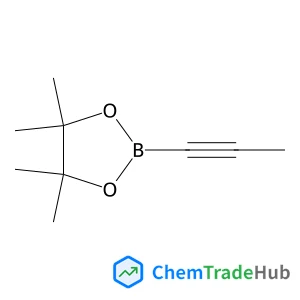
4,4,5,5-Tetramethyl-2-(1-propyn-1-YL)-1,3,2-dioxaborolane
CAS Number:
347389-75-7
Molecular Formula:
C9H15BO2
Sihai Yang, Xiang Lin, Alexander J. Blake, K. Mark Thomas, Peter Hubberstey, Neil R. Champness, Martin Schröder
H2 adsorption in (Me2NH2)[In(L)] is enhanced by exchange of Me2NH2+ for Li+ cations; the Li+-exchanged material displays a lower isosteric heat for H2 adsorption than the parent material, indicating that the increase in H2 capacity is due to an increase in the accessible pore volume on cation exchange, while the lower adsorption enthalpy is consistent with increased pore size.

Journal of Saudi Chemical Society

Russian Journal of Coordination Chemistry

Russian Journal of Organic Chemistry

Russian Journal of Applied Chemistry

Saudi Pharmaceutical Journal

New Journal of Chemistry

Russian Journal of General Chemistry

Chemical Communications

Nature Medicine

Journal of Natural Medicines
Christian Schröder
DOI: 10.1039/C2CP23329K
Benjamin N. Moore, Ryan R. Julian
DOI: 10.1039/C2CP23443B
Cinzia Chiappe, Christian Silvio Pomelli
DOI: 10.1039/C2CP43074F
J. Aldegunde, F. J. Aoiz, L. González-Sánchez, M. P. de Miranda, V. Sáez-Rábanos
DOI: 10.1039/C2CP23252A
DOI: 10.1039/C2CP43047A
Yoshitaka Aoki, Akihisa Harada, Aiko Nakao, Toyoki Kunitake, Hiroki Habazaki
DOI: 10.1039/C2CP23821G
DOI: 10.1039/C2CP42994B
Guotao Wu, Zhitao Xiong, Yuan Ping Feng, Ping Chen
DOI: 10.1039/C2CP23636B
2-Methylbenzene-1,4-diamine dihydrochloride (CAS: 615-45-2) should be stored in ...
(1S,4S)-2,5-Diazabicyclo[2.2.1]heptane dihydrobromide is generally considered sa...
(6-Chloropyridazin-3-YL)methanamine finds applications in the pharmaceutical ind...
2-Fluoro-3-methylphenol is primarily used in the synthesis of pharmaceuticals, p...
When handling 3-Methoxy-4-nitrobenzonitrile, it is important to wear appropriate...
When handling 1,3-Oxazolo[4,5-b]pyridine-2(3H)-thione (CAS: 211949-57-4), it is ...
4-Ethynylbenzamide (CAS: 90347-86-7) falls under various regulatory guidelines i...
3-(2-Ethylphenyl)-2-thioxo-4-imidazolidinone is primarily used as an intermediat...
(2-Fluoro-6-methoxyphenyl)acetic acid, also known as 4-fluoro-3-methoxybenzoic a...
Market trends for 2-[4-(Hydroxymethyl)phenoxy]ethanol (CAS: 102196-18-9) indicat...
ChemComm publishes urgent research which is of outstanding significance and interest to experts in the field, while also appealing to the journal’s broad chemistry readership. Our communication format is ideally suited to short, urgent studies that are of such importance that they require accelerated publication. Our scope covers all topics in chemistry, and research at the interface of chemistry and other disciplines (such as materials science, nanoscience, physics, engineering and biology) where there is a significant novelty in the chemistry aspects. Major topic areas covered include: Analytical Chemistry Catalysis Chemical Biology and medicinal chemistry Computational Chemistry and Machine Learning Energy and sustainable chemistry Environmental Chemistry Green Chemistry Inorganic Chemistry Materials Chemistry Nanoscience Organic Chemistry Physical Chemistry Polymer Chemistry Supramolecular Chemistry