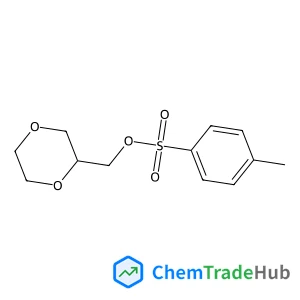
(S)-(1,4-Dioxan-2-yl)methyl 4-methylbenzenesulfonate
CAS Number:
917882-64-5
Molecular Formula:
C12H16O5S
Chandra A. Nesbitt, Ken K.-C. Yeung
Advances in mass spectrometry and capillary-format separation continue to improve the sensitivity of protein analysis. Of equal importance is the miniaturization of sample pretreatment such as enrichment and proteolysis. In a previous report (Nesbitt et al., Electrophoresis, 2008, 29, 466–474), nanoliter-volume protein enrichment, tryptic digestion, and partial separation was demonstrated in capillary electrophoresis followed by MALDI mass spectral analysis. A discontinuous buffer system, consisting of ammonium (pH 10) and acetate (pH 4), was used to create a pH junction inside the capillary, trapping a protein with a neutral isoelectric point, myoglobin (pI 7.2). Moreover, co-enrichment of myoglobin with trypsin led to an in-capillary digestion. In this paper, the ability of this discontinuous buffer system to perform similar in-capillary sample pretreatment on proteins with moderately acidic and basic pI was studied and reported. Lentil lectin (pI 8.6) and a multi-phosphorylated protein, β-casein (pI 5.1), were selected as model proteins. In addition to the previously shown tryptic digestion, proteolysis with endoproteinase Asp-N was also performed. Digestion of these acidic and basic pI proteins produced a few peptides with extreme pI values lying outside the trapping range of the discontinuous buffer. An alteration in the peptide trapping procedure was made to accommodate these analytes. Offline MALDI mass spectral analysis confirmed the presence of the expected peptides. The presented miniaturized sample pretreatment methodology was proven to be applicable on proteins with a moderately wide range of pI. Flexibility in the choice of protease was also evident.

Chemical Communications

Russian Journal of Applied Chemistry

Drug Discovery Today

Organic Process Research & Development

Current Opinion in Colloid & Interface Science

Russian Journal of General Chemistry

Journal of Saudi Chemical Society

Russian Chemical Bulletin

Nature Medicine

Russian Journal of Organic Chemistry
Fangfang Zhang, Jing Qun, Shilie Pan, Zhihua Yang, Dianzeng Jia
DOI: 10.1039/C5CP00864F
Ana R. Santos, Rebecca K. Blundell, Peter Licence
DOI: 10.1039/C5CP01069A
Florian Ehlers, Mirko Scholz, Jens Schimpfhauser, Jürgen Bienert, Kawon Oum, Thomas Lenzer
DOI: 10.1039/C4CP05600K
Sneha Munshi, Athi N. Naganathan
DOI: 10.1039/C4CP06102K
Chun-Chih Chang, Jia-Jen Ho
DOI: 10.1039/C5CP01121C
Robert W. Wheatley, Douglas H. Juers, Bogdan B. Lev, Reuben E. Huber, Sergei Yu. Noskov
DOI: 10.1039/C4CP04952G
Dimitris Zaouris, Andreas Kartakoullis, Pavle Glodic, Peter C. Samartzis, Helgi Rafn Hróðmarsson, Ágúst Kvaran
DOI: 10.1039/C5CP00748H
Anesh Gopal, Akinori Saeki, Shu Seki
DOI: 10.1039/C5CP01044F
Tao Yang, Dorian S. N. Parker, Beni B. Dangi, Ralf I. Kaiser, Alexander M. Mebel
DOI: 10.1039/C4CP04288C
2-(2-Chloroacetamido)-3-phenylpropanoic acid (CAS: 7765-11-9) is generally consi...
2-(Benzyloxy)-5-bromobenzoic acid can be handled safely if appropriate precautio...
(4-Methyl-1,2,5-oxadiazol-3-yl)methanamine hydrochloride is a chemical compound ...
2-(5-Hexylthiophen-2-yl)-4,4,5,5-tetramethyl-1,3,2-dioxaborolane (CAS: 917985-54...
While 4-(8-Methyl-9H-1,3-dioxolo[4,5-h][2,3]benzodiazepin-5-yl)benzenamine (CAS:...
The market for tert-butyl 3-hydroxy-4,5,7,8-tetrahydro-2H-pyrazolo[3,4-d]azepine...
Waste containing 3,5-Diamino-1H-pyrazole-4-carbonitrile (CAS: 6844-58-2) should ...
(6-Fluoro-3-pyridinyl)boronic acid can be synthesized through the reaction of 6-...
Dibenzyl carbonimidoylbiscarbamate (CAS: 10065-79-9) finds applications in vario...
The market for (beta,beta,2,3,4,5,6-~2~H_7_)Phenylalanine (CAS: 74228-83-4) is g...

Analyst publishes analytical and bioanalytical research that reports premier fundamental discoveries and inventions, and the applications of those discoveries, unconfined by traditional discipline barriers.
![(1S)-1,5-Anhydro-2-O-alpha-L-arabinopyranosyl-1-[5-hydroxy-7-({6-O-[3-(4-hydroxy-3-methoxyphenyl)propanoyl]-beta-D-glucopyranosyl}oxy)-2-(4-hydroxyphenyl)-4-oxo-4H-chromen-6-yl]-D-glucitol structure](https://static.chemtradehub.com/structs/225/2252345-81-4-bcff.webp "(1S)-1,5-Anhydro-2-O-alpha-L-arabinopyranosyl-1-[5-hydroxy-7-({6-O-[3-(4-hydroxy-3-methoxyphenyl)propanoyl]-beta-D-glucopyranosyl}oxy)-2-(4-hydroxyphenyl)-4-oxo-4H-chromen-6-yl]-D-glucitol structure")
![Heptadecanoic Acid 3-[2-[4-(6-Fluoro-1,2-benzisoxazol-3-yl)-1-piperidinyl]ethyl]-6,7,8,9-tetrahydro-2-methyl-4-oxo-4H-pyrido[1,2-a]pyrimidin-9-yl Ester structure](https://static.chemtradehub.com/structs/140/1404053-62-8-9da4.webp "Heptadecanoic Acid 3-[2-[4-(6-Fluoro-1,2-benzisoxazol-3-yl)-1-piperidinyl]ethyl]-6,7,8,9-tetrahydro-2-methyl-4-oxo-4H-pyrido[1,2-a]pyrimidin-9-yl Ester structure")
![3-[4-(difluoromethoxy)phenyl]-2-({[(9H-fluoren-9-yl)methoxy]carbonyl}amino)propanoic acid structure](https://static.chemtradehub.com/structs/149/1496564-27-2-952e.webp "3-[4-(difluoromethoxy)phenyl]-2-({[(9H-fluoren-9-yl)methoxy]carbonyl}amino)propanoic acid structure")