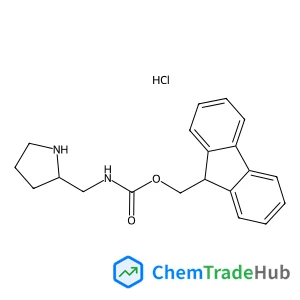
(S)-(9H-Fluoren-9-yl)methyl (pyrrolidin-2-ylmethyl)carbamate hydrochloride
CAS Number:
1217813-15-4
Molecular Formula:
C20H23ClN2O2
Igor S. Ignatyev, Manuel Montejo, Juan Jesús López González
The mechanism of the base catalyzed hydrolysis of tetramethoxysilane (TMOS), proposed earlier on the basis of experimental data, is assessed by theoretical methods, i.e. MP2 and B3LYP with 6-31G(d) and Dunning correlation-consistent basis sets. Models considered involve one and two hydrolyzing water molecules attacking (MeO)4Si in the frontside position with a nucleophile (NH3 and OH−) in the backside position. This approach allowed us to simulate uniformly the catalytic action of weak and strong bases. It was shown that the presence of a base in the backside position considerably lowers the activation barrier for hydrolysis. The inclusion of the additional water molecule which results in a substantial lowering of the barrier for uncatalyzed hydrolysis does not change noticeably the catalytic effect. In both one- and two-water molecules models the structure of the transition state in the presence of a nucleophile becomes nearly octahedral in which hexacoordinate silicon and four oxygens of the TMOS moiety have a planar arrangement
Bradley F. Habenicht, Stephen J. Paddison, Mark E. Tuckerman
DOI: 10.1039/C0CP00130A
Miriam Kunze, Yunus Karatas, Hans-Dieter Wiemhöfer, Hellmut Eckert, Monika Schönhoff
DOI: 10.1039/B925840J
Jiehua Liu, Xiangfeng Wei, Yaolun Yu, Xin Wang, Wei-Qiao Deng, Xue-Wei Liu
DOI: 10.1039/C0CP01396J
Sarah Couck, Tom Rémy, Gino V. Baron, Jorge Gascon, Freek Kapteijn, Joeri F. M. Denayer
DOI: 10.1039/B927115E
Samar G. Moussa, Barbara J. Finlayson-Pitts
DOI: 10.1039/C000447B
Chuan-Pei Lee, Po-Yen Chen, R. Vittal
DOI: 10.1039/B923477B
Sason Shaik
DOI: 10.1039/C001372M
Eugenii Ya. Misochko, Alexander V. Akimov, Vasilii A. Belov, Daniil A. Tyurin, Vyacheslav P. Bubnov, Ivan E. Kareev, Eduard B. Yagubskii
DOI: 10.1039/B926279B
Hiroaki Murata, Haruro Ishitani, Masakazu Iwamoto
DOI: 10.1039/C0CP00565G
Waste containing N-Methoxy-N-methyl-1,3-thiazole-5-carboxamide (CAS: 898825-89-3...
N-(4-Biphenylyl)dibenzo[b,d]furan-4-amine should be stored in a tightly sealed c...
The market for 3-Acetamido-5-amino-2,4,6-triiodobenzoic acid (CAS: 1713-07-1) is...
Benzyl 2-O-acetyl-3,4,6-tri-O-benzyl-beta-D-galactopyranoside (CAS: 61820-03-9) ...
2-Ethylpiperazine dihydrochloride (CAS: 438050-52-3) is regulated under the Glob...
1,1'-[1,3-Phenylenebis(methylene)]bis(3-methyl-1H-pyrrole-2,5-dione) (CAS: 11946...
Several alternatives can be used in the synthesis of 5-Fluoro-2-(1-pyrrolidinyl)...
Proper personal protective equipment (PPE) must be worn when handling this compo...
When handling 6-Bromoimidazo[1,2-a]pyridin-8-amine, it is important to wear appr...
Alternatives to (2S,4R)-4-(4-Nitrobenzyl)pyrrolidine-2-carboxylic acid hydrochlo...

Physical Chemistry Chemical Physics (PCCP) is an international journal co-owned by 19 physical chemistry and physics societies from around the world. This journal publishes original, cutting-edge research in physical chemistry, chemical physics and biophysical chemistry. To be suitable for publication in PCCP, articles must include significant innovation and/or insight into physical chemistry; this is the most important criterion that reviewers and Editors will judge against when evaluating submissions. The journal has a broad scope and welcomes contributions spanning experiment, theory, computation and data science. Topical coverage includes spectroscopy, dynamics, kinetics, statistical mechanics, thermodynamics, electrochemistry, catalysis, surface science, quantum mechanics, quantum computing and machine learning. Interdisciplinary research areas such as polymers and soft matter, materials, nanoscience, energy, surfaces/interfaces, and biophysical chemistry are welcomed if they demonstrate significant innovation and/or insight into physical chemistry. Joined experimental/theoretical studies are particularly appreciated when complementary and based on up-to-date approaches.