












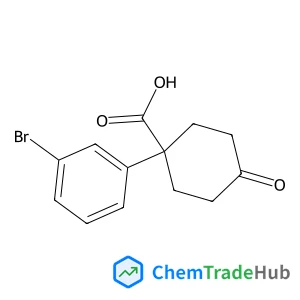
1-(3-Bromophenyl)-4-oxocyclohexanecarboxylic acid
CAS Number:
1385694-53-0
Molecular Formula:
C13H13BrO3
Andreas J. Thorvaldsen, Lara Ferrighi, Kenneth Ruud, Hans Ågren, Poul Jørgensen
We present a theory for the analytic calculation of frequency-dependent polarizability gradients, and apply the methodology to the calculation of coherent anti-Stokes Raman scattering (CARS). The formalism used is based on an open-ended theory for the calculation of frequency-dependent molecular response properties of arbitrary order, also including contributions from perturbation-dependent basis sets. An important feature of our approach is the close connection between the formalism—which is fully matrix-based in an atomic orbital basis—and the implementation, allowing for the rapid implementation of higher-order molecular properties. Care is taken to allow the formalism to be utilized with linearly-scaling Hartree–Fock and density-functional theory codes. By avoiding the evaluation of responses due to geometry distortions, only 9 response equations need to be solved for the calculation of the CARS intensities, independent of the size of the molecular system. The theory is illustrated by calculations on a set of polyaromatic hydrocarbons using a DFT/B3LYP force field and Hartree–Fock polarizability gradients. Good agreement with the experimental CARS spectra of these compounds is obtained.
Deepak Gautam, Puneet Singh Gahlaut, Shristi Pathak, Barun Jana
DOI: 10.1039/D3OB01526B
Chao Hu
DOI: 10.1039/D3OB01708G
Guoliang Wei, Yutao Lou, Meihua Bao
DOI: 10.1039/D3OB01792C
Cheng Zhang, Xiunan Lu, Chengxing Peng, Yawei Zhang, Xiong Zhu, Jian Zhang
DOI: 10.1039/D3OB01699D
Changsheng Zhou, Ming Huang, Yufeng Yao, Chunyu Chen, Xin Yi, Ke-fang Yang, Guo-Qiao Lai, Wenjing Xuan, Pinglu Zhang
DOI: 10.1039/D3OB01570J
Yue Wang, Jinzan Feng, Er-Qing Li, Zhenhua Jia, Teck-Peng Loh
DOI: 10.1039/D3OB01679J
DOI: 10.1039/D3OB01393F
Liang Liu, Renshi Luo, Jinghui Tong, Jianhua Liao
DOI: 10.1039/D3OB01753B
Mohammad Faizan Bhat, Alejandro Prats Luján, Mohammad Saifuddin, Peter Fodran, Gerrit J. Poelarends
DOI: 10.1039/D3OB01405C
4-Amino-3-bromophenol (CAS: 74440-80-5) falls under the classification of a haza...
(17beta)-3-Oxoestr-4-en-17-yl acetate should be stored in a cool, dry place away...
2-[(2,2-Diethoxyethyl)disulfanyl]-1,1-diethoxyethane (CAS: 76505-71-0) is a colo...
The market and research for 1-(β-D-ribofuranosyl)-1H-imidazo[4,5-c]pyridin-4-ami...
Waste containing Conjugated Estrogen (CAS: 12126-59-9) should be collected and d...
The market for Bis(2,2,2-trifluoroethyl) (methoxycarbonylmethyl)phosphonate (CAS...
There are several alternatives to 3,4'-Di-O-methylellagic acid (CAS: 57499-59-9)...
2-Chloro-N,N-dimethylpyridin-4-amine (CAS: 59047-70-0) is regulated under the Gl...
Cerium(3+);oxygen(2-);vanadium(5+) (CAS: 13597-19-8) is a complex inorganic comp...
7-Chloro-1-iodoisoquinoline (CAS: 1203579-27-4) is generally considered safe whe...

Physical Chemistry Chemical Physics (PCCP) is an international journal co-owned by 19 physical chemistry and physics societies from around the world. This journal publishes original, cutting-edge research in physical chemistry, chemical physics and biophysical chemistry. To be suitable for publication in PCCP, articles must include significant innovation and/or insight into physical chemistry; this is the most important criterion that reviewers and Editors will judge against when evaluating submissions. The journal has a broad scope and welcomes contributions spanning experiment, theory, computation and data science. Topical coverage includes spectroscopy, dynamics, kinetics, statistical mechanics, thermodynamics, electrochemistry, catalysis, surface science, quantum mechanics, quantum computing and machine learning. Interdisciplinary research areas such as polymers and soft matter, materials, nanoscience, energy, surfaces/interfaces, and biophysical chemistry are welcomed if they demonstrate significant innovation and/or insight into physical chemistry. Joined experimental/theoretical studies are particularly appreciated when complementary and based on up-to-date approaches.
![[3-Formyl-5-(trifluoromethoxy)phenyl]boronic acid structure](https://static.chemtradehub.com/structs/145/1451393-39-7-aebb.webp "[3-Formyl-5-(trifluoromethoxy)phenyl]boronic acid structure")




