












Multigram-scale chemoenzymatic synthesis of diverse aminopolycarboxylic acids as potential metallo-β-lactamase inhibitors
Literature Information
Publication Date
2023-12-12
DOI
10.1039/D3OB01405C
Impact Factor
3.876
Authors
Mohammad Faizan Bhat, Alejandro Prats Luján, Mohammad Saifuddin, Peter Fodran, Gerrit J. Poelarends
View Original
Abstract
Toxin A, a precursor to naturally occurring aspergillomarasmine A, aspergillomarasmine B, lycomarasmine and related aminopolycarboxylic acids, was synthesized as the desired (2S,2′S)-diastereomer on a multigram-scale (>99% conversion, 82% isolated yield, dr > 95 : 5) from commercially available starting materials using the enzyme ethylenediamine-N,N′-disuccinic acid lyase. A single-step protection route of this chiral synthon was developed to aid N-sulfonylation/-alkylation and reductive amination at the terminal primary amine for easy derivatization, followed by global deprotection to give the corresponding toxin A derivatives, including lycomarasmine, in moderate to good yields (23–66%) and with high stereopurity (dr > 95 : 5). Furthermore, a chemoenzymatic route was developed to introduce a click handle on toxin A (yield 72%, dr > 95 : 5) and its cyclized congener for further analogue design. Finally, a chemoenzymatic route towards the synthesis of photocaged aspergillomarasmine B (yield 8%, dr > 95 : 5) was established, prompting further steps into smart prodrug design and precision delivery. These new synthetic methodologies have the prospective of facilitating research into the finding of more selective and potent metallo-β-lactamase (MBL) inhibitors, which are urgently needed to combat MBL-based infections.
Related Literature
Nb2C MXene assisted CoNi bimetallic catalysts for hydrogenolysis of aromatic ethers
Sen-Wang Wang, Zhen-Hong He, Jian-Gang Chen, Kuan Wang, Zhong-Yu Wang, Pan-Pan Guo, Jie Lan, Weitao Wang
2020-12-28
Paper
DOI: 10.1039/D0SE01532F
A hierarchical CoP@NiCo-LDH nanoarray as an efficient and flexible catalyst electrode for the alkaline oxygen evolution reaction
Wenli Tian, Jie Zhang, Hao Feng, Hao Wen, Xun Sun, Xin Guan, Dengchao Zheng, Jing Liao, Minglei Yan, Yadong Yao
2020-11-23
Communication
DOI: 10.1039/D0SE01490G
Ultra-low amount Pt-doped Co2P/Ni2P on nickel foam as an efficient electrocatalyst for the hydrogen evolution reaction in an alkaline electrolyte
Xin Xiao, Dongping Sun, Xiaoheng Liu, Bo Qiu
2020-12-28
Paper
DOI: 10.1039/D0SE01679A
A comparison of sizing methods for a long-term renewable hybrid system. Case study: Galapagos Islands 2031
A. Cano, Paul Arévalo, F. Jurado
2021-02-04
Paper
DOI: 10.1039/D1SE00078K
H-USY and H-ZSM-5 zeolites as catalysts for HDPE conversion under a hydrogen reductive atmosphere
Cátia S. Costa, Marta Muñoz, M. Rosário Ribeiro
2021-01-14
Paper
DOI: 10.1039/D0SE01584A
Highly efficient and stable perovskite solar cells produced by maximizing additive engineering
Linlin Qiu, Jiacheng Zou, Wei-Hsiang Chen, Lika Dong, Deqiang Mei, Jieqiong Wang, Pei-Cheng Jiang
2020-11-12
Paper
DOI: 10.1039/D0SE01498B
The controlled synthesis of V-doped MoS2-NixSy hollow nanospheres and their electrocatalytic performance in hydrogen evolution reaction
Wensi Wang, Huimin Zhao, Yunmei Du, Yu Yang, Shaoxiang Li, Yanru Liu
2020-12-16
Paper
DOI: 10.1039/D0SE01456G
Influence of process conditions on hydrothermal liquefaction of eucalyptus biomass for biocrude production and investigation of the inorganics distribution
Saqib Sohail Toor, Kamaldeep Sharma, Asbjørn Haaning Nielsen, Thomas Helmer Pedersen, Lasse Aistrup Rosendahl
2021-01-23
Paper
DOI: 10.1039/D0SE01634A
The influence of pre-steaming and lignin distribution on wood pellet robustness and ease of subsequent enzyme-mediated cellulose hydrolysis
Masatsugu Takada, John N. Saddler
2020-11-16
Paper
DOI: 10.1039/D0SE01229G
Mechanisms of photoredox catalysts: the role of optical spectroscopy
Noufal Kandoth, Javier Pérez Hernández
2021-01-20
Review Article
DOI: 10.1039/D0SE01454K
You might also like
Compound Q&A
What regulatory guidelines apply to 4-Amino-3-bromophenol (CAS: 74440-80-5)?
4-Amino-3-bromophenol (CAS: 74440-80-5) falls under the classification of a haza...
74440-80-54-Amino-3-bromopheno...
Compound Q&A
How should (17beta)-3-Oxoestr-4-en-17-yl acetate (CAS: 1425-10-1) be stored?
(17beta)-3-Oxoestr-4-en-17-yl acetate should be stored in a cool, dry place away...
1425-10-1(17beta)-3-Oxoestr-4...
Compound Q&A
What are the physical and chemical properties of 2-[(2,2-Diethoxyethyl)disulfanyl]-1,1-diethoxyethane (CAS: 76505-71-0)?
2-[(2,2-Diethoxyethyl)disulfanyl]-1,1-diethoxyethane (CAS: 76505-71-0) is a colo...
76505-71-02-[(2,2-Diethoxyethy...
Compound Q&A
What is the market or research trend for 1-(β-D-ribofuranosyl)-1H-imidazo[4,5-c]pyridin-4-amine?
The market and research for 1-(β-D-ribofuranosyl)-1H-imidazo[4,5-c]pyridin-4-ami...
6736-58-91-(beta-D-Ribofurano...
Compound Q&A
How should waste containing Conjugated Estrogen (CAS: 12126-59-9) be handled?
Waste containing Conjugated Estrogen (CAS: 12126-59-9) should be collected and d...
12126-59-9Conjugated Estrogen
Compound Q&A
What is the market or research trend for Bis(2,2,2-trifluoroethyl) (methoxycarbonylmethyl)phosphonate?
The market for Bis(2,2,2-trifluoroethyl) (methoxycarbonylmethyl)phosphonate (CAS...
88738-78-7Bis(2,2,2-trifluoroe...
Compound Q&A
Are there alternatives to 3,4'-Di-O-methylellagic acid (CAS: 57499-59-9) in synthesis?
There are several alternatives to 3,4'-Di-O-methylellagic acid (CAS: 57499-59-9)...
57499-59-93,4'-Di-O-methylella...
Compound Q&A
What regulatory guidelines apply to 2-Chloro-N,N-dimethylpyridin-4-amine (CAS: 59047-70-0)?
2-Chloro-N,N-dimethylpyridin-4-amine (CAS: 59047-70-0) is regulated under the Gl...
59047-70-02-Chloro-N,N-dimethy...
Compound Q&A
What is cerium(3+);oxygen(2-);vanadium(5+) (CAS: 13597-19-8)?
Cerium(3+);oxygen(2-);vanadium(5+) (CAS: 13597-19-8) is a complex inorganic comp...
13597-19-8cerium(3+);oxygen(2-...
Compound Q&A
Is 7-Chloro-1-iodoisoquinoline (CAS: 1203579-27-4) safe?
7-Chloro-1-iodoisoquinoline (CAS: 1203579-27-4) is generally considered safe whe...
1203579-27-47-Chloro-1-iodoisoqu...
Source Journal
Organic & Biomolecular Chemistry

CiteScore:
3.4
Self-citation Rate:
10.3%
Articles per Year:
1041
Organic & Biomolecular Chemistry (OBC) publishes original and high impact research and reviews in organic chemistry. We welcome research that shows new or significantly improved protocols or methodologies in total synthesis, synthetic methodology or physical and theoretical organic chemistry as well as research that shows a significant advance in the organic chemistry or molecular design aspects of chemical biology, catalysis, supramolecular and macromolecular chemistry, theoretical chemistry, mechanism-oriented physical organic chemistry, medicinal chemistry or natural products. Articles published in the journal should report new work which makes a highly-significant impact in the field. Routine and incremental work is generally not suitable for publication in the journal. More details about key areas of our scope are below. In all cases authors should include in their article clear rationale for why their research has been carried out.
Recommended Compounds
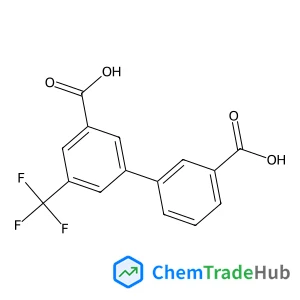
3-(3-Carboxyphenyl)-5-(trifluoromethyl)benzoic acid
CAS Number:
1261930-96-4
Molecular Formula:
C15H9F3O4
![2-Methyl-2-propanyl 4-[3-(aminomethyl)phenyl]-1-piperazinecarboxylate structure](https://static.chemtradehub.com/structs/889/889948-55-4-5c12.webp "2-Methyl-2-propanyl 4-[3-(aminomethyl)phenyl]-1-piperazinecarboxylate structure")
2-Methyl-2-propanyl 4-[3-(aminomethyl)phenyl]-1-piperazinecarboxylate
CAS Number:
889948-55-4
Molecular Formula:
C16H25N3O2
![2-[1-(4-Chlorobenzyl)-1H-indol-3-yl]-2-oxo-N-(6-quinolinyl)acetamide structure](https://static.chemtradehub.com/structs/501/501921-61-5-756a.webp "2-[1-(4-Chlorobenzyl)-1H-indol-3-yl]-2-oxo-N-(6-quinolinyl)acetamide structure")
2-[1-(4-Chlorobenzyl)-1H-indol-3-yl]-2-oxo-N-(6-quinolinyl)acetamide
CAS Number:
501921-61-5
Molecular Formula:
C26H18ClN3O2

Recommended Suppliers




Disclaimer
This page provides academic journal information for reference and research purposes only. We are not affiliated with any journal publishers and do not handle publication submissions. For publication-related inquiries, please contact the respective journal publishers directly.
If you notice any inaccuracies in the information displayed, please contact us at support@chemtradehub.com. We will promptly review and address your concerns.