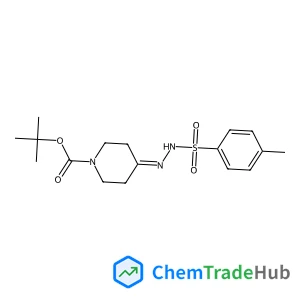
tert-Butyl 4-(2-(p-Tolylsulfonyl)hydrazono)piperidine-1-carboxylate
CAS Number:
1046478-89-0
Molecular Formula:
C17H25N3O4S
Yujun Zheng, Craig C. Martens, Weiyi Ren
In this paper, we develop the formalism of entangled trajectory molecular dynamics (ETMD), introduced by Donoso and Martens [Phys. Rev. Lett. 2001, 87, 223202] in a form applicable to the treatment of general (i.e., nonpolynomial) potentials. We formulate our approach directly in terms of the integrodifferential equation obeyed by the Wigner function, without assuming a Taylor series expansion of the potential in powers of the coordinate. This alternative formalism has distinct advantages for propagating distribution functions represented by finite trajectory ensembles and for nonpolynomial potentials. We use a numerical implementation of the new approach to calculate the reaction probabilities for three model systems: the cubic polynomial potential, symmetric Eckart barrier and asymmetric Eckart barrier. Our results are in excellent agreement with the results of exact quantum calculation.
Joshua J. Melko, Shaun G. Ard, Joseph A. Fournier, Jun Li, Nicholas S. Shuman, Hua Guo, Albert A. Viggiano
DOI: 10.1039/C3CP50335F
Yingchang Yang, Xiaobo Ji, Fang Lu, Qiyuan Chen, Craig E. Banks
DOI: 10.1039/C3CP52808A
Andrej Grubisic, Volker Schweikhard, Thomas A. Baker, David J. Nesbitt
DOI: 10.1039/C3CP44385J
Antonio Politano, Davide Campi
DOI: 10.1039/C3CP51954F
Rana Tabassum, Satyendra K. Mishra, Banshi D. Gupta
DOI: 10.1039/C3CP51525G
Robert P. Lynch, Nathan Quill, Shohei Nakahara, D. Noel Buckley
DOI: 10.1039/C3CP52253A
Makoto Uchida, Young-Chul Park, Katsuyoshi Kakinuma, Hiroshi Yano, Donald A. Tryk, Takeo Kamino, Hiroyuki Uchida, Masahiro Watanabe
DOI: 10.1039/C3CP51801A
Huangjing Zhao, Youngjune Park, Dong Hyun Lee, Ah-Hyung Alissa Park
DOI: 10.1039/C3CP52459K
When considering alternatives to 1-(4-Chlorophenyl)-N-hydroxymethanimine (CAS: 3...
This compound should be stored in a cool, dry place away from direct sunlight. I...
3-(4-Bromophenyl)-5-(2-fluorophenyl)-1,2,4-oxadiazole is synthesized through a m...
5-Chloro-2-(4-chlorophenyl)-4-methyl-6-[3-(1-piperidinyl)propoxy]pyrimidine (CAS...
2-Chloro-4-(difluoromethoxy)pyridine is used in the pharmaceutical industry for ...
3-Chloro-6-methylpyridazine (CAS: 1121-79-5) is classified under the Globally Ha...
Several alternatives can be used in the synthesis of Methyl 4,5-dimethyl-2-nitro...
Alternatives to (2E,2'E)-3,3'-(1,4-Phenylene)bisacrylaldehyde include other acry...
3-Amino-5-chloropyridin-2-ol hydrochloride is an organic compound with the CAS n...
When handling 6,7-Difluoro-2,3-dihydro-4H-chromen-4-one, it is essential to wear...

Physical Chemistry Chemical Physics (PCCP) is an international journal co-owned by 19 physical chemistry and physics societies from around the world. This journal publishes original, cutting-edge research in physical chemistry, chemical physics and biophysical chemistry. To be suitable for publication in PCCP, articles must include significant innovation and/or insight into physical chemistry; this is the most important criterion that reviewers and Editors will judge against when evaluating submissions. The journal has a broad scope and welcomes contributions spanning experiment, theory, computation and data science. Topical coverage includes spectroscopy, dynamics, kinetics, statistical mechanics, thermodynamics, electrochemistry, catalysis, surface science, quantum mechanics, quantum computing and machine learning. Interdisciplinary research areas such as polymers and soft matter, materials, nanoscience, energy, surfaces/interfaces, and biophysical chemistry are welcomed if they demonstrate significant innovation and/or insight into physical chemistry. Joined experimental/theoretical studies are particularly appreciated when complementary and based on up-to-date approaches.