












Weighting non-covalent forces in the molecular recognition of C60. Relevance of concave–convex complementarity
Literature Information
Publication Date
2008-08-12
DOI
10.1039/B810177A
Impact Factor
6.222
Authors
Emilio M. Pérez, Agostina L. Capodilupo, Gustavo Fernández, Luis Sánchez, Pedro M. Viruela, Rafael Viruela, Enrique Ortí, Massimo Bietti
View Original
Abstract
The relative contributions of several weak intermolecular forces to the overall stability of the complexes formed between structurally related receptors and [60]fullerene are compared, revealing a discernible contribution from concave–convex complementarity.
Related Literature
Electronic structure and rovibrational predissociation of the 21Π state in KLi
P. Jasik, J. Kozicki, T. Kilich, J. E. Sienkiewicz, N. E. Henriksen
2018-06-25
Paper
DOI: 10.1039/C8CP02551G
Unveiling CO adsorption on Cu surfaces: new insights from molecular orbital principles
Kareem M. Gameel, Icell M. Sharafeldin, Amr U. Abourayya, Ahmed H. Biby, Nageh K. Allam
2018-09-25
Paper
DOI: 10.1039/C8CP04253E
Strain-driven carrier-type switching of surface two-dimensional electron and hole gases in a KTaO3 thin film‡
2018-08-30
Paper
DOI: 10.1039/C8CP03650K
The magnetic fingerprint of dithiazolyl-based molecule magnets
Jordi Ribas-Arino, Juan J. Novoa, Ria Broer, Mercè Deumal
2018-07-12
Paper
DOI: 10.1039/C8CP03173H
An insight into the effects of transition metals on the thermal expansion of complex perovskite compounds: an experimental and density functional theory investigation
Xiao Wang, Ye Han, Xiaojie Song, Weihui Liu, Yinxi Jin, Wentao Liu, Hongzhi Cui
2018-06-05
Paper
DOI: 10.1039/C8CP02451K
Reaction mechanism of the selective reduction of CO2 to CO by a tetraaza [CoIIN4H]2+ complex in the presence of protons
Alejandro J. Garza
2018-09-03
Paper
DOI: 10.1039/C8CP01963K
Sub-molecular spectroscopy and temporary molecular charging of Ni-phthalocyanine on graphene with STM
Mali Zhao, Faisal Almarzouqi, Eric Duverger, Philippe Sonnet, Gérald Dujardin, Andrew J. Mayne
2018-07-05
Paper
DOI: 10.1039/C8CP02113A
You might also like
Compound Q&A
What precautions should be taken when handling 4-(2-Furylmethyl)thiomorpholine 1,1-dioxide (CAS: 79206-94-3)?
When handling 4-(2-Furylmethyl)thiomorpholine 1,1-dioxide (CAS: 79206-94-3), it ...
79206-94-34-(2-Furylmethyl)thi...
Compound Q&A
What precautions should be taken when handling 4-Chloro-N-[2-(4-morpholinyl)ethyl]benzamide (CAS: 71320-77-9)?
When handling 4-Chloro-N-[2-(4-morpholinyl)ethyl]benzamide (CAS: 71320-77-9), it...
71320-77-94-Chloro-N-[2-(4-mor...
Compound Q&A
How should waste containing 2-[2-(2-Methoxyethoxy)ethoxy]ethyl 4-methylbenzenesulfonate (CAS: 62921-74-8) be handled?
Waste containing this compound (CAS: 62921-74-8) should be handled according to ...
62921-74-82-[2-(2-Methoxyethox...
Compound Q&A
How should waste containing (S)-Methyl 2-amino-3-cyclohexylpropanoate be handled?
Waste containing (S)-Methyl 2-amino-3-cyclohexylpropanoate should be collected i...
40056-18-6(S)-Methyl 2-amino-3...
Compound Q&A
How is 5-({4-[(2S,4R)-4-Hydroxy-2-methyltetrahydro-2H-pyran-4-yl]-2-thienyl}sulfanyl)-1-methyl-1,3-dihydro-2H-indol-2-one (CAS: 166882-70-8) typically synthesized?
This compound can be synthesized using a multi-step process involving the conjug...
166882-70-85-({4-[(2S,4R)-4-Hyd...
Compound Q&A
Are there alternatives to (2E)-3-(3,4-Dichlorophenyl)acrylic acid (CAS: 7312-27-8) in synthesis?
There are several alternatives to (2E)-3-(3,4-Dichlorophenyl)acrylic acid in syn...
7312-27-8(2E)-3-(3,4-Dichloro...
Compound Q&A
How should Ethyl 6-(2-nitrophenyl)imidazo[2,1-b][1,3]thiazole-3-carboxylate (CAS: 925437-84-9) be stored?
Ethyl 6-(2-nitrophenyl)imidazo[2,1-b][1,3]thiazole-3-carboxylate (CAS: 925437-84...
925437-84-9Ethyl 6-(2-nitrophen...
Compound Q&A
How should waste containing 2-(1,3-Thiazol-2-yl)ethanamine (CAS: 18453-07-1) be handled?
Waste containing 2-(1,3-Thiazol-2-yl)ethanamine (CAS: 18453-07-1) should be coll...
18453-07-12-(1,3-Thiazol-2-yl)...
Compound Q&A
How is Methyl 5-iodo-2-methylbenzoate (CAS: 103440-54-6) typically synthesized?
Methyl 5-iodo-2-methylbenzoate can be synthesized through the iodination of meth...
103440-54-6Methyl 5-iodo-2-meth...
Compound Q&A
How is 5-Chloro[1,2,4]triazolo[1,5-a]pyridine (CAS: 1427399-34-5) typically synthesized?
5-Chloro[1,2,4]triazolo[1,5-a]pyridine is commonly synthesized via the condensat...
1427399-34-55-Chloro[1,2,4]triaz...
Source Journal
Chemical Communications

CiteScore:
8.6
Self-citation Rate:
4.7%
Articles per Year:
2458
ChemComm publishes urgent research which is of outstanding significance and interest to experts in the field, while also appealing to the journal’s broad chemistry readership. Our communication format is ideally suited to short, urgent studies that are of such importance that they require accelerated publication. Our scope covers all topics in chemistry, and research at the interface of chemistry and other disciplines (such as materials science, nanoscience, physics, engineering and biology) where there is a significant novelty in the chemistry aspects. Major topic areas covered include: Analytical Chemistry Catalysis Chemical Biology and medicinal chemistry Computational Chemistry and Machine Learning Energy and sustainable chemistry Environmental Chemistry Green Chemistry Inorganic Chemistry Materials Chemistry Nanoscience Organic Chemistry Physical Chemistry Polymer Chemistry Supramolecular Chemistry
Recommended Compounds
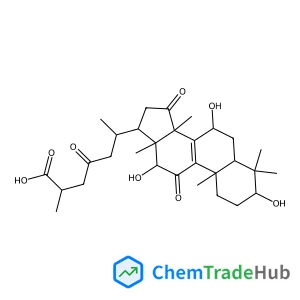
(3beta,7beta,12beta)-3,7,12-Trihydroxy-11,15,23-trioxolanost-8-en-26-oic acid
CAS Number:
98665-22-6
Molecular Formula:
C30H44O8
Recommended Suppliers





Disclaimer
This page provides academic journal information for reference and research purposes only. We are not affiliated with any journal publishers and do not handle publication submissions. For publication-related inquiries, please contact the respective journal publishers directly.
If you notice any inaccuracies in the information displayed, please contact us at support@chemtradehub.com. We will promptly review and address your concerns.