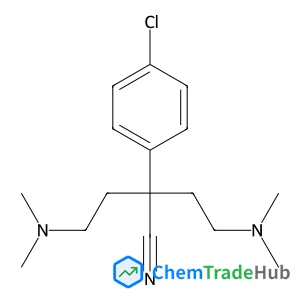
2-(4-Chlorophenyl)-4-(dimethylamino)-2-(2-(dimethylamino)ethyl)butanenitrile
CAS Number:
1246816-57-8
Molecular Formula:
C16H24ClN3
María J. Fabra, José M. Fraile, Clara I. Herrerías, Fernando J. Lahoz, José A. Mayoral, Ignacio Pérez
Surface effects on a laponite-exchanged bis(oxazoline)–copper complex modify the stereochemical course of the Mukaiyama aldol reaction between 2-(trimethylsilyloxy)furan and α-ketoesters, leading up to 90% ee (dr 86 : 14) becoming the best overall result obtained for this reaction and significantly improving the homogeneous process.
Yuannan Chen, Aimin Ren, Zhongyue Yang, Tengfei He, Xiaoli Ding, Hongxing Zhang, Luyi Zou
DOI: 10.1039/C8CP00525G
Hui-Min Mu, Jin-Peng Li, Xiao-Chun Wang
DOI: 10.1039/C8CP04010A
Antenor J. Paulista Neto, Eudes E. Fileti
DOI: 10.1039/C8CP00797G
Elliot Christ, Dominique Collin, Jean-Philippe Lamps
DOI: 10.1039/C8CP00009C
Osamu Takahashi, Hanna Myllynen, Joakim Laksman, Elisabeth Rachlew, Edwin Kukk
DOI: 10.1039/C7CP08428E
Marcelo Goulart, Lorenz Kranabetter, Martin Kuhn, Paul Martini, Norbert Gitzl, Manuel Rainer, Johannes Postler, Paul Scheier, Andrew M. Ellis
DOI: 10.1039/C8CP01273C
Clinton G. Wiener, Zhe Qiang, Yanfeng Xia, Bryan D. Vogt
DOI: 10.1039/C8CP05670F
Elena F. Belogolova, Evgeniya P. Doronina, Valery F. Sidorkin
DOI: 10.1039/C8CP04582H
This compound is mainly used as an intermediate in the synthesis of antipsychoti...
Waste containing 1-(D-Ribofuranosyl)-1,4-dihydro-3-pyridinecarboxamide (CAS: 191...
2-Methyl-2-propanyl 3-bromo-3-(hydroxymethyl)-1-azetidinecarboxylate (CAS: 20079...
N-(4-Chloro-2-pyridinyl)acetamide (CAS: 245056-66-0) is a chemical compound with...
5-Chloro-2-hydroxybenzoic acid, also known as 5-chlorosalicylic acid, is an arom...
When handling 1,1-Dichloro-1-fluoroethane (CAS: 1717-00-6), it is important to u...
Fmoc-(2S,3R)-3-phenylpyrrolidine-2-carboxylic acid is a white crystalline solid ...
4-Amino-5-bromo-2-pyridinecarboxylic acid is primarily used as a precursor in th...
Handling this compound should be done with personal protective equipment (PPE) i...
When handling 8-bromo-2,2-dimethyl-3,4-dihydro-2H-1,4-benzoxazin-3-one, use prop...

ChemComm publishes urgent research which is of outstanding significance and interest to experts in the field, while also appealing to the journal’s broad chemistry readership. Our communication format is ideally suited to short, urgent studies that are of such importance that they require accelerated publication. Our scope covers all topics in chemistry, and research at the interface of chemistry and other disciplines (such as materials science, nanoscience, physics, engineering and biology) where there is a significant novelty in the chemistry aspects. Major topic areas covered include: Analytical Chemistry Catalysis Chemical Biology and medicinal chemistry Computational Chemistry and Machine Learning Energy and sustainable chemistry Environmental Chemistry Green Chemistry Inorganic Chemistry Materials Chemistry Nanoscience Organic Chemistry Physical Chemistry Polymer Chemistry Supramolecular Chemistry