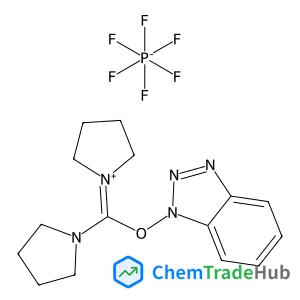
(1H-Benzotriazol-1-yloxy)(di-1-pyrrolidinyl)methylium hexafluorophosphate
CAS Number:
105379-24-6
Molecular Formula:
C15H21F6N5OP
Dechao Niu, Yongsheng Li, Xiaoli Qiao, Liang Li, Wenru Zhao, Hangrong Chen, Qiaoling Zhao, Zhi Ma
Novel amino- or thiol-functionalized superparamagnetic copolymer-silica nanospheres (NH2-SMCSNs/SH-SMCSNs), which consist of a magnetic core and a silica cross-linked block copolymer shell, have been fabricated.
Kosuke Sato, Ekadashi Pradhan, Ryoji Asahi, Alexey V. Akimov
DOI: 10.1039/C8CP03841D
Nobuyoshi Koga, Satoki Kodani
DOI: 10.1039/C8CP05701J
Cheng-Xing Cui, Ganglong Cui
DOI: 10.1039/C8CP02651C
DOI: 10.1039/C8CP91801E
Chaitanya V. Mungi, Sachin Kumar Singh, Sudha Rajamani
DOI: 10.1039/C8CP91818J
Cédric Bomme, Denis Anielski, Benjamin Erk, Jens Viefhaus
DOI: 10.1039/C8CP00936H
Yingxiang Cai, Li Zeng, Yu Zhang, Xuechun Xu
DOI: 10.1039/C8CP03447H
Anthony C. Legon, Nicholas R. Walker
DOI: 10.1039/C8CP03432J
Kevin G. Yager
DOI: 10.1039/C8CP02854K
Ran Yang, Xiaodong Tian, Kejie He, Seth Leon Filbrun, Ning Fang
DOI: 10.1039/C8CP05710A
When handling 4-(2-Furylmethyl)thiomorpholine 1,1-dioxide (CAS: 79206-94-3), it ...
When handling 4-Chloro-N-[2-(4-morpholinyl)ethyl]benzamide (CAS: 71320-77-9), it...
Waste containing this compound (CAS: 62921-74-8) should be handled according to ...
Waste containing (S)-Methyl 2-amino-3-cyclohexylpropanoate should be collected i...
This compound can be synthesized using a multi-step process involving the conjug...
There are several alternatives to (2E)-3-(3,4-Dichlorophenyl)acrylic acid in syn...
Ethyl 6-(2-nitrophenyl)imidazo[2,1-b][1,3]thiazole-3-carboxylate (CAS: 925437-84...
Waste containing 2-(1,3-Thiazol-2-yl)ethanamine (CAS: 18453-07-1) should be coll...
Methyl 5-iodo-2-methylbenzoate can be synthesized through the iodination of meth...
5-Chloro[1,2,4]triazolo[1,5-a]pyridine is commonly synthesized via the condensat...

ChemComm publishes urgent research which is of outstanding significance and interest to experts in the field, while also appealing to the journal’s broad chemistry readership. Our communication format is ideally suited to short, urgent studies that are of such importance that they require accelerated publication. Our scope covers all topics in chemistry, and research at the interface of chemistry and other disciplines (such as materials science, nanoscience, physics, engineering and biology) where there is a significant novelty in the chemistry aspects. Major topic areas covered include: Analytical Chemistry Catalysis Chemical Biology and medicinal chemistry Computational Chemistry and Machine Learning Energy and sustainable chemistry Environmental Chemistry Green Chemistry Inorganic Chemistry Materials Chemistry Nanoscience Organic Chemistry Physical Chemistry Polymer Chemistry Supramolecular Chemistry
![5-Acetyl-2,3-dihydrobenzo[b]furan structure](https://static.chemtradehub.com/structs/908/90843-31-5-eea4.webp "5-Acetyl-2,3-dihydrobenzo[b]furan structure")