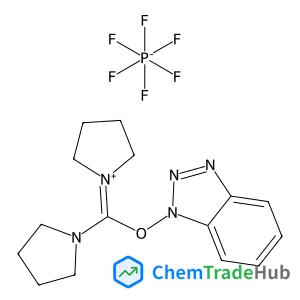
(1H-Benzotriazol-1-yloxy)(di-1-pyrrolidinyl)methylium hexafluorophosphate
CAS Number:
105379-24-6
Molecular Formula:
C15H21F6N5OP
Kalyan K. Sadhu, Parimal K. Bharadwaj
The movement of a copper ion inside the cavity of cryptands having two distinct metal binding sites at each end is linked to a fluorescence ON–OFF process in a reversible manner, providing a new way of fluorescence switching.
Fangyong Yan, Ryohei Kakuchi, Kenji Takahashi, Hyung J. Kim
DOI: 10.1039/C8CP01724G
Yu-Hsuan Weng, Yu-Jane Sheng
DOI: 10.1039/C8CP03215G
Sehee Na, Sascha Jurkovic, Thorsten Friedrich, Thorsten Koslowski
DOI: 10.1039/C8CP02420K
Xi Zhang, Yongli Huang, Chang Q. Sun
DOI: 10.1039/C8CP04891F
Yosslen Aray, Antonio Díaz Barrios
DOI: 10.1039/C8CP03387K
Kostiantyn V. Sopiha, Oleksandr I. Malyi, Clas Persson, Ping Wu
DOI: 10.1039/C8CP02535E
Sandra Schröter, Apiwat Wijaikhum, Andrew West, Nicolas Minesi, James Dedrick, Erik Wagenaars, Nelson de Oliveira, Laurent Nahon, Mark J. Kushner, Jean-Paul Booth, Kari Niemi, Timo Gans, Deborah O'Connell
DOI: 10.1039/C8CP02473A
Maria Barrio, Pol Lloveras, Alain Polian, Jean-Paul Itié, Josep-Lluis Tamarit
DOI: 10.1039/C8CP01813H
Ran Yang, Xiaodong Tian, Kejie He, Seth Leon Filbrun, Ning Fang
DOI: 10.1039/C8CP05710A
When handling 4-(2-Furylmethyl)thiomorpholine 1,1-dioxide (CAS: 79206-94-3), it ...
When handling 4-Chloro-N-[2-(4-morpholinyl)ethyl]benzamide (CAS: 71320-77-9), it...
Waste containing this compound (CAS: 62921-74-8) should be handled according to ...
Waste containing (S)-Methyl 2-amino-3-cyclohexylpropanoate should be collected i...
This compound can be synthesized using a multi-step process involving the conjug...
There are several alternatives to (2E)-3-(3,4-Dichlorophenyl)acrylic acid in syn...
Ethyl 6-(2-nitrophenyl)imidazo[2,1-b][1,3]thiazole-3-carboxylate (CAS: 925437-84...
Waste containing 2-(1,3-Thiazol-2-yl)ethanamine (CAS: 18453-07-1) should be coll...
Methyl 5-iodo-2-methylbenzoate can be synthesized through the iodination of meth...
5-Chloro[1,2,4]triazolo[1,5-a]pyridine is commonly synthesized via the condensat...

ChemComm publishes urgent research which is of outstanding significance and interest to experts in the field, while also appealing to the journal’s broad chemistry readership. Our communication format is ideally suited to short, urgent studies that are of such importance that they require accelerated publication. Our scope covers all topics in chemistry, and research at the interface of chemistry and other disciplines (such as materials science, nanoscience, physics, engineering and biology) where there is a significant novelty in the chemistry aspects. Major topic areas covered include: Analytical Chemistry Catalysis Chemical Biology and medicinal chemistry Computational Chemistry and Machine Learning Energy and sustainable chemistry Environmental Chemistry Green Chemistry Inorganic Chemistry Materials Chemistry Nanoscience Organic Chemistry Physical Chemistry Polymer Chemistry Supramolecular Chemistry