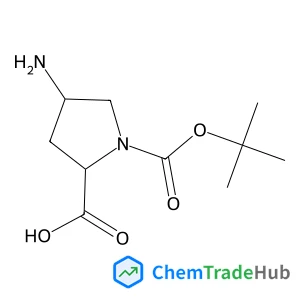
(2R,4R)-1-Boc-4-Aminopyrrolidine-2-carboxylic acid
CAS Number:
132622-98-1
Molecular Formula:
C10H18N2O4
Katia Júlia de Almeida, N. Arul Murugan, Zilvinas Rinkevicius, Håkan Wilhelm Hugosson, Olav Vahtras, Hans Ågren, Amary Cesar
We have performed Car–Parrinello molecular dynamics simulations at ambient conditions for four-, five- and six-coordinated Cu(II) aqua complexes. The molecular geometry has been investigated in terms of Cu–O, Cu–H bond lengths and O–Cu–O bond angles and compared with earlier experimental measurement results and theoretical calculations. We find that the average Cu–O and Cu–H bond lengths increase with increasing coordination number. We have also observed relatively faster structural transition in the case of five-coordinated complex between trigonal bipyramidal and square pyramidal geometry. This result deviates from the findings of the earlier report (A. Pasquarello et al., Science, 2001, 291, 856) on copper(II) in aqueous solution and we attribute these differences to the neglect of solvent environment in our calculations. The averaged absorption spectra for the copper(II) aqua complexes have been computed using spin-restricted density functional linear response formalism taking 100 snap shots from a trajectory of 0.48 ps. We find that the calculated spectra are significantly different, showing clear features that distinguish each coordination model. Comparison with the experimentally reported absorption spectra is made wherever it is possible and the results obtained favor the distorted fivefold-coordination arrangement for the molecular structure of the Cu(II) ion in aqueous solution.
Jaume Puy, Joan Cecília, Josep Galceran
DOI: 10.1039/C3CP51038G
Daniel R. Albert, H. Floyd Davis
DOI: 10.1039/C3CP51930A
Shamon A. Walker, Devin T. Edwards, Ting Ann Siaw, Brandon D. Armstrong
DOI: 10.1039/C3CP51628H
Rita Nissim, Richard G. Compton
DOI: 10.1039/C3CP51732B
Yingchang Yang, Xiaobo Ji, Fang Lu, Qiyuan Chen, Craig E. Banks
DOI: 10.1039/C3CP52808A
Rana Tabassum, Satyendra K. Mishra, Banshi D. Gupta
DOI: 10.1039/C3CP51525G
Harry L. Tuller, Melanie Kuhn, Guido Ciampi, William Higgins, Kanai S. Shah
DOI: 10.1039/C3CP51043C
Ming Cheng, Xichuan Yang, Cheng Chen, Jianghua Zhao, Fuguo Zhang
DOI: 10.1039/C3CP51980E
Jhenny F. Galan, Chi Ngong Tang, Shubhashis Chakrabarty, Zhiwei Liu, Vojislava Pophristic
DOI: 10.1039/C3CP50353D
Youyi Xia, Tenjiao Li, Jun Chen
DOI: 10.1039/C3CP51080H
When considering alternatives to 1-(4-Chlorophenyl)-N-hydroxymethanimine (CAS: 3...
This compound should be stored in a cool, dry place away from direct sunlight. I...
3-(4-Bromophenyl)-5-(2-fluorophenyl)-1,2,4-oxadiazole is synthesized through a m...
5-Chloro-2-(4-chlorophenyl)-4-methyl-6-[3-(1-piperidinyl)propoxy]pyrimidine (CAS...
2-Chloro-4-(difluoromethoxy)pyridine is used in the pharmaceutical industry for ...
3-Chloro-6-methylpyridazine (CAS: 1121-79-5) is classified under the Globally Ha...
Several alternatives can be used in the synthesis of Methyl 4,5-dimethyl-2-nitro...
Alternatives to (2E,2'E)-3,3'-(1,4-Phenylene)bisacrylaldehyde include other acry...
3-Amino-5-chloropyridin-2-ol hydrochloride is an organic compound with the CAS n...
When handling 6,7-Difluoro-2,3-dihydro-4H-chromen-4-one, it is essential to wear...

Physical Chemistry Chemical Physics (PCCP) is an international journal co-owned by 19 physical chemistry and physics societies from around the world. This journal publishes original, cutting-edge research in physical chemistry, chemical physics and biophysical chemistry. To be suitable for publication in PCCP, articles must include significant innovation and/or insight into physical chemistry; this is the most important criterion that reviewers and Editors will judge against when evaluating submissions. The journal has a broad scope and welcomes contributions spanning experiment, theory, computation and data science. Topical coverage includes spectroscopy, dynamics, kinetics, statistical mechanics, thermodynamics, electrochemistry, catalysis, surface science, quantum mechanics, quantum computing and machine learning. Interdisciplinary research areas such as polymers and soft matter, materials, nanoscience, energy, surfaces/interfaces, and biophysical chemistry are welcomed if they demonstrate significant innovation and/or insight into physical chemistry. Joined experimental/theoretical studies are particularly appreciated when complementary and based on up-to-date approaches.