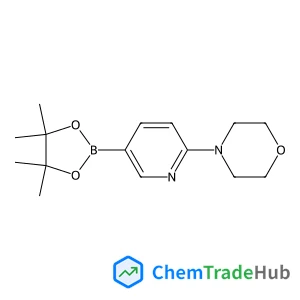
4-(5-(4,4,5,5-tetramethyl-1,3,2-dioxaborolan-2-yl)pyridin-2-yl)morpholine
CAS Number:
485799-04-0
Molecular Formula:
C15H23BN2O3
Chen Song, Yueyuan Xia, Mingwen Zhao, Xiangdong Liu, Jiling Li, Lijuan Li
We combined classical molecular dynamics (MD) simulation with ab initio calculations to study the electronic structure evolution of DNA during its conformation transition process. By using MD simulation, we obtained the conformation transition trajectory of an oligonucleotide poly(dC)-poly(dG), from which we selected a series of representative conformations and then performed ab initio calculations for these conformations to reveal their electronic structures. Counterintuitively, the results indicate that during the conformation transition process of DNA, thermal fluctuation plays a more important role than global conformation parameters in affecting the electronic structure of DNA.
Filipa Macedo, Telma Guiu, Chris H. J. Franco, Vânia André, Alexander M. Kirillov
DOI: 10.1039/D3LF00123G
Kavita Devi, Ghanshyam S. Chauhan, Sunita Ranote, Sandeep Chauhan, Kiran Kumar
DOI: 10.1039/D3LP00118K
Smriti Chaturvedi, Snehasis Chakraborty
DOI: 10.1039/D3FB00094J
Peiying Fan, Yuhan Zhang, Li Guan, Han Wang, George Zheng Chen
DOI: 10.1039/D3SU00197K
Biqiong Chen
DOI: 10.1039/D3SU00302G
Weiliang Han, Weigao Han, Zhicheng Tang
DOI: 10.1039/D3LF00147D
(1R,3S)-1,3-Cyclopentanediol finds applications in various industries. In the ph...
When handling N'-[4-(Dimethylamino)phenyl]-N,N-dimethyl-1,4-benzenediamine, it i...
There are several alternatives to 5-(2,4-Difluorophenyl)-2-methoxypyrimidine in ...
1-(3-Methoxyphenoxy)propan-2-ol (CAS: 382141-68-6) must comply with the Globally...
Tetrodotoxin Citrate is extremely dangerous and should be handled with extreme c...
2-Methyl-2-propanyl [(1R,3S)-3-hydroxycyclopentyl]carbamate (CAS: 225641-84-9) i...
Waste containing 4-(2-Hydroxyhexafluoroisopropyl)Benzoic Acid (CAS: 16261-80-6) ...
2-Methyl-2-proanyl {(2S)-1-[(benzyloxy)amino]-3-hydroxy-3-methyl-1-oxo-2-butanyl...
Benzeneethanamine, α-ethyl-, hydrochloride (1:1) is an organic compound with the...
In the synthesis of compounds similar to 3-{(E)-[4-(Dimethylamino)phenyl]diazeny...

Physical Chemistry Chemical Physics (PCCP) is an international journal co-owned by 19 physical chemistry and physics societies from around the world. This journal publishes original, cutting-edge research in physical chemistry, chemical physics and biophysical chemistry. To be suitable for publication in PCCP, articles must include significant innovation and/or insight into physical chemistry; this is the most important criterion that reviewers and Editors will judge against when evaluating submissions. The journal has a broad scope and welcomes contributions spanning experiment, theory, computation and data science. Topical coverage includes spectroscopy, dynamics, kinetics, statistical mechanics, thermodynamics, electrochemistry, catalysis, surface science, quantum mechanics, quantum computing and machine learning. Interdisciplinary research areas such as polymers and soft matter, materials, nanoscience, energy, surfaces/interfaces, and biophysical chemistry are welcomed if they demonstrate significant innovation and/or insight into physical chemistry. Joined experimental/theoretical studies are particularly appreciated when complementary and based on up-to-date approaches.