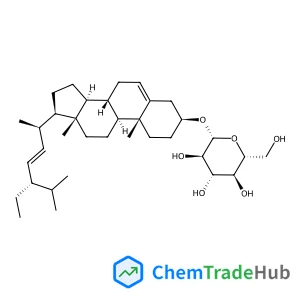
(3beta,22E)-Stigmasta-5,22-dien-3-yl beta-D-glucopyranoside
CAS Number:
19716-26-8
Molecular Formula:
C35H58O6
Huan Li, Choiwan Lau, Jianzhong Lu
For clinical diagnosis, a small number of targets (2–10 biomarkers) are often all that is required for disease assessment and accurate early disease diagnosis. In the current paper we have developed novel, carrier-resolved, single-label-based multiplexed assays for the simultaneous detection and quantification of a limited number of DNA targets associated with breast cancer. In contrast to current encoding strategies, every hybridization signal for the corresponding DNA target in our protocol is uniquely immobilized onto one carrier vehicle with a unique and intrinsic physico-chemical signature. Moreover, a simple chemiluminescence setup is employed to read the carrier code instead of expensive and complicated flow-cytometer or imaging-systems commonly used for multiplexed assays. Herein we demonstrate a new protocol using three homogeneous carriers, i.e. thermo-sensitive poly(N-isopropylacrylamide) (PNIP), polystyrene beads, and magnetic beads respectively. This new methodology allowed for the simultaneous determination of three oligonucleotide sequences (60 bases in length) associated with the breast cancer gene (BRCA1) and showed high selectivity and attomolar–femtomolar sensitivity. The mixture of three different capture probe conjugates first hybridizes with three corresponding target sequences, sandwiches with three biotinylated DNAs, and then reacts with peroxidase–streptavidin polymer in a single vessel without any washing, leading to the development of a ‘one-pot reaction system’. Only one washing step in our protocol is required prior to detection leading to our whole procedure being simple and efficient. The results show that the hybridization response to sample mixtures containing increasing levels of each target is proportional to the amount of corresponding DNA targets, indicating minimal cross-interferences. The work presented here validates the design and concept of a system for the detection of a limited number of DNA targets and provides the foundation for the development of highly sensitive techniques with increased multi-analyte capabilities.
Xi Zhang, Yuan Yuan, Longrong Wang, Yanzhi Guo, Menglong Li, Chuan Li, Xuemei Pu
DOI: 10.1039/C8CP02016G
Larwsk H. Gonçalves da Silva, David Hochberg
DOI: 10.1039/C8CP01828F
Milan Rambukwella, Anish Ravishanker, Alessandro Fortunelli, Mauro Stener, Amala Dass
DOI: 10.1039/C8CP01564C
Jesper Norell, Raphael M. Jay, Markus Hantschmann, Meiyuan Guo, Philippe Wernet, Michael Odelius
DOI: 10.1039/C7CP08326B
Linh Trong Hoang, Siu Ning Leung, Zheng Hong Zhu
DOI: 10.1039/C8CP01715H
Shenli Zhang, Haoyan Sha, Ricardo H. R. Castro, Roland Faller
DOI: 10.1039/C8CP02010H
Dipankar Sukul, Aparesh Pal, Sanjoy Satpati, Utpal Adhikari
DOI: 10.1039/C7CP06848D
C. López-Bueno, D. Bugallo, V. Leborán, F. Rivadulla
DOI: 10.1039/C8CP00165K
When handling 2-Chloro-1,2-bis(4-methylphenyl)ethanone (CAS: 71193-32-3), it is ...
4-Ethoxy-3-(5-methyl-4-oxo-7-propyl-1,4-dihydroimidazo[5,1-f][1,2,4]triazin-2-yl...
Methyl 3-Oxo-4-Androsten-17-Carboxylate (CAS: 2681-55-2) should be stored in a c...
(R)-3-Amino-4-(3-hexylphenylamino)-4-oxobutylphosphonic acid is primarily used i...
2-Methyl-2-propanyl 3-amino-3-carbamoyl-1-azetidinecarboxylate (CAS: 1254120-14-...
There are alternative reagents that can be used in synthesis instead of (E)-4-(t...
[2-(3-Chlorophenyl)-1,3-thiazol-4-yl]methanol (CAS: 121202-20-8) is a crystallin...
The market and research trends for Methyl (2S)-[(4S)-2,2-dimethyl-1,3-dioxolan-4...
The market for 1-Bromo-2-isocyanatoethane (CAS: 42865-19-0) is driven by its use...
4-Nitro-D-phenylalanine hydrochloride (CAS: 147065-06-3) is primarily used in re...

Analyst publishes analytical and bioanalytical research that reports premier fundamental discoveries and inventions, and the applications of those discoveries, unconfined by traditional discipline barriers.