












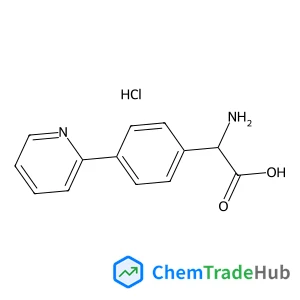
2-Amino-2-(4-(pyridin-2-YL)phenyl)acetic acid hydrochloride
CAS Number:
1135818-89-1
Molecular Formula:
C13H13ClN2O2
Keiichi Yoshimatsu, Lei Ye, Patrik Stenlund, Ioannis S. Chronakis
A simple electrospinning method is developed to introduce signal transduction ability into molecularly imprinted nanofibers.
Chris Barnes, Manoj Nair, Eric O. Aboagye
DOI: 10.1039/D2RE00219A
Longlong Ma
DOI: 10.1039/D2RE00273F
Vida Khodkari, Mohammad Taghi Nazeri, Siamak Javanbakht
DOI: 10.1039/D2RE00195K
Debashis Panda, Vaishnavi Kulkarni, Sanjay Kumar Singh
DOI: 10.1039/D2RE00211F
Jing Song, Chencan Du, Junjie Wang, Yongjin Cui, Yujun Wang, Jian Deng, Guangsheng Luo
DOI: 10.1039/D2RE00224H
Heling Zhang, Huaizhi Yang, Zhiquan Pan, Qingrong Cheng
DOI: 10.1039/D2RE00086E
Chunrui Han, Rui Wang, Chang Shu, Xingang Li, Hong Li
DOI: 10.1039/D2RE00289B
Zhenzhou Ma, Bochong Chen, Liu Zhao, Enxian Yuan, Tingting Cui
DOI: 10.1039/D1RE00532D
Yanzhe Yu, Yonggen Lu, Xisong Cheng, Lei Han, Changling Yang
DOI: 10.1039/D2RE00060A
Ujjal Mondal, Ganapati D. Yadav
DOI: 10.1039/D2RE00025C
(3.beta.)-3-Hydroxy-N,N-dimethyl-chol-5-en-24-amide (CAS: 79066-03-8) is primari...
5-(Aminomethyl)-2-methoxyphenol (CAS: 89702-89-6) is classified under GHS as a s...
Thieno[2,3-c]pyridin-7(6H)-one (CAS: 28981-13-7) is a heterocyclic organic compo...
1-[(6-Methoxy-3-pyridinyl)methyl]-4-piperidinamine dihydrochloride is generally ...
[(2E)-3-Phenyl-2-propen-1-yl]phosphonic acid (CAS: 146404-58-2) is regulated und...
6-Bromo-7-methoxyquinoline (CAS: 1620515-86-7) falls under the scope of the Glob...
This compound is primarily used in the pharmaceutical industry for the developme...
1-Ethyl-7-[2-methyl-6-(4H-1,2,4-triazol-3-yl)-3-pyridinyl]-3,5-dihydropyrazino[2...
Alternative reagents such as 2-[(dimethylamino)methyl]phenylboronic acid or rela...
3-(Piperidin-4-yloxy)pyridine (CAS: 310881-48-2) is an organic compound with the...

ChemComm publishes urgent research which is of outstanding significance and interest to experts in the field, while also appealing to the journal’s broad chemistry readership. Our communication format is ideally suited to short, urgent studies that are of such importance that they require accelerated publication. Our scope covers all topics in chemistry, and research at the interface of chemistry and other disciplines (such as materials science, nanoscience, physics, engineering and biology) where there is a significant novelty in the chemistry aspects. Major topic areas covered include: Analytical Chemistry Catalysis Chemical Biology and medicinal chemistry Computational Chemistry and Machine Learning Energy and sustainable chemistry Environmental Chemistry Green Chemistry Inorganic Chemistry Materials Chemistry Nanoscience Organic Chemistry Physical Chemistry Polymer Chemistry Supramolecular Chemistry

![Bis(N,N''-dimethylpiperazine)tetra[copper(I) iodide] structure](https://static.chemtradehub.com/structs/140/1401708-91-5-2b86.webp "Bis(N,N''-dimethylpiperazine)tetra[copper(I) iodide] structure")
![(3E)-3-[4-Hydroxy-3,5-bis(2-methyl-2-propanyl)benzylidene]dihydro-2(3H)-furanone structure](https://static.chemtradehub.com/structs/102/102271-49-8-cba7.webp "(3E)-3-[4-Hydroxy-3,5-bis(2-methyl-2-propanyl)benzylidene]dihydro-2(3H)-furanone structure")





