












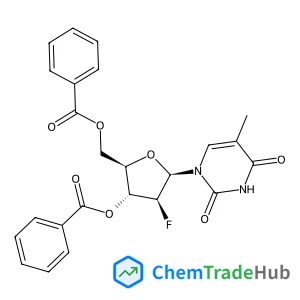
1-(3',5'-Di-O-benzoyl-2'-deoxy-2'-fluoro-b-D-arabinofuranosyl)thymine
CAS Number:
97614-47-6
Molecular Formula:
C24H21FN2O7
Jian Jin, Noriko Kobayashi, Wolfgang Schmitt, Izumi Ichinose
Positively-charged crystalline zinc hydroxide nanostrands with a diameter of 2 nm and a length of a few micrometres rapidly grew in dilute aqueous solution of zinc nitrate and aminoethanol. The nanostrands were composed of hexagonal clusters of [Zn61(OH)116(H2O)n]6+.
Shusaku Asano, Samuel J. Adams, Yuta Tsuji, Kazunari Yoshizawa, Atsushi Tahara, Jun-ichiro Hayashi
DOI: 10.1039/D2RE00147K
Marco A. Rossi, Letícia F. Rasteiro, Marco A. Fraga, José M. Assaf, Elisabete M. Assaf
DOI: 10.1039/D2RE00033D
Grazia Isa C. Righetti, Francesca Tentori, Elisabetta Brenna, Cristian Gambarotti
DOI: 10.1039/D2RE00312K
Debashis Panda, Vaishnavi Kulkarni, Sanjay Kumar Singh
DOI: 10.1039/D2RE00211F
Vaibhav Pandey, Kamal K. Pant, Sreedevi Upadhyayula
DOI: 10.1039/D2RE00427E
DOI: 10.1039/D2RE00044J
Nicolas Mattias Del Rio Fuenzalida, Eirin Alme, Frida Johanne Lundevall, Hans-René Bjørsvik
DOI: 10.1039/D2RE00071G
Suitao Qi, Kevin J. Smith, Yiming Zhou
DOI: 10.1039/D2RE00345G
(3.beta.)-3-Hydroxy-N,N-dimethyl-chol-5-en-24-amide (CAS: 79066-03-8) is primari...
5-(Aminomethyl)-2-methoxyphenol (CAS: 89702-89-6) is classified under GHS as a s...
Thieno[2,3-c]pyridin-7(6H)-one (CAS: 28981-13-7) is a heterocyclic organic compo...
1-[(6-Methoxy-3-pyridinyl)methyl]-4-piperidinamine dihydrochloride is generally ...
[(2E)-3-Phenyl-2-propen-1-yl]phosphonic acid (CAS: 146404-58-2) is regulated und...
6-Bromo-7-methoxyquinoline (CAS: 1620515-86-7) falls under the scope of the Glob...
This compound is primarily used in the pharmaceutical industry for the developme...
1-Ethyl-7-[2-methyl-6-(4H-1,2,4-triazol-3-yl)-3-pyridinyl]-3,5-dihydropyrazino[2...
Alternative reagents such as 2-[(dimethylamino)methyl]phenylboronic acid or rela...
3-(Piperidin-4-yloxy)pyridine (CAS: 310881-48-2) is an organic compound with the...

ChemComm publishes urgent research which is of outstanding significance and interest to experts in the field, while also appealing to the journal’s broad chemistry readership. Our communication format is ideally suited to short, urgent studies that are of such importance that they require accelerated publication. Our scope covers all topics in chemistry, and research at the interface of chemistry and other disciplines (such as materials science, nanoscience, physics, engineering and biology) where there is a significant novelty in the chemistry aspects. Major topic areas covered include: Analytical Chemistry Catalysis Chemical Biology and medicinal chemistry Computational Chemistry and Machine Learning Energy and sustainable chemistry Environmental Chemistry Green Chemistry Inorganic Chemistry Materials Chemistry Nanoscience Organic Chemistry Physical Chemistry Polymer Chemistry Supramolecular Chemistry
![5,7-Dihydroxy-3-(4-hydroxyphenyl)-6-[(1R,6R)-3-methyl-6-prop-1-en-2-ylcyclohex-2-en-1-yl]chromen-4-one structure](https://static.chemtradehub.com/structs/191/1914963-20-4-2b05.webp "5,7-Dihydroxy-3-(4-hydroxyphenyl)-6-[(1R,6R)-3-methyl-6-prop-1-en-2-ylcyclohex-2-en-1-yl]chromen-4-one structure")

![Bis(N,N''-dimethylpiperazine)tetra[copper(I) iodide] structure](https://static.chemtradehub.com/structs/140/1401708-91-5-2b86.webp "Bis(N,N''-dimethylpiperazine)tetra[copper(I) iodide] structure")





