


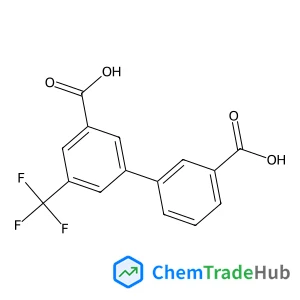
3-(3-Carboxyphenyl)-5-(trifluoromethyl)benzoic acid
CAS Number:
1261930-96-4
Molecular Formula:
C15H9F3O4
Dissociative electron attachment (DEA) to diethyl ether yielded primarily the C2H5O− ion, with a strong Feshbach resonance band at 9.1 eV and a weaker shape resonance band at 3.89 eV. Very similar spectra were obtained for dibutyl ether, with C4H9O− bands at 8.0 and 3.6 eV. Some of these primary ions subsequently lost H2 and yielded weaker signals of the C2H3O− and C4H7O− ions. In contrast, DEA to the cyclic ether tetrahydrofuran (THF) yielded mainly a fragment of mass 41, presumably deprotonated ketene, at 7.65 eV. The low-energy band was missing in THF. H− with two bands at 6.88 and 8.61 eV, and an ion of mass 43 (presumably deprotonated acetaldehyde) with two bands at 6.7 and 8.50 eV were also observed. We propose that in the primary DEA step the C–O bond is cleaved in both the open-chain and the cyclic ethers. In the open-chain ethers the excess energy is partitioned between the (internal and kinetic) energies of two fragments, resulting in an RO− ion cool enough to be observed. The ˙CH2(CH2)3O− ion resulting from cleavage of the C–O bond in THF contains the entire excess energy (more than 6 eV at an electron energy of 7.65 eV) and is too short-lived with respect to further dissociation and thermal autodetachment to be detected in a mass spectrometer. These findings imply that there could be a substantial difference between the fragmentation in the gas phase described here and fragmentation in the condensed phase where the initially formed fragments can be rapidly cooled by the environment.

Current Opinion in Solid State & Materials Science

Russian Journal of General Chemistry

Russian Journal of Bioorganic Chemistry

Chemical Communications

Russian Journal of Applied Chemistry

Nature Medicine

Organic Process Research & Development

Acta Materialia

Journal of Saudi Chemical Society

Saudi Pharmaceutical Journal
María Antiñolo, Elena Jiménez, José Albaladejo
DOI: 10.1039/C1CP21368G
Marcel Risch, Aldo Amore Bonapasta, Holger Dau
DOI: 10.1039/C1CP21776C
Thomas Roussel, Camelia Matei Ghimbeu, Julien Parmentier, Roger Gadiou, Cathie Vix-Guterl
DOI: 10.1039/C1CP21673B
Feng Hao, Hong Lin, Chen Zhou, Yizhu Liu
DOI: 10.1039/C1CP21833F
Kamil F. Dziubek, Andrzej Katrusiak
DOI: 10.1039/C1CP21087D
Davide Mores, Eli Stavitski, Suzanna P. Verkleij, Antoinette Lombard, Amandine Cabiac, Loïc Rouleau, Joël Patarin, Angélique Simon-Masseron, Bert M. Weckhuysen
DOI: 10.1039/C1CP21324E
Janusz Cukras, Joanna Sadlej
DOI: 10.1039/C1CP21359H
DOI: 10.1039/C0CP02835E
Jun-Sheng Yang, Chuan-Lu Yang, Mei-Shan Wang, Bao-Dong Chen, Xiao-Guang Ma
DOI: 10.1039/C1CP20695H
Dale A. C. Brownson, Craig E. Banks
DOI: 10.1039/C1CP21978B
4-Amino-3-bromophenol (CAS: 74440-80-5) falls under the classification of a haza...
(17beta)-3-Oxoestr-4-en-17-yl acetate should be stored in a cool, dry place away...
2-[(2,2-Diethoxyethyl)disulfanyl]-1,1-diethoxyethane (CAS: 76505-71-0) is a colo...
The market and research for 1-(β-D-ribofuranosyl)-1H-imidazo[4,5-c]pyridin-4-ami...
Waste containing Conjugated Estrogen (CAS: 12126-59-9) should be collected and d...
The market for Bis(2,2,2-trifluoroethyl) (methoxycarbonylmethyl)phosphonate (CAS...
There are several alternatives to 3,4'-Di-O-methylellagic acid (CAS: 57499-59-9)...
2-Chloro-N,N-dimethylpyridin-4-amine (CAS: 59047-70-0) is regulated under the Gl...
Cerium(3+);oxygen(2-);vanadium(5+) (CAS: 13597-19-8) is a complex inorganic comp...
7-Chloro-1-iodoisoquinoline (CAS: 1203579-27-4) is generally considered safe whe...

Physical Chemistry Chemical Physics (PCCP) is an international journal co-owned by 19 physical chemistry and physics societies from around the world. This journal publishes original, cutting-edge research in physical chemistry, chemical physics and biophysical chemistry. To be suitable for publication in PCCP, articles must include significant innovation and/or insight into physical chemistry; this is the most important criterion that reviewers and Editors will judge against when evaluating submissions. The journal has a broad scope and welcomes contributions spanning experiment, theory, computation and data science. Topical coverage includes spectroscopy, dynamics, kinetics, statistical mechanics, thermodynamics, electrochemistry, catalysis, surface science, quantum mechanics, quantum computing and machine learning. Interdisciplinary research areas such as polymers and soft matter, materials, nanoscience, energy, surfaces/interfaces, and biophysical chemistry are welcomed if they demonstrate significant innovation and/or insight into physical chemistry. Joined experimental/theoretical studies are particularly appreciated when complementary and based on up-to-date approaches.
![5,10-Dihydro-11H-dibenzo[b,e][1,4]diazepin-11-one structure](https://static.chemtradehub.com/structs/581/5814-41-5-0b01.webp "5,10-Dihydro-11H-dibenzo[b,e][1,4]diazepin-11-one structure")
![2-Methyl-2-propanyl 4-[3-(aminomethyl)phenyl]-1-piperazinecarboxylate structure](https://static.chemtradehub.com/structs/889/889948-55-4-5c12.webp "2-Methyl-2-propanyl 4-[3-(aminomethyl)phenyl]-1-piperazinecarboxylate structure")
![4-{2-[(9H-Fluoren-9-ylmethoxy)carbonyl]hydrazino}benzoic acid structure](https://static.chemtradehub.com/structs/214/214475-53-3-bf36.webp "4-{2-[(9H-Fluoren-9-ylmethoxy)carbonyl]hydrazino}benzoic acid structure")





