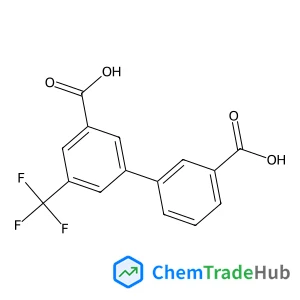
3-(3-Carboxyphenyl)-5-(trifluoromethyl)benzoic acid
CAS Number:
1261930-96-4
Molecular Formula:
C15H9F3O4
This article, in historical retrospective, describes the development of the celebrated Landau–Teller (LT) model of 1936 for vibrational-translational energy exchange in collisions of an atom with a diatomic molecule. We discuss semiclassical generalizations of the classical LT model and generalizations of the collinear LT model to account for the effects of rotation of the diatom on the vibrational relaxation rate. The former is based on the recovery of the Landau semiclassical exponent from the classical LT encounter time, and the latter on the definition of a 1-D driving mode within the manifold of the translational and rotational degrees of freedom of the colliding partners. The utility of generalized LT models is illustrated by three case studies that exemplify weak and strong effects of the rotation as well as the efficiencies of different driving modes in the vibrational relaxation of highly asymmetric diatoms.

Chemistry Education Research and Practice

Drug Discovery Today

Russian Journal of Bioorganic Chemistry

Russian Chemical Bulletin

Russian Journal of Applied Chemistry

Current Opinion in Solid State & Materials Science

Acta Materialia

Russian Journal of General Chemistry

Crystallography Reports

Russian Journal of Coordination Chemistry
Chizuko Tanaka, Jiro Tanaka, Masakatsu Matsumoto
DOI: 10.1039/C1CP20973F
Kohsuke Mori, Akihito Kumami, Hiromi Yamashita
DOI: 10.1039/C1CP21508F
Thomas Roussel, Camelia Matei Ghimbeu, Julien Parmentier, Roger Gadiou, Cathie Vix-Guterl
DOI: 10.1039/C1CP21673B
Junbo Hou, Yuyan Shao, Michael W. Ellis, Robert B. Moore, Baolian Yi
DOI: 10.1039/C1CP21915D
Tetsuya Morishita, Masuhiro Mikami, Ian K. Snook, Yusuke Sugiyama, Hideyuki Nakano
DOI: 10.1039/C1CP21544B
Dale A. C. Brownson, Craig E. Banks
DOI: 10.1039/C1CP21978B
Arnošt Zukal, Jacek Jagiello, Jana Mayerová, J. Čejka
DOI: 10.1039/C1CP20943D
Marta Kinga Bruska, Izabela Czekaj, Bernard Delley, John Mantzaras, Alexander Wokaun
DOI: 10.1039/C1CP20923J
Ismael A. Heisler, Kamila Mazur, Sayuri Yamaguchi, Stephen R. Meech
DOI: 10.1039/C1CP20990F
José F. de Lima, Claudio J. Magon, Hellmut Eckert
DOI: 10.1039/C1CP21404G
4-Amino-3-bromophenol (CAS: 74440-80-5) falls under the classification of a haza...
(17beta)-3-Oxoestr-4-en-17-yl acetate should be stored in a cool, dry place away...
2-[(2,2-Diethoxyethyl)disulfanyl]-1,1-diethoxyethane (CAS: 76505-71-0) is a colo...
The market and research for 1-(β-D-ribofuranosyl)-1H-imidazo[4,5-c]pyridin-4-ami...
Waste containing Conjugated Estrogen (CAS: 12126-59-9) should be collected and d...
The market for Bis(2,2,2-trifluoroethyl) (methoxycarbonylmethyl)phosphonate (CAS...
There are several alternatives to 3,4'-Di-O-methylellagic acid (CAS: 57499-59-9)...
2-Chloro-N,N-dimethylpyridin-4-amine (CAS: 59047-70-0) is regulated under the Gl...
Cerium(3+);oxygen(2-);vanadium(5+) (CAS: 13597-19-8) is a complex inorganic comp...
7-Chloro-1-iodoisoquinoline (CAS: 1203579-27-4) is generally considered safe whe...

Physical Chemistry Chemical Physics (PCCP) is an international journal co-owned by 19 physical chemistry and physics societies from around the world. This journal publishes original, cutting-edge research in physical chemistry, chemical physics and biophysical chemistry. To be suitable for publication in PCCP, articles must include significant innovation and/or insight into physical chemistry; this is the most important criterion that reviewers and Editors will judge against when evaluating submissions. The journal has a broad scope and welcomes contributions spanning experiment, theory, computation and data science. Topical coverage includes spectroscopy, dynamics, kinetics, statistical mechanics, thermodynamics, electrochemistry, catalysis, surface science, quantum mechanics, quantum computing and machine learning. Interdisciplinary research areas such as polymers and soft matter, materials, nanoscience, energy, surfaces/interfaces, and biophysical chemistry are welcomed if they demonstrate significant innovation and/or insight into physical chemistry. Joined experimental/theoretical studies are particularly appreciated when complementary and based on up-to-date approaches.
![Ethyl 5-[({[(2-methyl-2-propanyl)oxy]carbonyl}amino)methyl]-1,2-oxazole-3-carboxylate structure](https://static.chemtradehub.com/structs/253/253196-37-1-8450.webp "Ethyl 5-[({[(2-methyl-2-propanyl)oxy]carbonyl}amino)methyl]-1,2-oxazole-3-carboxylate structure")
![(2S)-2-({N-[(2S)-2-Ammonio-4-methylpentanoyl]glycyl}amino)-3-phenylpropanoate structure](https://static.chemtradehub.com/structs/429/4294-25-1-0842.webp "(2S)-2-({N-[(2S)-2-Ammonio-4-methylpentanoyl]glycyl}amino)-3-phenylpropanoate structure")