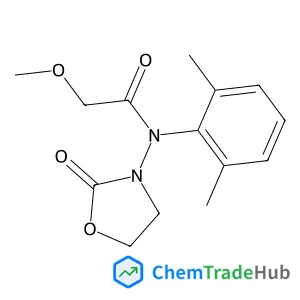
N-(2,6-Dimethylphenyl)-2-methoxy-N-(2-oxo-1,3-oxazolidin-3-yl)acetamide
CAS Number:
77732-09-3
Molecular Formula:
C14H18N2O4
Seunghee Hong, Yang Zou, Dohyun Moon, Myoung Soo Lah
An unprecedented twofold interpenetrating (3,4)-connected topology of the Cu3L4-type metal–organic framework was prepared using N,N′,N″-tris(4-pyridinyl)-1,3,5-benzenetricarboxamide (L) as a trigonal three-connection node and the copper(II) ion as a square planar four-connection node, where the framework contains remarkably large 1-D solvent channels.
Manfred Martin
DOI: 10.1039/B900162J
Daniel Lee, Jochem Struppe, Douglas W. Elliott, Leonard J. Mueller, Jeremy J. Titman
DOI: 10.1039/B818867J
C. C. de Araujo, M. Schuster, G. Portale, H. Mendil-Jakani, G. Gebel, J. Maier
DOI: 10.1039/B822069G
Wesley O. Gordon, Ye Xu, David R. Mullins, Steven H. Overbury
DOI: 10.1039/B913310K
Wolfgang Haiss, Santiago Martin, Lisa E. Scullion, Laurent Bouffier, Simon J. Higgins, Richard J. Nichols
DOI: 10.1039/B910194B
Hana Gerbelová, Tiago Q. Faria, Maria Manuel Sampaio, Rainer Rudolph, António L. Maçanita, Helena Santos
DOI: 10.1039/B819365G
Hauke Heller, Kirsten Ahrenstorf, Jose A. C. Broekaert, Horst Weller
DOI: 10.1039/B822306H
Rosa Becerra, Robin Walsh
DOI: 10.1039/B821330E
When handling 2-Chloro-1,2-bis(4-methylphenyl)ethanone (CAS: 71193-32-3), it is ...
4-Ethoxy-3-(5-methyl-4-oxo-7-propyl-1,4-dihydroimidazo[5,1-f][1,2,4]triazin-2-yl...
Methyl 3-Oxo-4-Androsten-17-Carboxylate (CAS: 2681-55-2) should be stored in a c...
(R)-3-Amino-4-(3-hexylphenylamino)-4-oxobutylphosphonic acid is primarily used i...
2-Methyl-2-propanyl 3-amino-3-carbamoyl-1-azetidinecarboxylate (CAS: 1254120-14-...
There are alternative reagents that can be used in synthesis instead of (E)-4-(t...
[2-(3-Chlorophenyl)-1,3-thiazol-4-yl]methanol (CAS: 121202-20-8) is a crystallin...
The market and research trends for Methyl (2S)-[(4S)-2,2-dimethyl-1,3-dioxolan-4...
The market for 1-Bromo-2-isocyanatoethane (CAS: 42865-19-0) is driven by its use...
4-Nitro-D-phenylalanine hydrochloride (CAS: 147065-06-3) is primarily used in re...

ChemComm publishes urgent research which is of outstanding significance and interest to experts in the field, while also appealing to the journal’s broad chemistry readership. Our communication format is ideally suited to short, urgent studies that are of such importance that they require accelerated publication. Our scope covers all topics in chemistry, and research at the interface of chemistry and other disciplines (such as materials science, nanoscience, physics, engineering and biology) where there is a significant novelty in the chemistry aspects. Major topic areas covered include: Analytical Chemistry Catalysis Chemical Biology and medicinal chemistry Computational Chemistry and Machine Learning Energy and sustainable chemistry Environmental Chemistry Green Chemistry Inorganic Chemistry Materials Chemistry Nanoscience Organic Chemistry Physical Chemistry Polymer Chemistry Supramolecular Chemistry