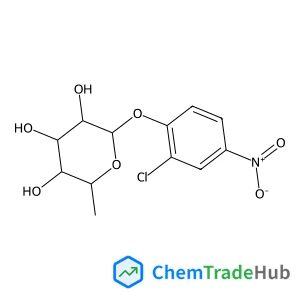
2-Chloro-4-nitrophenyl 6-deoxy-alpha-L-galactopyranoside
CAS Number:
157843-41-9
Molecular Formula:
C12H14ClNO7
Rodrigo A. A. Munoz, Donglai Lu, Avi Cagan, Joseph Wang
A fast, simple and sensitive electrochemical method for sensing peroxide-based explosives based on their acid treatment is reported. The method relies on the high electrocatalytic activity of Prussian-blue (PB)-modified electrodes towards the acid-generated hydrogen peroxide in the harsh acidic medium (down to pH 0.3) used for releasing hydrogen peroxide. Such effective operation of PB electrochemical sensors in strongly acidic media eliminates the need for an additional neutralization step required in analogous peroxidase-based assays (due to acid-induced enzyme deactivation processes). Factors affecting the efficiency of the acid pre-treatment of triacetone triperoxide (TATP) have been examined and optimized to allow its sensitive measurement down to the 50 ng level within 60 s. Chronoamperometric detection of microgram amounts of solid TATP, following a one-minute acid mixing and placing a 20 μL droplet onto a disposable PB-modified screen-printed electrode is illustrated. Similar results were obtained for the peroxide explosive hexamethylene triperoxide diamine (HMTD). By greatly simplifying the analytical procedure, such an acid-operated ‘artificial peroxidase’ electrocatalytic transducer holds great promise for designing ‘one-step’, user-friendly, miniaturized, cost-effective devices for field screening of peroxide explosives.
Yu Tang, Jian Dou, Christopher M. Andolina, Yuting Li, Hongbin Ma, Stephen D. House, Xiaoyan Zhang, Judith Yang, Franklin (Feng) Tao
DOI: 10.1039/C7CP07407G
Jun Ma, Jean-Louis Marignier, Pascal Pernot, Chantal Houée-Levin, Anil Kumar, Michael D. Sevilla, Amitava Adhikary, Mehran Mostafavi
DOI: 10.1039/C8CP00352A
DOI: 10.1039/C7CP08239H
A. S. Dobrota, L. D. Rafailović
DOI: 10.1039/C8CP00992A
Yong-Dao Chen, Song Yu, Wen-Hui Zhao, Shun-Fang Li, Xiang-Mei Duan
DOI: 10.1039/C8CP01145A
Themmila Khamrang, Marappan Velusamy, Mohan Ramesh, Murugavel Kathiresan, Arunkumar Kathiravan
DOI: 10.1039/C7CP08038G
Bin Tu, Guo-jun Hu, Qiao-jun Fang, Jun-jie Qi, Xun-wen Xiao, Yan-fang Geng, Qing-dao Zeng
DOI: 10.1039/C7CP08201K
Xi Zhang, Yuan Yuan, Longrong Wang, Yanzhi Guo, Menglong Li, Chuan Li, Xuemei Pu
DOI: 10.1039/C8CP02016G
Jinyang Jiang, Yiru Yan, Dongshuai Hou, Jiao Yu
DOI: 10.1039/C7CP08640G
Chol-Jun Yu, Un-Song Ri, Gum-Chol Ri, Jin-Song Kim
DOI: 10.1039/C8CP01468J
When handling 2-Chloro-1,2-bis(4-methylphenyl)ethanone (CAS: 71193-32-3), it is ...
4-Ethoxy-3-(5-methyl-4-oxo-7-propyl-1,4-dihydroimidazo[5,1-f][1,2,4]triazin-2-yl...
Methyl 3-Oxo-4-Androsten-17-Carboxylate (CAS: 2681-55-2) should be stored in a c...
(R)-3-Amino-4-(3-hexylphenylamino)-4-oxobutylphosphonic acid is primarily used i...
2-Methyl-2-propanyl 3-amino-3-carbamoyl-1-azetidinecarboxylate (CAS: 1254120-14-...
There are alternative reagents that can be used in synthesis instead of (E)-4-(t...
[2-(3-Chlorophenyl)-1,3-thiazol-4-yl]methanol (CAS: 121202-20-8) is a crystallin...
The market and research trends for Methyl (2S)-[(4S)-2,2-dimethyl-1,3-dioxolan-4...
The market for 1-Bromo-2-isocyanatoethane (CAS: 42865-19-0) is driven by its use...
4-Nitro-D-phenylalanine hydrochloride (CAS: 147065-06-3) is primarily used in re...

Analyst publishes analytical and bioanalytical research that reports premier fundamental discoveries and inventions, and the applications of those discoveries, unconfined by traditional discipline barriers.