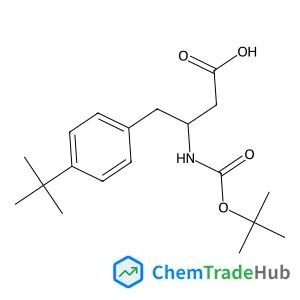
(S)-3-((tert-Butoxycarbonyl)amino)-4-(4-(tert-butyl)phenyl)butanoic acid
CAS Number:
403661-85-8
Molecular Formula:
C19H29NO4
Bin Tu, Guo-jun Hu, Qiao-jun Fang, Jun-jie Qi, Xun-wen Xiao, Yan-fang Geng, Qing-dao Zeng
Tetrathiafulvalenes (TTFs) are a class of important functional materials whose intermolecular interaction, which will contribute to constructing a supramolecular structure, still needs further understanding. In this study, the self-assembly behavior and structure of a series of TTFs bearing different alkyl chains and substituents were investigated by scanning tunneling microscopy (STM) in combination with density functional theory (DFT) calculations. Contrary to previous reports, herein, a series of benzoic acid-functionalized TTFs (CnTTFCOOH) and pyridine-functionalized TTFs (CnTTFN) with different lengths of alkyl chains have been substituted on the sulfur atom, where n is equal to 8, 10, 14, or 16. Due to the weak intra- and intermolecular interactions, CnTTFN (n = 8 and 10) molecules cannot be observed during STM scanning. For other cases, various self-assembled monolayers with different nanostructures were observed depending on different substituents. The results reveal that the alkyl chains and functional groups on the TTF skeleton synergistically affect the molecular self-assembly process, which results from the synergism of van der Waals, hydrogen bonding, and S⋯S interactions. These results not only help to explain the relationship between structures and properties, but also help to design better molecular structures for various fields.
DOI: 10.1039/B713875J
Andreas Nenning, Manuel Holzmann, Jürgen Fleig, Alexander K. Opitz
DOI: 10.1039/D1MA00202C
Bruno Freitas, Willian G. Nunes, Davi Marcelo Soares, Fernando C. Rufino, Cássio Murilo Moreira, Leonardo Morais Da Silva, Hudson Zanin
DOI: 10.1039/D0MA00783H
Luke W. Giles, Charl F. J. Faul, Rico F. Tabor
DOI: 10.1039/D1MA00340B
Sergio Gámez-Valenzuela, David Neusser, Belén Villacampa, Rocío Ponce Ortiz, Sabine Ludwigs, Raquel Andreu, M. Carmen Ruiz Delgado
DOI: 10.1039/D1MA00415H
Wesley Sattler, Gerard Parkin
DOI: 10.1039/B917156H
Shujuan Bian, Kui Gao, Huijie Shen, Xuheng Jiang, Yafeng Long, Yong Chen
DOI: 10.1039/C3TB20169D
When handling 4-Methyl-6-(trifluoromethyl)quinoline (CAS: 40716-16-3), safety go...
4-(3,5-Difluorophenyl)aniline is an aromatic organic compound with the CAS numbe...
5-{[4-(Trifluoromethyl)phenyl]sulfanyl}-1,2,3-thiadiazole-4-carboxylic acid can ...
The market for 4-Benzylaniline hydrochloride (CAS: 6317-57-3) is steadily growin...
[3-(Diethylsulfamoyl)phenyl]boronic acid is generally considered safe when handl...
3-Bromo-2,5-dimethoxyaniline is mainly used in the pharmaceutical and chemical i...
N-Methyl-1-(5-methyl-1H-indol-3-yl)methanamine (CAS: 915922-67-7) is subject to ...
This compound is primarily used in the pharmaceutical industry for the synthesis...
2-Methyl-2-propanyl [(1S,3R)-3-aminocyclohexyl]carbamate (CAS: 1298101-47-9) sho...
Ethyl 2-bromo-4,4,4-trifluorobutanoate (CAS: 367-33-9) is utilized in the pharma...

Physical Chemistry Chemical Physics (PCCP) is an international journal co-owned by 19 physical chemistry and physics societies from around the world. This journal publishes original, cutting-edge research in physical chemistry, chemical physics and biophysical chemistry. To be suitable for publication in PCCP, articles must include significant innovation and/or insight into physical chemistry; this is the most important criterion that reviewers and Editors will judge against when evaluating submissions. The journal has a broad scope and welcomes contributions spanning experiment, theory, computation and data science. Topical coverage includes spectroscopy, dynamics, kinetics, statistical mechanics, thermodynamics, electrochemistry, catalysis, surface science, quantum mechanics, quantum computing and machine learning. Interdisciplinary research areas such as polymers and soft matter, materials, nanoscience, energy, surfaces/interfaces, and biophysical chemistry are welcomed if they demonstrate significant innovation and/or insight into physical chemistry. Joined experimental/theoretical studies are particularly appreciated when complementary and based on up-to-date approaches.
![N-{3-[Benzyl(methyl)amino]propyl}-9-chloro-5,6,7,8-tetrahydro-2-acridinecarboxamide structure](https://static.chemtradehub.com/structs/142/1426944-49-1-1e4c.webp "N-{3-[Benzyl(methyl)amino]propyl}-9-chloro-5,6,7,8-tetrahydro-2-acridinecarboxamide structure")
![(4aR,5S,6R,8aS)-5-[2-(3-Furyl)ethyl]-8a-(hydroxymethyl)-5,6-dimethyl-3,4,4a,5,6,7,8,8a-octahydro-1-naphthalenecarboxylic acid structure](https://static.chemtradehub.com/structs/184/18411-75-1-d4cd.webp "(4aR,5S,6R,8aS)-5-[2-(3-Furyl)ethyl]-8a-(hydroxymethyl)-5,6-dimethyl-3,4,4a,5,6,7,8,8a-octahydro-1-naphthalenecarboxylic acid structure")