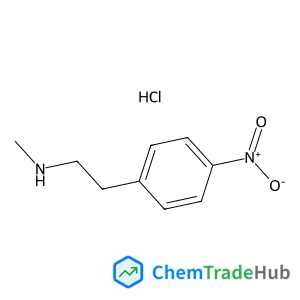
N-Methyl-2-(4-nitrophenyl)ethanamine hydrochloride (1:1)
CAS Number:
166943-39-1
Molecular Formula:
C9H13ClN2O2
Martin Bröring, Christian Hell, Carsten D. Brandt
The first compound with a MnIV–I bond has successfully been prepared by oxidation of a manganese(III) corrole with molecular iodine and was structurally characterized by X-ray diffraction.
Jiajia Zhang, Lei Yang, Yu Zhong, Hequn Hao, Mei Yang, Renyong Liu
DOI: 10.1039/C9CP01211G
Di Wang, Fusheng Yang, Zhen Wu, Le Wu, Zaoxiao Zhang
DOI: 10.1039/C9CP01467E
José I. Martínez, Julio A. Alonso
DOI: 10.1039/C9CP01114E
Reggie L. Hudson
DOI: 10.1039/C9CP01709G
G. Nawn, G. Pace, J. W. Park, R. Wycisk, G. Cavinato, P. N. Pintauro
DOI: 10.1039/C9CP01891C
Jun Chai, Chen Ming, Xiaolong Du, Pengfei Qiu, Yi-Yang Sun, Lidong Chen
DOI: 10.1039/C9CP00755E
Azeem Banday, Mahboob Ali, Raghvendra Pandey, Sevi Murugavel
DOI: 10.1039/C9CP00408D
Chongguang Zhao, Chen Li
DOI: 10.1039/C9CP01243E
Xiaohui Sun, Wengang Zong, Jingbo Wang, Zerong Li, Xiangyuan Li
DOI: 10.1039/C9CP01207A
When handling 2-Chloro-1,2-bis(4-methylphenyl)ethanone (CAS: 71193-32-3), it is ...
4-Ethoxy-3-(5-methyl-4-oxo-7-propyl-1,4-dihydroimidazo[5,1-f][1,2,4]triazin-2-yl...
Methyl 3-Oxo-4-Androsten-17-Carboxylate (CAS: 2681-55-2) should be stored in a c...
(R)-3-Amino-4-(3-hexylphenylamino)-4-oxobutylphosphonic acid is primarily used i...
2-Methyl-2-propanyl 3-amino-3-carbamoyl-1-azetidinecarboxylate (CAS: 1254120-14-...
There are alternative reagents that can be used in synthesis instead of (E)-4-(t...
[2-(3-Chlorophenyl)-1,3-thiazol-4-yl]methanol (CAS: 121202-20-8) is a crystallin...
The market and research trends for Methyl (2S)-[(4S)-2,2-dimethyl-1,3-dioxolan-4...
The market for 1-Bromo-2-isocyanatoethane (CAS: 42865-19-0) is driven by its use...
4-Nitro-D-phenylalanine hydrochloride (CAS: 147065-06-3) is primarily used in re...

ChemComm publishes urgent research which is of outstanding significance and interest to experts in the field, while also appealing to the journal’s broad chemistry readership. Our communication format is ideally suited to short, urgent studies that are of such importance that they require accelerated publication. Our scope covers all topics in chemistry, and research at the interface of chemistry and other disciplines (such as materials science, nanoscience, physics, engineering and biology) where there is a significant novelty in the chemistry aspects. Major topic areas covered include: Analytical Chemistry Catalysis Chemical Biology and medicinal chemistry Computational Chemistry and Machine Learning Energy and sustainable chemistry Environmental Chemistry Green Chemistry Inorganic Chemistry Materials Chemistry Nanoscience Organic Chemistry Physical Chemistry Polymer Chemistry Supramolecular Chemistry