












Combination between lacunary polyoxometalates and high-nuclear transition metal clusters under hydrothermal conditions: I. from isolated cluster to 1-D chain
Literature Information
Publication Date
2007-02-15
DOI
10.1039/B617191E
Impact Factor
6.222
Authors
Shou-Tian Zheng, Da-Qiang Yuan, Hong-Peng Jia, Jie Zhang
View Original
Abstract
The hydrothermal reactions of [A-α-SiW9O34]10−/[A-α-PW9O34]9− with NiCl2·6H2O and amines yielded four unprecedented hybrid high-nuclear Ni-subsituted polyoxotungstates.
Related Literature
Visible light-induced nuclease activity of a ternary mono-phenanthroline copper(ii) complex containing l-methionine as a photosensitizer
Ashis K. Patra, Shanta Dhar, Munirathinam Nethaji, Akhil R. Chakravarty
2003-06-03
Communication
DOI: 10.1039/B303442A
The multiphoton photochemistry of 2-iodooctane in methanol
Fang Gao, Robert N. Compton, Richard M. Pagni
2003-06-03
Communication
DOI: 10.1039/B302814N
Room-temperature heterogeneous hydroxylation of phenol with hydrogen peroxide over Fe2+, Co2+ ion-exchanged Naβ zeolite
Jung-Nam Park, Chul Wee Lee
2003-02-06
Communication
DOI: 10.1039/B212296K
Migratory insertion in N-heterocyclic carbene complexes of palladium; an experimental and DFT study
Andreas A. Danopoulos, Nikolaos Tsoureas, Jennifer C. Green, Michael B. Hursthouse
2003-02-24
Communication
DOI: 10.1039/B212453J
An unprecedented trans-oriented product from the cleavage of a dipeptide
Manas K. Saha, Ivan Bernal
2003-02-05
Communication
DOI: 10.1039/B212587K
Formation of surface-grafted copolymer brushes with continuous composition gradients
Michael R. Tomlinson, Jan Genzer
2003-05-16
Communication
DOI: 10.1039/B303823H
Anchor chain length alters the apparent mechanism of chloride channel function in SCMTR derivatives
Paul H. Schlesinger, Natasha K. Djedovič, Riccardo Ferdani, Jolanta Pajewska, Robert Pajewski, George W. Gokel
2003-01-06
Communication
DOI: 10.1039/B211629B
Sub-Tcelectron transfer at the HTSC/polymer interface
Nicolas Le-Poul, Stephen J. Green, J. Paul Attfield
2003-02-07
Communication
DOI: 10.1039/B300023K
Hydrogen bonded molecular assembly by reversible cyclization reaction of anthracene
Masashi Ikegami, Ikuma Ohshiro, Tatsuo Arai
2003-06-03
Communication
DOI: 10.1039/B304034H
New insight into a convenient base-promoted synthesis of Ru3(CO)12
Matthieu Fauré, Catherine Saccavini, Guy Lavigne
2003-06-03
Communication
DOI: 10.1039/B303884J
You might also like
Compound Q&A
What are the main uses of (3.beta.)-3-Hydroxy-N,N-dimethyl-chol-5-en-24-amide (CAS: 79066-03-8)?
(3.beta.)-3-Hydroxy-N,N-dimethyl-chol-5-en-24-amide (CAS: 79066-03-8) is primari...
79066-03-8(3.beta.)-3-Hydroxy-...
Compound Q&A
What regulatory guidelines apply to 5-(aminomethyl)-2-methoxyphenol (CAS: 89702-89-6)?
5-(Aminomethyl)-2-methoxyphenol (CAS: 89702-89-6) is classified under GHS as a s...
89702-89-65-(aminomethyl)-2-me...
Compound Q&A
What is Thieno[2,3-c]pyridin-7(6H)-one (CAS: 28981-13-7)?
Thieno[2,3-c]pyridin-7(6H)-one (CAS: 28981-13-7) is a heterocyclic organic compo...
28981-13-7Thieno[2,3-c]pyridin...
Compound Q&A
Is 1-[(6-Methoxy-3-pyridinyl)methyl]-4-piperidinamine dihydrochloride (CAS: 1185311-28-7) safe?
1-[(6-Methoxy-3-pyridinyl)methyl]-4-piperidinamine dihydrochloride is generally ...
1185311-28-71-[(6-Methoxy-3-pyri...
Compound Q&A
What regulatory guidelines apply to [(2E)-3-Phenyl-2-propen-1-yl]phosphonic acid (CAS: 146404-58-2)?
[(2E)-3-Phenyl-2-propen-1-yl]phosphonic acid (CAS: 146404-58-2) is regulated und...
146404-58-2[(2E)-3-Phenyl-2-pro...
Compound Q&A
What regulatory guidelines apply to 6-Bromo-7-methoxyquinoline (CAS: 1620515-86-7)?
6-Bromo-7-methoxyquinoline (CAS: 1620515-86-7) falls under the scope of the Glob...
1620515-86-76-Bromo-7-methoxyqui...
Compound Q&A
What industries use (2R)-1-(1-Benzofuran-2-yl)-N-propyl-2-pentanamine (CAS: 260550-89-8)?
This compound is primarily used in the pharmaceutical industry for the developme...
260550-89-8(2R)-1-(1-Benzofuran...
Compound Q&A
What are the main uses of 1-Ethyl-7-[2-methyl-6-(4H-1,2,4-triazol-3-yl)-3-pyridinyl]-3,5-dihydropyrazino[2,3-b]pyrazin-2(1H)-one (CAS: 1228013-15-7)?
1-Ethyl-7-[2-methyl-6-(4H-1,2,4-triazol-3-yl)-3-pyridinyl]-3,5-dihydropyrazino[2...
1228013-15-71-Ethyl-7-[2-methyl-...
Compound Q&A
Are there alternatives to {5-(Acryloylamino)-2-[(dimethylamino)methyl]phenyl}boronic acid (CAS: 1217500-78-1) in synthesis?
Alternative reagents such as 2-[(dimethylamino)methyl]phenylboronic acid or rela...
1217500-78-1{5-(Acryloylamino)-2...
Compound Q&A
What is 3-(Piperidin-4-yloxy)pyridine (CAS: 310881-48-2)?
3-(Piperidin-4-yloxy)pyridine (CAS: 310881-48-2) is an organic compound with the...
310881-48-23-(Piperidin-4-yloxy...
Source Journal
Chemical Communications

CiteScore:
8.6
Self-citation Rate:
4.7%
Articles per Year:
2458
ChemComm publishes urgent research which is of outstanding significance and interest to experts in the field, while also appealing to the journal’s broad chemistry readership. Our communication format is ideally suited to short, urgent studies that are of such importance that they require accelerated publication. Our scope covers all topics in chemistry, and research at the interface of chemistry and other disciplines (such as materials science, nanoscience, physics, engineering and biology) where there is a significant novelty in the chemistry aspects. Major topic areas covered include: Analytical Chemistry Catalysis Chemical Biology and medicinal chemistry Computational Chemistry and Machine Learning Energy and sustainable chemistry Environmental Chemistry Green Chemistry Inorganic Chemistry Materials Chemistry Nanoscience Organic Chemistry Physical Chemistry Polymer Chemistry Supramolecular Chemistry
Recommended Compounds
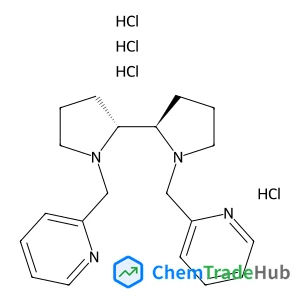
(2R,2'R)-1,1'-Bis(2-pyridinylmethyl)-2,2'-bipyrrolidine tetrahydrochloride
CAS Number:
1228077-88-0
Molecular Formula:
C20H30Cl4N4
Recommended Suppliers






Disclaimer
This page provides academic journal information for reference and research purposes only. We are not affiliated with any journal publishers and do not handle publication submissions. For publication-related inquiries, please contact the respective journal publishers directly.
If you notice any inaccuracies in the information displayed, please contact us at support@chemtradehub.com. We will promptly review and address your concerns.