













Fabrication of polyimide nanotubes and carbon nanotubes containing magnetic iron oxide in confinement
Literature Information
Publication Date
2005-06-23
DOI
10.1039/B503831F
Impact Factor
6.222
Authors
Jyongsik Jang, Kyung Jin Lee, Younggeun Kim
View Original
Abstract
Polyimide nanotubes with tunable wall thickness were fabricated by a precursor impregnation method using an AAO template, and carbon nanotubes containing magnetic iron oxide were obtained using ferric chloride-embedded polyimide precursor by a carbonization process.
Related Literature
Aromatic C–H bond cleavage by using a Cu(i) ate-complex
Guanghui Zhang, Hong Yi, Jie Xin, Yi Deng, Ruopeng Bai, Zhiliang Huang, A. Jeremy Kropf, Emilio E. Bunel, Xiaotian Qi, Yu Lan
2016-06-13
Research Article
DOI: 10.1039/C6QO00201C
Correction: Light-driven highly efficient glycosylation reactions
Run-Ze Mao, De-Cai Xiong, Qin Li, Jinyou Duan, Xin-Shan Ye
2016-05-09
Correction
DOI: 10.1039/C6QO90020H
Rh(iii)-catalyzed redox-neutral annulation of azo and diazo compounds: one-step access to cinnolines
Peng Sun, Youzhi Wu, Yue Huang, Xiaoming Wu, Jinyi Xu, Hequan Yao, Aijun Lin
2015-11-26
Research Article
DOI: 10.1039/C5QO00331H
Triphenylphosphine promoted regio and stereoselective α-halogenation of ynamides‡
B. Prabagar, Sanatan Nayak, Rajendra K. Mallick, Rangu Prasad, Akhila K. Sahoo
2015-11-30
Research Article
DOI: 10.1039/C5QO00345H
A quantum mechanical study of the mechanism and stereoselectivity of the N-heterocyclic carbene catalyzed [4 + 2] annulation reaction of enals with azodicarboxylates
Yang Wang, Linjie Zheng, Donghui Wei, Mingsheng Tang
2015-05-06
Research Article
DOI: 10.1039/C5QO00121H
Straightforward regioselective construction of 3,4-dihydro-2H-1,4-thiazine by rhodium catalysed [3 + 3] cycloaddition of thiirane with 1-sulfonyl-1,2,3-triazole: a pronounced acid additive effect
Xiao-Long Lu, Ya-Ting Liu, Qing-Xia Wang, Mei-Hua Shen, Hua-Dong Xu
2016-03-31
Research Article
DOI: 10.1039/C6QO00084C
Correction: Transition metal-catalyzed direct remote C–H functionalization of alkyl groups via C(sp3)–H bond activation
Guanyinsheng Qiu
2015-05-06
Correction
DOI: 10.1039/C5QO90023A
You might also like
Compound Q&A
How should waste containing N-Methoxy-N-methyl-1,3-thiazole-5-carboxamide (CAS: 898825-89-3) be handled?
Waste containing N-Methoxy-N-methyl-1,3-thiazole-5-carboxamide (CAS: 898825-89-3...
898825-89-3N-Methoxy-N-methyl-1...
Compound Q&A
How should N-(4-Biphenylyl)dibenzo[b,d]furan-4-amine (CAS: 1318338-47-4) be stored?
N-(4-Biphenylyl)dibenzo[b,d]furan-4-amine should be stored in a tightly sealed c...
1318338-47-4N-(4-Biphenylyl)dibe...
Compound Q&A
What is the market or research trend for 3-Acetamido-5-amino-2,4,6-triiodobenzoic acid (CAS: 1713-07-1)?
The market for 3-Acetamido-5-amino-2,4,6-triiodobenzoic acid (CAS: 1713-07-1) is...
1713-07-13-Acetamido-5-amino-...
Compound Q&A
How should Benzyl 2-O-acetyl-3,4,6-tri-O-benzyl-beta-D-galactopyranoside (CAS: 61820-03-9) be stored?
Benzyl 2-O-acetyl-3,4,6-tri-O-benzyl-beta-D-galactopyranoside (CAS: 61820-03-9) ...
61820-03-9Benzyl 2-O-acetyl-3,...
Compound Q&A
What regulatory guidelines apply to 2-Ethylpiperazine dihydrochloride (CAS: 438050-52-3)?
2-Ethylpiperazine dihydrochloride (CAS: 438050-52-3) is regulated under the Glob...
438050-52-32-Ethylpiperazine di...
Compound Q&A
What regulatory guidelines apply to 1,1'-[1,3-Phenylenebis(methylene)]bis(3-methyl-1H-pyrrole-2,5-dione) (CAS: 119462-56-5)?
1,1'-[1,3-Phenylenebis(methylene)]bis(3-methyl-1H-pyrrole-2,5-dione) (CAS: 11946...
119462-56-51,1'-[1,3-Phenyleneb...
Compound Q&A
Are there alternatives to 5-Fluoro-2-(1-pyrrolidinyl)pyridine (CAS: 1287217-79-1) in synthesis?
Several alternatives can be used in the synthesis of 5-Fluoro-2-(1-pyrrolidinyl)...
1287217-79-15-Fluoro-2-(1-pyrrol...
Compound Q&A
What precautions should be taken when handling 1-((2R,3R,4R,5R)-5-((bis(4-methoxyphenyl)(phenyl)methoxy)methyl)-4-hydroxy-3-methoxytetrahydrofuran-2-yl)-5-methylpyrimidine-2,4(1H,3H)-dione (CAS: 153631-19-7)?
Proper personal protective equipment (PPE) must be worn when handling this compo...
153631-19-71-((2R,3R,4R,5R)-5-(...
Compound Q&A
What precautions should be taken when handling 6-Bromoimidazo[1,2-a]pyridin-8-amine (CAS: 676371-00-9)?
When handling 6-Bromoimidazo[1,2-a]pyridin-8-amine, it is important to wear appr...
676371-00-96-Bromoimidazo[1,2-a...
Compound Q&A
Are there alternatives to (2S,4R)-4-(4-Nitrobenzyl)pyrrolidine-2-carboxylic acid hydrochloride (CAS: 1049740-22-8) in synthesis?
Alternatives to (2S,4R)-4-(4-Nitrobenzyl)pyrrolidine-2-carboxylic acid hydrochlo...
1049740-22-8(2S,4R)-4-(4-Nitrobe...
Source Journal
Chemical Communications

CiteScore:
8.6
Self-citation Rate:
4.7%
Articles per Year:
2458
ChemComm publishes urgent research which is of outstanding significance and interest to experts in the field, while also appealing to the journal’s broad chemistry readership. Our communication format is ideally suited to short, urgent studies that are of such importance that they require accelerated publication. Our scope covers all topics in chemistry, and research at the interface of chemistry and other disciplines (such as materials science, nanoscience, physics, engineering and biology) where there is a significant novelty in the chemistry aspects. Major topic areas covered include: Analytical Chemistry Catalysis Chemical Biology and medicinal chemistry Computational Chemistry and Machine Learning Energy and sustainable chemistry Environmental Chemistry Green Chemistry Inorganic Chemistry Materials Chemistry Nanoscience Organic Chemistry Physical Chemistry Polymer Chemistry Supramolecular Chemistry
Recommended Compounds


4-(Dimethylaminomethyl)phenylacetic acid hydrochloride
CAS Number:
99985-52-1
Molecular Formula:
C11H16ClNO2
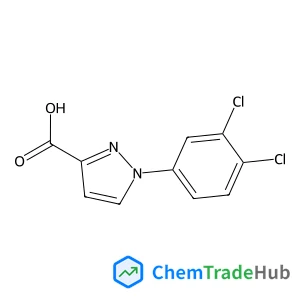
1-(3,4-Dichlorophenyl)-1H-pyrazole-3-carboxylic acid
CAS Number:
1152949-12-6
Molecular Formula:
C10H6Cl2N2O2

Recommended Suppliers






Disclaimer
This page provides academic journal information for reference and research purposes only. We are not affiliated with any journal publishers and do not handle publication submissions. For publication-related inquiries, please contact the respective journal publishers directly.
If you notice any inaccuracies in the information displayed, please contact us at support@chemtradehub.com. We will promptly review and address your concerns.