


Development of an integrated optic oxygen sensor using a novel, generic platform
Literature Information
Publication Date
2004-11-12
DOI
10.1039/B409814P
Impact Factor
4.616
Authors
Conor S. Burke, Orla McGaughey, Jean-Marc Sabattié, Henry Barry, Aisling K. McEvoy, Colette McDonagh, Brian D. MacCraith
View Original
Abstract
This paper describes the development of a generic platform for enhanced, integrated optic sensors based on fluorescence detection. The platform employs a novel optical configuration in order to achieve enhanced performance and has inherent multianalyte detection capability. The sensor element comprises a multimode ridge waveguide that has been patterned with an analyte-sensitive fluorescent spot, which is excited directly using a LED. The platform was applied to the detection of gaseous oxygen as a proof of principle. The sol–gel-derived sensor spots were doped with an oxygen-sensitive fluorescent dichlororuthenium dye complex and intensity-based calibration data were generated from the oxygen-dependent waveguide output. The sensor achieved a LOD of 0.62% and a resolution of less than 0.96% gaseous oxygen, which compares favourably with a similar, recently reported system. This device highlights the combination of inexpensive rapid prototyping techniques and a dedicated sensor enhancement strategy that together facilitate the production of an effective prototype sensor platform.
Recommended Journals

Journal of Medicinal Chemistry

Russian Chemical Reviews

Science

Molecular Pharmacology

Pharmacological Reviews

Kinetics and Catalysis

European Journal of Wood and Wood Products

Organic Preparations and Procedures International

Journal of Heterocyclic Chemistry

Proceedings of the National Academy of Sciences of the United States of America
Related Literature
Synthesis of branched Pd nanocrystals with tunable structures, their growth mechanism, and enhanced electrocatalytic properties
Xueli Guo, Yiwei Tan
2015-10-26
Paper
DOI: 10.1039/C5CP05531H
Zigzag-edge related ferromagnetism in MoSe2 nanoflakes
Baorui Xia, Daqiang Gao, Peitao Liu, Yonggang Liu, Shoupeng Shi, Kun Tao
2015-11-11
Paper
DOI: 10.1039/C5CP05640C
ZnO modified ZSM-5 and Y zeolites fabricated by atomic layer deposition for propane conversion
Ting Gong, Lijun Qin, Jian Lu, Hao Feng
2015-11-20
Paper
DOI: 10.1039/C5CP05043J
The fabrication of In2O3/In2S3/Ag nanocubes for efficient photoelectrochemical water splitting
Rui Xu, Haohua Li, Wenwen Zhang, Zepeng Yang, Guiwu Liu, Ziwei Xu, Haicheng Shao
2015-12-17
Paper
DOI: 10.1039/C5CP05833C
Variable electronic properties of lateral phosphorene–graphene heterostructures
Xiaoqing Tian, Lin Liu, Yu Du, Juan Gu, Jian-bin Xu, Boris I. Yakobson
2015-11-06
Paper
DOI: 10.1039/C5CP05443E
Synergistic effect of novel redox additives of p-nitroaniline and dimethylglyoxime for highly improving the supercapacitor performances
Yong Fu Nie, Qian Wang, Xiang Ying Chen, Zhong Jie Zhang
2015-12-21
Paper
DOI: 10.1039/C5CP06147D
Theoretical analysis of NMR shieldings in XSe and XTe (X = Si, Ge, Sn and Pb): the spin-rotation constant saga
2015-12-21
Paper
DOI: 10.1039/C5CP07025B
Defect chemistry and lithium transport in Li3OCl anti-perovskite superionic conductors
Chi Chen, Zarah Medina Baiyee, Xin Chen, Chunming Niu
2015-10-28
Paper
DOI: 10.1039/C5CP05722A
An economic prediction of the finer resolution level wavelet coefficients in electronic structure calculations
Szilvia Nagy, János Pipek
2015-06-26
Paper
DOI: 10.1039/C5CP01214G
You might also like
Compound Q&A
What are the main uses of 1H-Indazole-6-carbonitrile (CAS: 141290-59-7)?
1H-Indazole-6-carbonitrile finds applications in pharmaceuticals, where it serve...
141290-59-71H-Indazole-6-carbon...
Compound Q&A
How should waste containing Dioctyl (2E)-2-butenedioate (CAS: 2997-85-5) be handled?
Waste containing Dioctyl (2E)-2-butenedioate (CAS: 2997-85-5) should be collecte...
2997-85-5Dioctyl (2E)-2-buten...
Compound Q&A
What industries use Sodium [(1,2-benzoxazol-3-ylmethyl)sulfonyl]azanide (CAS: 68291-98-5)?
Sodium [(1,2-benzoxazol-3-ylmethyl)sulfonyl]azanide is primarily used in pharmac...
68291-98-5Sodium [(1,2-benzoxa...
Compound Q&A
Are there alternatives to Dimethyl 4-(4,4,5,5-tetramethyl-1,3,2-dioxaborolan-2-yl)-2,6-pyridinedicarboxylate (CAS: 741709-66-0) in synthesis?
Dimethyl 4-(4,4,5,5-tetramethyl-1,3,2-dioxaborolan-2-yl)-2,6-pyridinedicarboxyla...
741709-66-0Dimethyl 4-(4,4,5,5-...
Compound Q&A
How should waste containing 2-Fluoro-6-hydrazinopyridine (CAS: 80714-39-2) be handled?
Waste containing 2-Fluoro-6-hydrazinopyridine (CAS: 80714-39-2) should be manage...
80714-39-22-Fluoro-6-hydrazino...
Compound Q&A
What is 6-Formyl-2-pyridinecarboxylic acid (CAS: 499214-11-8)?
6-Formyl-2-pyridinecarboxylic acid is an organic compound with the molecular for...
499214-11-86-Formyl-2-pyridinec...
Compound Q&A
What is the market or research trend for 3-(3,4-dimethoxyphenyl)-2,5-dimethyl-N-(2-morpholin-4-ylethyl)pyrazolo[1,5-a]pyrimidin-7-amine (CAS: 900874-91-1)?
Research trends for this compound indicate a focus on its potential applications...
900874-91-13-(3,4-dimethoxyphen...
Compound Q&A
How is 9H-Tribenzo[b,d,f]azepine (CAS: 29875-73-8) typically synthesized?
9H-Tribenzo[b,d,f]azepine is typically synthesized via a multi-step process invo...
29875-73-89H-Tribenzo[b,d,f]az...
Compound Q&A
How is 1-Cyclopropyl-7-ethoxy-6-fluoro-8-methoxy-4-oxo-1,4-dihydro-3-quinolinecarboxylic acid (CAS: 1797982-51-4) typically synthesized?
1-Cyclopropyl-7-ethoxy-6-fluoro-8-methoxy-4-oxo-1,4-dihydro-3-quinolinecarboxyli...
1797982-51-41-Cyclopropyl-7-etho...
Compound Q&A
How should waste containing Methyl 3-oxo-1,2,3,4-tetrahydro-6-quinoxalinecarboxylate (CAS: 671820-52-3) be handled?
Waste containing Methyl 3-oxo-1,2,3,4-tetrahydro-6-quinoxalinecarboxylate (CAS: ...
671820-52-3Methyl 3-oxo-1,2,3,4...
Source Journal
Analyst

CiteScore:
7.8
Self-citation Rate:
5.6%
Articles per Year:
653
Analyst publishes analytical and bioanalytical research that reports premier fundamental discoveries and inventions, and the applications of those discoveries, unconfined by traditional discipline barriers.
Recommended Compounds
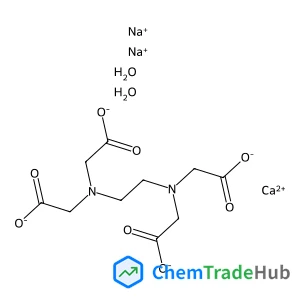
EthylenediaminetetraaceticacidcalciumDisodiumsalthydrate
CAS Number:
23411-34-9
Molecular Formula:
C10H16CaN2Na2O10
![N-[(9H-Fluoren-9-ylmethoxy)carbonyl]serine structure](https://static.chemtradehub.com/structs/737/73724-45-5-b0dc.webp "N-[(9H-Fluoren-9-ylmethoxy)carbonyl]serine structure")

Recommended Suppliers




Disclaimer
This page provides academic journal information for reference and research purposes only. We are not affiliated with any journal publishers and do not handle publication submissions. For publication-related inquiries, please contact the respective journal publishers directly.
If you notice any inaccuracies in the information displayed, please contact us at support@chemtradehub.com. We will promptly review and address your concerns.