













Comparison of diffuse-reflectance absorbance and attenuated total reflectance FT-IR for the discrimination of bacteria
Literature Information
Publication Date
2004-10-04
DOI
10.1039/B408169B
Impact Factor
4.616
Authors
Catherine L. Winder, Royston Goodacre
View Original
Abstract
A collection of bacteria belonging to the genus Bacillus were analysed by diffuse reflectance absorbance and attenuated total reflectance Fourier transform infrared (FT-IR) spectroscopy in the mid-infrared. The diffuse reflectance absorbance method is a rapid whole organism fingerprinting method, which generates a biochemical profile of the bacteria, where samples are presented to the FT-IR spectrometer dried on a metal carrier. The attenuated total reflectance FT-IR used in conjunction with a diamond attenuated total reflectance (ATR) accessory produces a biochemical profile of the surface chemistry of bacteria directly without the need for drying, and has not previously been used in the discrimination of bacteria. Principal component, discriminant function and hierarchical cluster analysis were performed on the data to discriminate the bacteria. The differentiation of the bacteria to species level was observed in both analyses however, it was concluded that the ATR FT-IR illustrated better sub-species differentiation of the microorganisms. This may imply that the total biochemical profiling infers discrimination to species level whereas strain specific markers are present on the cell surface chemistry.
Related Literature
Phase transition behaviors of the supported DPPC bilayer investigated by sum frequency generation (SFG) vibrational spectroscopy and atomic force microscopy (AFM)
Heng-Liang Wu, Yujin Tong, Qiling Peng, Na Li, Shen Ye
2015-10-02
Paper
DOI: 10.1039/C5CP04960A
Deviation of polarity from linearity in liquid mixtures containing an ionic liquid
Vijay Beniwal, Shashi K. Shukla, Anil Kumar
2015-11-04
Communication
DOI: 10.1039/C5CP05921F
Ultrafast excited state hydrogen atom transfer in salicylideneaniline driven by changes in aromaticity
Luis Gutiérrez-Arzaluz, Fernando Cortés-Guzmán, Tomás Rocha-Rinza, Jorge Peón
2015-08-06
Communication
DOI: 10.1039/C5CP03699B
Synergistic effect of novel redox additives of p-nitroaniline and dimethylglyoxime for highly improving the supercapacitor performances
Yong Fu Nie, Qian Wang, Xiang Ying Chen, Zhong Jie Zhang
2015-12-21
Paper
DOI: 10.1039/C5CP06147D
Revealing photofragmentation dynamics through interactions between Rydberg states: REMPI of HI as a case study
Helgi Rafn Hróðmarsson, Ágúst Kvaran
2015-11-11
Paper
DOI: 10.1039/C5CP06185G
Hydrogen-bonding and vibrational coupling of water in a hydrophobic hydration shell as observed by Raman-MCR and isotopic dilution spectroscopy
Mohammed Ahmed, Ajay K. Singh, Jahur A. Mondal
2015-12-18
Paper
DOI: 10.1039/C5CP07014G
Theoretical study of the coordination behavior of formate and formamidoximate with dioxovanadium(v) cation: implications for selectivity towards uranyl
Nada Mehio, J. Casey Johnson, Vyacheslav S. Bryantsev
2015-10-28
Paper
DOI: 10.1039/C5CP06165B
A zero dimensional model of lithium–sulfur batteries during charge and discharge
Monica Marinescu, Teng Zhang, Gregory J. Offer
2015-11-12
Paper
DOI: 10.1039/C5CP05755H
Carbon monoxide oxidation catalysed by defective palladium chloride: DFT calculations, EXAFS, and in situ DRIRS measurements
Qiaohong Li, Luyang Qiao, Ruiping Chen, Zuju Ma, Rui Si, Yuangen Yao, Kechen Wu
2015-12-15
Paper
DOI: 10.1039/C5CP07309J
You might also like
Compound Q&A
What are the main uses of 1H-Indazole-6-carbonitrile (CAS: 141290-59-7)?
1H-Indazole-6-carbonitrile finds applications in pharmaceuticals, where it serve...
141290-59-71H-Indazole-6-carbon...
Compound Q&A
How should waste containing Dioctyl (2E)-2-butenedioate (CAS: 2997-85-5) be handled?
Waste containing Dioctyl (2E)-2-butenedioate (CAS: 2997-85-5) should be collecte...
2997-85-5Dioctyl (2E)-2-buten...
Compound Q&A
What industries use Sodium [(1,2-benzoxazol-3-ylmethyl)sulfonyl]azanide (CAS: 68291-98-5)?
Sodium [(1,2-benzoxazol-3-ylmethyl)sulfonyl]azanide is primarily used in pharmac...
68291-98-5Sodium [(1,2-benzoxa...
Compound Q&A
Are there alternatives to Dimethyl 4-(4,4,5,5-tetramethyl-1,3,2-dioxaborolan-2-yl)-2,6-pyridinedicarboxylate (CAS: 741709-66-0) in synthesis?
Dimethyl 4-(4,4,5,5-tetramethyl-1,3,2-dioxaborolan-2-yl)-2,6-pyridinedicarboxyla...
741709-66-0Dimethyl 4-(4,4,5,5-...
Compound Q&A
How should waste containing 2-Fluoro-6-hydrazinopyridine (CAS: 80714-39-2) be handled?
Waste containing 2-Fluoro-6-hydrazinopyridine (CAS: 80714-39-2) should be manage...
80714-39-22-Fluoro-6-hydrazino...
Compound Q&A
What is 6-Formyl-2-pyridinecarboxylic acid (CAS: 499214-11-8)?
6-Formyl-2-pyridinecarboxylic acid is an organic compound with the molecular for...
499214-11-86-Formyl-2-pyridinec...
Compound Q&A
What is the market or research trend for 3-(3,4-dimethoxyphenyl)-2,5-dimethyl-N-(2-morpholin-4-ylethyl)pyrazolo[1,5-a]pyrimidin-7-amine (CAS: 900874-91-1)?
Research trends for this compound indicate a focus on its potential applications...
900874-91-13-(3,4-dimethoxyphen...
Compound Q&A
How is 9H-Tribenzo[b,d,f]azepine (CAS: 29875-73-8) typically synthesized?
9H-Tribenzo[b,d,f]azepine is typically synthesized via a multi-step process invo...
29875-73-89H-Tribenzo[b,d,f]az...
Compound Q&A
How is 1-Cyclopropyl-7-ethoxy-6-fluoro-8-methoxy-4-oxo-1,4-dihydro-3-quinolinecarboxylic acid (CAS: 1797982-51-4) typically synthesized?
1-Cyclopropyl-7-ethoxy-6-fluoro-8-methoxy-4-oxo-1,4-dihydro-3-quinolinecarboxyli...
1797982-51-41-Cyclopropyl-7-etho...
Compound Q&A
How should waste containing Methyl 3-oxo-1,2,3,4-tetrahydro-6-quinoxalinecarboxylate (CAS: 671820-52-3) be handled?
Waste containing Methyl 3-oxo-1,2,3,4-tetrahydro-6-quinoxalinecarboxylate (CAS: ...
671820-52-3Methyl 3-oxo-1,2,3,4...
Source Journal
Analyst

CiteScore:
7.8
Self-citation Rate:
5.6%
Articles per Year:
653
Analyst publishes analytical and bioanalytical research that reports premier fundamental discoveries and inventions, and the applications of those discoveries, unconfined by traditional discipline barriers.
Recommended Compounds
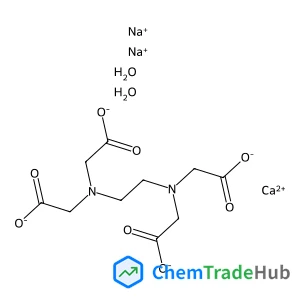
EthylenediaminetetraaceticacidcalciumDisodiumsalthydrate
CAS Number:
23411-34-9
Molecular Formula:
C10H16CaN2Na2O10
Recommended Suppliers




Disclaimer
This page provides academic journal information for reference and research purposes only. We are not affiliated with any journal publishers and do not handle publication submissions. For publication-related inquiries, please contact the respective journal publishers directly.
If you notice any inaccuracies in the information displayed, please contact us at support@chemtradehub.com. We will promptly review and address your concerns.