













Diagnosis of used engine oil based on gas phase analysis
Literature Information
Publication Date
2004-08-26
DOI
10.1039/B406619G
Impact Factor
4.616
Authors
Kelly Sepcic, Mira Josowicz, Jiri Janata, Ted Selby
View Original
Abstract
A method for determination of the volatile compounds present in new and used petroleum oils was developed. The identification of the new and used oils was based on the abundance of volatile compounds in headspace above the oils. Multivariate analysis based on principal component analysis (PCA), and hierarchal cluster analysis was used to evaluate the degradation compounds found in used engine oil. The gas phase of new and used petroleum oils was analyzed using a time of flight mass spectrometer (TOF MS) and sensor arrays. The samples included used engine oil, up to 35,500 miles. The principal components identified by PCA were volatile constituents of the oils. New and used oils were also differentiated using multivariate analysis of the results from these gas phase detection methods. The identification of the origin of volatile samples in the used oils has been studied by spiking newer oil samples with a complex mixture of volatile compounds. These samples were then analyzed with the sensor array. Results from the spiked samples correlated better with the older, more used oil samples, confirming that the previously identified volatile compounds can be used to classify new and used engine oils. Using chemometrics, the used oils were differentiated into categories using metal oxide semiconductor (MOS) and quartz crystal microbalance (QCM) sensor arrays or mass spectrometry. The QCM sensors were able to better differentiate the new and used oil samples compared to the metal oxides. In the mass spectrometry and sensor array analysis the new oils were clustered into groups and separated by mileages. The older, more used oils were clearly distinguished from the newer oils.
Related Literature
Relationship between vesicle size and steric hindrance influences vesicle rupture on solid supports
2015-12-15
Paper
DOI: 10.1039/C5CP06786C
Reducing the V2O3(0001) surface through electron bombardment – a quantitative structure determination with I/V-LEED
Felix E. Feiten, Helmut Kuhlenbeck, Hans-Joachim Freund
2015-12-22
Paper
DOI: 10.1039/C5CP07390A
A zero dimensional model of lithium–sulfur batteries during charge and discharge
Monica Marinescu, Teng Zhang, Gregory J. Offer
2015-11-12
Paper
DOI: 10.1039/C5CP05755H
From cellulose fibrils to single chains: understanding cellulose dissolution in ionic liquids
Xueming Yuan, Gang Cheng
2015-11-05
Perspective
DOI: 10.1039/C5CP05744B
Real-space numerical grid methods in quantum chemistry
Luca Frediani, Dage Sundholm
2015-11-03
Editorial
DOI: 10.1039/C5CP90198G
The fabrication of In2O3/In2S3/Ag nanocubes for efficient photoelectrochemical water splitting
Rui Xu, Haohua Li, Wenwen Zhang, Zepeng Yang, Guiwu Liu, Ziwei Xu, Haicheng Shao
2015-12-17
Paper
DOI: 10.1039/C5CP05833C
Ullmann coupling mediated assembly of an electrically driven altitudinal molecular rotor
Colin J. Murphy, Zachary C. Smith, Alex Pronschinski, Emily A. Lewis, Melissa L. Liriano, Chloe Wong, Christopher J. Ivimey, Mitchell Duffy, Wojciech Musial, Andrew J. Therrien, Samuel W. Thomas III, E. Charles H. Sykes
2015-11-03
Paper
DOI: 10.1039/C5CP05294G
Theoretical study on the dehydrogenation reaction of dihydrogen bonded phenol–borane-trimethylamine in the excited state
Yonggang Yang, Yufang Liu, Dapeng Yang, Hui Li, Kai Jiang, Jinfeng Sun
2015-08-12
Paper
DOI: 10.1039/C5CP02530C
Strain tuning of the charge density wave in monolayer and bilayer 1T-TaS2
Li-Yong Gan, Li-Hong Zhang, Qingyun Zhang, Chun-Sheng Guo, Udo Schwingenschlögl
2015-12-07
Paper
DOI: 10.1039/C5CP05695K
A new look at oxide formation at the copper/electrolyte interface by in situ spectroscopies
Cigdem Toparli, Adnan Sarfraz, Andreas Erbe
2015-11-02
Paper
DOI: 10.1039/C5CP05172J
You might also like
Compound Q&A
What are the main uses of 1H-Indazole-6-carbonitrile (CAS: 141290-59-7)?
1H-Indazole-6-carbonitrile finds applications in pharmaceuticals, where it serve...
141290-59-71H-Indazole-6-carbon...
Compound Q&A
How should waste containing Dioctyl (2E)-2-butenedioate (CAS: 2997-85-5) be handled?
Waste containing Dioctyl (2E)-2-butenedioate (CAS: 2997-85-5) should be collecte...
2997-85-5Dioctyl (2E)-2-buten...
Compound Q&A
What industries use Sodium [(1,2-benzoxazol-3-ylmethyl)sulfonyl]azanide (CAS: 68291-98-5)?
Sodium [(1,2-benzoxazol-3-ylmethyl)sulfonyl]azanide is primarily used in pharmac...
68291-98-5Sodium [(1,2-benzoxa...
Compound Q&A
Are there alternatives to Dimethyl 4-(4,4,5,5-tetramethyl-1,3,2-dioxaborolan-2-yl)-2,6-pyridinedicarboxylate (CAS: 741709-66-0) in synthesis?
Dimethyl 4-(4,4,5,5-tetramethyl-1,3,2-dioxaborolan-2-yl)-2,6-pyridinedicarboxyla...
741709-66-0Dimethyl 4-(4,4,5,5-...
Compound Q&A
How should waste containing 2-Fluoro-6-hydrazinopyridine (CAS: 80714-39-2) be handled?
Waste containing 2-Fluoro-6-hydrazinopyridine (CAS: 80714-39-2) should be manage...
80714-39-22-Fluoro-6-hydrazino...
Compound Q&A
What is 6-Formyl-2-pyridinecarboxylic acid (CAS: 499214-11-8)?
6-Formyl-2-pyridinecarboxylic acid is an organic compound with the molecular for...
499214-11-86-Formyl-2-pyridinec...
Compound Q&A
What is the market or research trend for 3-(3,4-dimethoxyphenyl)-2,5-dimethyl-N-(2-morpholin-4-ylethyl)pyrazolo[1,5-a]pyrimidin-7-amine (CAS: 900874-91-1)?
Research trends for this compound indicate a focus on its potential applications...
900874-91-13-(3,4-dimethoxyphen...
Compound Q&A
How is 9H-Tribenzo[b,d,f]azepine (CAS: 29875-73-8) typically synthesized?
9H-Tribenzo[b,d,f]azepine is typically synthesized via a multi-step process invo...
29875-73-89H-Tribenzo[b,d,f]az...
Compound Q&A
How is 1-Cyclopropyl-7-ethoxy-6-fluoro-8-methoxy-4-oxo-1,4-dihydro-3-quinolinecarboxylic acid (CAS: 1797982-51-4) typically synthesized?
1-Cyclopropyl-7-ethoxy-6-fluoro-8-methoxy-4-oxo-1,4-dihydro-3-quinolinecarboxyli...
1797982-51-41-Cyclopropyl-7-etho...
Compound Q&A
How should waste containing Methyl 3-oxo-1,2,3,4-tetrahydro-6-quinoxalinecarboxylate (CAS: 671820-52-3) be handled?
Waste containing Methyl 3-oxo-1,2,3,4-tetrahydro-6-quinoxalinecarboxylate (CAS: ...
671820-52-3Methyl 3-oxo-1,2,3,4...
Source Journal
Analyst

CiteScore:
7.8
Self-citation Rate:
5.6%
Articles per Year:
653
Analyst publishes analytical and bioanalytical research that reports premier fundamental discoveries and inventions, and the applications of those discoveries, unconfined by traditional discipline barriers.
Recommended Compounds
![N-[(9H-Fluoren-9-ylmethoxy)carbonyl]serine structure](https://static.chemtradehub.com/structs/737/73724-45-5-b0dc.webp "N-[(9H-Fluoren-9-ylmethoxy)carbonyl]serine structure")
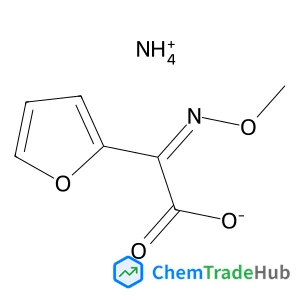
Ammonium (Z)-2-(furan-2-yl)-2-(methoxyimino)acetate
CAS Number:
97148-39-5
Molecular Formula:
C7H10N2O4

Recommended Suppliers




Disclaimer
This page provides academic journal information for reference and research purposes only. We are not affiliated with any journal publishers and do not handle publication submissions. For publication-related inquiries, please contact the respective journal publishers directly.
If you notice any inaccuracies in the information displayed, please contact us at support@chemtradehub.com. We will promptly review and address your concerns.