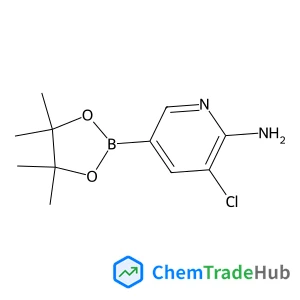
3-Chloro-5-(4,4,5,5-tetramethyl-1,3,2-dioxaborolan-2-yl)-2-pyridinamine
CAS Number:
1032758-99-8
Molecular Formula:
C11H16BClN2O2
The phase equilibrium behavior of a typical colloidal dispersion by the van der Waals-like theory was studied. In this theory, the colloid–colloid potential is split into two parts: a repulsive part modeled by the hard-core potential and an attractive part modeled by the square-well potential corrected by a linear tail. The theory is numerically elegant since the colloidal free energy is analytic and, physically, the model can be used to study the role played by the strength and range of interactions on the formation of coexisting phases. The effect of the strength of the interaction can be accounted for by varying the width of the square-well potential (simulated by γ parameter) while the range of the interaction—by changing the “slope” of the linear potential (simulated by λ parameter). In this work, we consider three separate cases. First, we fixed the threshold values γth, being γLLth = 0.221 for liquid–liquid and γSSth = 0.0329 for solid–solid, and increased λ to examine the appearance of the liquid–liquid and solid–solid coexistence curves which were both calculated with respect to their liquid–solid counterparts. Second, we fixed the threshold values λth, being λLLth = 0.325 for liquid–liquid and λSSth = 0.0456 for solid–solid, and increased γ (keeping the λ-slope unchanged) to bring in the strength of the interaction. In these two cases, the calculations showed that a switching on of λ or γ has the consequence of inducing stable liquid–liquid or metastable solid–solid coexisting phases. Finally, we maintained a given γ plus λ. Here the calculated liquid–liquid and solid–solid phase diagrams can be analyzed in finer details to exhibit the combined influences of the strength and range of interactions.
Baris A. Borsa, Mert Sudagidan, Mehmet E. Aldag, Isik I. Baris, Elif E. Acar, Cagatay Acuner, Murat Kavruk, Veli C. Ozalp
DOI: 10.1039/D0MD00347F
Yan Yin, Yuxing Sun, Lianhua Zhao, Jinpeng Pan
DOI: 10.1039/C9MD00537D
Yuichiro Akao, Stacie Canan, Yafeng Cao, Kevin Condroski, Ola Engkvist, Sachiko Itono, Rina Kaki, Chiaki Kimura, Thierry Kogej, Kazuya Nagaoka, Akira Naito, Hiromi Nakai, Garry Pairaudeau, Constantin Radu, Ieuan Roberts, Mitsuyuki Shimada, David Shum, Nao-aki Watanabe, Huanxu Xie, Shuji Yonezawa, Osamu Yoshida, Ryu Yoshida, Charles Mowbray, Benjamin Perry
DOI: 10.1039/D0MD00353K
Larissa G. Maciel, Andrey da S. Barbosa, Edilson B. de Alencar-Filho, Thereza A. Soares, Janaína V. dos Anjos
DOI: 10.1039/D0MD00305K
Alexandria M. Chan
DOI: 10.1039/D0MD00286K
Felix F. Loeffler, Isabelle F. T. Viana, Nico Fischer, Carolina S. Silva, Antônio F. Purificação, Jr., Catarina M. C. S. Araújo, Bruno H. S. Leite, Ricardo Durães-Carvalho, Tereza Magalhães, Clarice N. L. Morais, Marli T. Cordeiro, Roberto D. Lins
DOI: 10.1039/D1MD00124H
Shikha Gulati, Parinita Singh, Anchita Diwan, Ayush Mongia, Sanjay Kumar
DOI: 10.1039/D0MD00298D
Kelly Yang, Racquel Harrison
DOI: 10.1039/D1MD00194A
Hidetoshi Kajino, Tomomi Nagatani, Miku Oi, Atsuya Nishiyama, Makoto Nakanishi, Kenzo Yamatsugu, Shigehiro A. Kawashima, Motomu Kanai
DOI: 10.1039/D0CB00029A
Paul J. Koovits, Marco A. Dessoy, An Matheeussen, Louis Maes, Guy Caljon, Leonardo L. G. Ferreira, Rafael C. Chelucci, Simone Michelan-Duarte, Adriano D. Andricopulo, Simon Campbell, Jadel M. Kratz, Charles E. Mowbray, Luiz C. Dias
DOI: 10.1039/D0MD00165A
This compound is mainly used as an intermediate in the synthesis of antipsychoti...
Waste containing 1-(D-Ribofuranosyl)-1,4-dihydro-3-pyridinecarboxamide (CAS: 191...
2-Methyl-2-propanyl 3-bromo-3-(hydroxymethyl)-1-azetidinecarboxylate (CAS: 20079...
N-(4-Chloro-2-pyridinyl)acetamide (CAS: 245056-66-0) is a chemical compound with...
5-Chloro-2-hydroxybenzoic acid, also known as 5-chlorosalicylic acid, is an arom...
When handling 1,1-Dichloro-1-fluoroethane (CAS: 1717-00-6), it is important to u...
Fmoc-(2S,3R)-3-phenylpyrrolidine-2-carboxylic acid is a white crystalline solid ...
4-Amino-5-bromo-2-pyridinecarboxylic acid is primarily used as a precursor in th...
Handling this compound should be done with personal protective equipment (PPE) i...
When handling 8-bromo-2,2-dimethyl-3,4-dihydro-2H-1,4-benzoxazin-3-one, use prop...

Physical Chemistry Chemical Physics (PCCP) is an international journal co-owned by 19 physical chemistry and physics societies from around the world. This journal publishes original, cutting-edge research in physical chemistry, chemical physics and biophysical chemistry. To be suitable for publication in PCCP, articles must include significant innovation and/or insight into physical chemistry; this is the most important criterion that reviewers and Editors will judge against when evaluating submissions. The journal has a broad scope and welcomes contributions spanning experiment, theory, computation and data science. Topical coverage includes spectroscopy, dynamics, kinetics, statistical mechanics, thermodynamics, electrochemistry, catalysis, surface science, quantum mechanics, quantum computing and machine learning. Interdisciplinary research areas such as polymers and soft matter, materials, nanoscience, energy, surfaces/interfaces, and biophysical chemistry are welcomed if they demonstrate significant innovation and/or insight into physical chemistry. Joined experimental/theoretical studies are particularly appreciated when complementary and based on up-to-date approaches.