












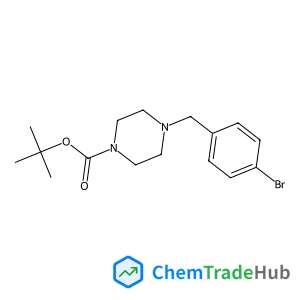
2-Methyl-2-propanyl 4-(4-bromobenzyl)-1-piperazinecarboxylate
CAS Number:
844891-10-7
Molecular Formula:
C16H23BrN2O2
Howell G. M. Edwards, Hew D. V. Prendergast
“Dragon′s blood” is the name applied to the deep-red coloured resin obtained from various plants. The original source in Roman times, used by many cultures and esteemed for its depth of colour and mystical association, was the dragon tree Dracaena cinnabari (Convallariaceae), found only on the Indian Ocean island of Socotra, (Yemen). Additional sources emerged later, including another species of Dracaena, D. draco, from the Canary Islands and Madeira, and species in the genera Daemonorops (Palmae) from South East Asia and Croton (Euphorbiaceae) from tropical parts of both the New and Old Worlds. In this study, examples of dragon's blood resins from the Economic Botany Collections at the Royal Botanic Gardens, Kew, dating from 1851 to 1993, have been analysed non-destructively using Raman spectroscopy. The Raman spectra of well-documented, provenanced specimens have been used to establish the source of specimens of questionable or unknown origin. It has also been possible from the Raman spectra to indicate whether processing of the resins has been undertaken in the preparation of the specimens before their deposition at Kew.
Ying Chen, Hardeep S. Mehta, Mark C. Butler, Eric D. Walter, Patrick N. Reardon, Ryan S. Renslow, Karl T. Mueller, Nancy M. Washton
DOI: 10.1039/C7CP03933F
HyukSu Han, Kang Min Kim, Chan-Woo Lee, Caroline S. Lee, Rajendra C. Pawar, Jacob L. Jones, Jeong Ho Ryu, Taeseup Song, Suk Hyun Kang, Heechae Choi, Sungwook Mhin
DOI: 10.1039/C7CP05523D
Wenkai Zhang, Yunjing Wang, Xiaohui Liu, Xianrui Meng, Hao Xu, Yuanqing Xu, Baoying Liu, Xiaomin Fang, Hai-Bei Li, Tao Ding
DOI: 10.1039/C7CP05927B
S. Papović, N. Cvjetićanin, Slobodan Gadžurić, M. Bešter-Rogač, M. Vraneš
DOI: 10.1039/C7CP04478J
Jinyang Jiang, Pan Wang, Dongshuai Hou
DOI: 10.1039/C7CP05437H
Julie L. Calahan, Joseph W. Lubach, Eric J. Munson
DOI: 10.1039/C7CP04223J
L. Delmondo, J. A. Muñoz-Tabares, A. Sacco, N. Garino, M. Castellino, G. P. Salvador, M. Quaglio, A. Chiodoni
DOI: 10.1039/C7CP05091G
Andrej Antušek, Martin Blaško, Miroslav Urban, Pavol Noga, Danilo Kisić, Miloš Nenadović, Davor Lončarević, Zlatko Rakočević
DOI: 10.1039/C7CP05637K
Waste containing 2-Ethyl-4-Methyl-1H-Imidazole-5-Carbaldehyde (CAS: 88634-80-4) ...
Triethoxy(octyl)silane (CAS: 1385031-14-0) is widely used in the pharmaceuticals...
Several alternatives to 3-iodo-7-nitro-1H-indazole (CAS: 864724-64-1) exist in t...
Yes, there are alternatives to Benzene, bis[(trimethoxysilyl)ethyl] (CAS: 266317...
Isothiazole-3-carbonitrile (CAS: 1452-17-1) is generally considered safe when us...
(3-Chlorophenyl)methanol (CAS: 873-63-2) is considered low to moderately toxic. ...
(2S,3S)-2-Hydroxy-3-({[(2-methyl-2-propanyl)oxy]carbonyl}amino)-3-(2-naphthyl)pr...
Proper handling of methyl 2-(bromomethyl)-5-methoxybenzoate requires the use of ...
6,8-Dibromoimidazo[1,2-a]pyridine-2-carboxylic acid (CAS: 904805-36-3) is an aro...
3-Amino-5-bromo-2-pyridinecarbonitrile is considered safe when handled under pro...

Analyst publishes analytical and bioanalytical research that reports premier fundamental discoveries and inventions, and the applications of those discoveries, unconfined by traditional discipline barriers.
methanone structure](https://static.chemtradehub.com/structs/814/81449-01-6-786d.webp "[4-(Hydroxymethyl)phenyl](phenyl)methanone structure")




