












Development of a dual luciferase reporter screening assay for the detection of synthetic glucocorticoids in animal tissues
Literature Information
Publication Date
2003-11-11
DOI
10.1039/B309539H
Impact Factor
4.616
Authors
Sylvie Briand Schumacher, Olivia Van den hauwe, Carlos H. Van Peteghem, Hanspeter Naegeli
View Original
Abstract
Synthetic glucocorticoids belong to the most frequently administered drugs in livestock production. These synthetic hormones are employed for therapeutic purposes against inflammatory reactions, disorders of the musculoskeletal system, bovine ketosis and many other diseases of farm animals. A widespread illegal use of synthetic glucocorticoids to improve feed intake and weight gain has also been observed. To enforce the residue limits imposed on glucocorticoid drugs and preclude their illicit administration as growth promoters, it is necessary to establish high throughput analytical methods that can be applied to the screening of animal tissues. Here, we developed a dual luciferase reporter assay that detects residues or contaminants with glucocorticoid activity. This screening assay is performed by transfection of human cell lines with two reporter constructs followed by the measurement of two distinct luminescence signals, one of which serves as internal control to correct for assay variabilities and unspecific matrix effects. The limit of detection (1.25 µg for dexamethasone in liver) depends on the biological potency of each synthetic glucocorticoid but, with all drugs tested, the maximal response reaches a 20 to 30 fold induction of luciferase activity. In combination with an appropriate sample clean-up method (recovery of 82%), this luciferase assay has been applied to the analysis of liver samples from calves treated with a single therapeutic injection of either dexamethasone or flumethasone. Thus, the dual luciferase reporter assay provides a new screening tool to detect unwanted glucocorticoid activities in animal tissues or other crude biological samples without knowledge of the precise chemical entity of the parent compounds or their metabolites.
Recommended Journals
Related Literature
Enzymatic grafting of amylose on chitin nanofibers for hierarchical construction of controlled microstructures
Naomichi Egashira, Kazuya Yamamoto, Jun-ichi Kadokawa
2017-05-05
Paper
DOI: 10.1039/C7PY00521K
A nanoparticle-preparation kit using ethylene glycol-based block copolymers with a common temperature-responsive block
Chun Man Lee, Iren Constantinescu, Lily E. Takeuchi, Sreeparna Vappala, Ravin Narain, Takao Aoyagi
2017-11-22
Communication
DOI: 10.1039/C7PY01541K
Naphthodipyrrolidone (NDP) based conjugated polymers with high electron mobility and ambipolar transport properties
Haichang Zhang, Shuo Zhang, Yifan Mao, Kewei Liu, Yu-Ming Chen, Zhang Jiang, Joseph Strzalka, Wenjun Yang, Chien-Lung Wang, Yu Zhu
2017-05-12
Communication
DOI: 10.1039/C7PY00616K
Looped flow RAFT polymerization for multiblock copolymer synthesis
Agnès Kuroki, Ivan Martinez-Botella, Christian H. Hornung, Liam Martin, Elizabeth G. L. Williams, Katherine E. S. Locock, Matthias Hartlieb
2017-05-12
Communication
DOI: 10.1039/C7PY00630F
Phosphazene/triisobutylaluminum-promoted anionic ring-opening polymerization of 1,2-epoxybutane initiated by secondary carbamates
L. Hassouna, N. Illy, P. Guégan
2017-06-13
Paper
DOI: 10.1039/C7PY00675F
Grafting challenging monomers from proteins using aqueous ICAR ATRP under bio-relevant conditions
Theresa Ramelot, Dominik Konkolewicz, Scott Graner
2017-06-13
Paper
DOI: 10.1039/C7PY00669A
Thermoresponsive laterally-branched polythiophene phenylene derivative as water-soluble temperature sensor
Victor R. De la Rosa, David Barker, Richard Hoogenboom
2017-06-21
Paper
DOI: 10.1039/C7PY00919D
Olefin cross metathesis and ring-closing metathesis in polymer chemistry
Fern Sinclair, Joëlle Prunet, Michael P. Shaver
2017-04-24
Review Article
DOI: 10.1039/C7PY00340D
You might also like
Compound Q&A
What precautions should be taken when handling 4-(2-Furylmethyl)thiomorpholine 1,1-dioxide (CAS: 79206-94-3)?
When handling 4-(2-Furylmethyl)thiomorpholine 1,1-dioxide (CAS: 79206-94-3), it ...
79206-94-34-(2-Furylmethyl)thi...
Compound Q&A
What precautions should be taken when handling 4-Chloro-N-[2-(4-morpholinyl)ethyl]benzamide (CAS: 71320-77-9)?
When handling 4-Chloro-N-[2-(4-morpholinyl)ethyl]benzamide (CAS: 71320-77-9), it...
71320-77-94-Chloro-N-[2-(4-mor...
Compound Q&A
How should waste containing 2-[2-(2-Methoxyethoxy)ethoxy]ethyl 4-methylbenzenesulfonate (CAS: 62921-74-8) be handled?
Waste containing this compound (CAS: 62921-74-8) should be handled according to ...
62921-74-82-[2-(2-Methoxyethox...
Compound Q&A
How should waste containing (S)-Methyl 2-amino-3-cyclohexylpropanoate be handled?
Waste containing (S)-Methyl 2-amino-3-cyclohexylpropanoate should be collected i...
40056-18-6(S)-Methyl 2-amino-3...
Compound Q&A
How is 5-({4-[(2S,4R)-4-Hydroxy-2-methyltetrahydro-2H-pyran-4-yl]-2-thienyl}sulfanyl)-1-methyl-1,3-dihydro-2H-indol-2-one (CAS: 166882-70-8) typically synthesized?
This compound can be synthesized using a multi-step process involving the conjug...
166882-70-85-({4-[(2S,4R)-4-Hyd...
Compound Q&A
Are there alternatives to (2E)-3-(3,4-Dichlorophenyl)acrylic acid (CAS: 7312-27-8) in synthesis?
There are several alternatives to (2E)-3-(3,4-Dichlorophenyl)acrylic acid in syn...
7312-27-8(2E)-3-(3,4-Dichloro...
Compound Q&A
How should Ethyl 6-(2-nitrophenyl)imidazo[2,1-b][1,3]thiazole-3-carboxylate (CAS: 925437-84-9) be stored?
Ethyl 6-(2-nitrophenyl)imidazo[2,1-b][1,3]thiazole-3-carboxylate (CAS: 925437-84...
925437-84-9Ethyl 6-(2-nitrophen...
Compound Q&A
How should waste containing 2-(1,3-Thiazol-2-yl)ethanamine (CAS: 18453-07-1) be handled?
Waste containing 2-(1,3-Thiazol-2-yl)ethanamine (CAS: 18453-07-1) should be coll...
18453-07-12-(1,3-Thiazol-2-yl)...
Compound Q&A
How is Methyl 5-iodo-2-methylbenzoate (CAS: 103440-54-6) typically synthesized?
Methyl 5-iodo-2-methylbenzoate can be synthesized through the iodination of meth...
103440-54-6Methyl 5-iodo-2-meth...
Compound Q&A
How is 5-Chloro[1,2,4]triazolo[1,5-a]pyridine (CAS: 1427399-34-5) typically synthesized?
5-Chloro[1,2,4]triazolo[1,5-a]pyridine is commonly synthesized via the condensat...
1427399-34-55-Chloro[1,2,4]triaz...
Source Journal
Analyst

CiteScore:
7.8
Self-citation Rate:
5.6%
Articles per Year:
653
Analyst publishes analytical and bioanalytical research that reports premier fundamental discoveries and inventions, and the applications of those discoveries, unconfined by traditional discipline barriers.
Recommended Compounds
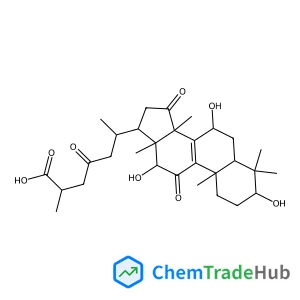
(3beta,7beta,12beta)-3,7,12-Trihydroxy-11,15,23-trioxolanost-8-en-26-oic acid
CAS Number:
98665-22-6
Molecular Formula:
C30H44O8

Recommended Suppliers






Disclaimer
This page provides academic journal information for reference and research purposes only. We are not affiliated with any journal publishers and do not handle publication submissions. For publication-related inquiries, please contact the respective journal publishers directly.
If you notice any inaccuracies in the information displayed, please contact us at support@chemtradehub.com. We will promptly review and address your concerns.