













Human-centric intelligent systems for exploration and knowledge discovery
Literature Information
Publication Date
2004-12-01
DOI
10.1039/B307211H
Impact Factor
4.616
Authors
View Original
Abstract
This speculative article discusses research and development relating to computational intelligence (CI) technologies comprising powerful machine-based search and exploration techniques that can generate, extract, process and present high-quality information from complex, poorly understood biotechnology domains. The integration and capture of user experiential knowledge within such CI systems in order to support and stimulate knowledge discovery and increase scientific and technological understanding is of particular interest. The manner in which appropriate user interaction can overcome problems relating to poor problem representation within systems utilising evolutionary computation (EC), machine-learning and software agent technologies is investigated. The objective is the development of user-centric intelligent systems that support an improving knowledge-base founded upon gradual problem re-definition and reformulation. Such an approach can overcome initial lack of understanding and associated uncertainty.
Related Literature
Two equivalent methyl internal rotations in 2,5-dimethylthiophene investigated by microwave spectroscopy
Vinh Van, Wolfgang Stahl, Ha Vinh Lam Nguyen
2015-09-29
Communication
DOI: 10.1039/C5CP03513A
Singular analysis and coupled cluster theory
Heinz-Jürgen Flad, Gohar Harutyunyan, Bert-Wolfgang Schulze
2015-06-15
Paper
DOI: 10.1039/C5CP01183C
Theoretical study on the dehydrogenation reaction of dihydrogen bonded phenol–borane-trimethylamine in the excited state
Yonggang Yang, Yufang Liu, Dapeng Yang, Hui Li, Kai Jiang, Jinfeng Sun
2015-08-12
Paper
DOI: 10.1039/C5CP02530C
A simulation study of the electrostriction effects in dielectric elastomer composites containing polarizable inclusions with different spatial distributions
Hartmut Löwen, Lei Zhu
2015-11-13
Paper
DOI: 10.1039/C5CP05522A
Impact of the electron–phonon coupling symmetry on the polaron stability and mobility in organic molecular semiconductors
Sven Stafström
2015-12-07
Communication
DOI: 10.1039/C5CP06577A
Hydrogen-bonding and vibrational coupling of water in a hydrophobic hydration shell as observed by Raman-MCR and isotopic dilution spectroscopy
Mohammed Ahmed, Ajay K. Singh, Jahur A. Mondal
2015-12-18
Paper
DOI: 10.1039/C5CP07014G
Measurement and prediction of quantum coherence effects in biological processes
Aurélien de la Lande, Vicent Moliner, Dennis Salahub
2015-09-17
Editorial
DOI: 10.1039/C5CP90134K
A new look at oxide formation at the copper/electrolyte interface by in situ spectroscopies
Cigdem Toparli, Adnan Sarfraz, Andreas Erbe
2015-11-02
Paper
DOI: 10.1039/C5CP05172J
Thiolated Au18 cluster: preferred Ag sites for doping, structures, and optical and chiroptical properties
Bertha Molina, Alfredo Tlahuice-Flores
2015-12-03
Communication
DOI: 10.1039/C5CP05171A
You might also like
Compound Q&A
What are the main uses of 1H-Indazole-6-carbonitrile (CAS: 141290-59-7)?
1H-Indazole-6-carbonitrile finds applications in pharmaceuticals, where it serve...
141290-59-71H-Indazole-6-carbon...
Compound Q&A
How should waste containing Dioctyl (2E)-2-butenedioate (CAS: 2997-85-5) be handled?
Waste containing Dioctyl (2E)-2-butenedioate (CAS: 2997-85-5) should be collecte...
2997-85-5Dioctyl (2E)-2-buten...
Compound Q&A
What industries use Sodium [(1,2-benzoxazol-3-ylmethyl)sulfonyl]azanide (CAS: 68291-98-5)?
Sodium [(1,2-benzoxazol-3-ylmethyl)sulfonyl]azanide is primarily used in pharmac...
68291-98-5Sodium [(1,2-benzoxa...
Compound Q&A
Are there alternatives to Dimethyl 4-(4,4,5,5-tetramethyl-1,3,2-dioxaborolan-2-yl)-2,6-pyridinedicarboxylate (CAS: 741709-66-0) in synthesis?
Dimethyl 4-(4,4,5,5-tetramethyl-1,3,2-dioxaborolan-2-yl)-2,6-pyridinedicarboxyla...
741709-66-0Dimethyl 4-(4,4,5,5-...
Compound Q&A
How should waste containing 2-Fluoro-6-hydrazinopyridine (CAS: 80714-39-2) be handled?
Waste containing 2-Fluoro-6-hydrazinopyridine (CAS: 80714-39-2) should be manage...
80714-39-22-Fluoro-6-hydrazino...
Compound Q&A
What is 6-Formyl-2-pyridinecarboxylic acid (CAS: 499214-11-8)?
6-Formyl-2-pyridinecarboxylic acid is an organic compound with the molecular for...
499214-11-86-Formyl-2-pyridinec...
Compound Q&A
What is the market or research trend for 3-(3,4-dimethoxyphenyl)-2,5-dimethyl-N-(2-morpholin-4-ylethyl)pyrazolo[1,5-a]pyrimidin-7-amine (CAS: 900874-91-1)?
Research trends for this compound indicate a focus on its potential applications...
900874-91-13-(3,4-dimethoxyphen...
Compound Q&A
How is 9H-Tribenzo[b,d,f]azepine (CAS: 29875-73-8) typically synthesized?
9H-Tribenzo[b,d,f]azepine is typically synthesized via a multi-step process invo...
29875-73-89H-Tribenzo[b,d,f]az...
Compound Q&A
How is 1-Cyclopropyl-7-ethoxy-6-fluoro-8-methoxy-4-oxo-1,4-dihydro-3-quinolinecarboxylic acid (CAS: 1797982-51-4) typically synthesized?
1-Cyclopropyl-7-ethoxy-6-fluoro-8-methoxy-4-oxo-1,4-dihydro-3-quinolinecarboxyli...
1797982-51-41-Cyclopropyl-7-etho...
Compound Q&A
How should waste containing Methyl 3-oxo-1,2,3,4-tetrahydro-6-quinoxalinecarboxylate (CAS: 671820-52-3) be handled?
Waste containing Methyl 3-oxo-1,2,3,4-tetrahydro-6-quinoxalinecarboxylate (CAS: ...
671820-52-3Methyl 3-oxo-1,2,3,4...
Source Journal
Analyst

CiteScore:
7.8
Self-citation Rate:
5.6%
Articles per Year:
653
Analyst publishes analytical and bioanalytical research that reports premier fundamental discoveries and inventions, and the applications of those discoveries, unconfined by traditional discipline barriers.
Recommended Compounds



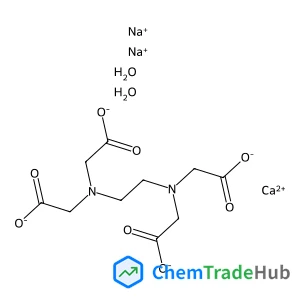
EthylenediaminetetraaceticacidcalciumDisodiumsalthydrate
CAS Number:
23411-34-9
Molecular Formula:
C10H16CaN2Na2O10
Recommended Suppliers





Disclaimer
This page provides academic journal information for reference and research purposes only. We are not affiliated with any journal publishers and do not handle publication submissions. For publication-related inquiries, please contact the respective journal publishers directly.
If you notice any inaccuracies in the information displayed, please contact us at support@chemtradehub.com. We will promptly review and address your concerns.