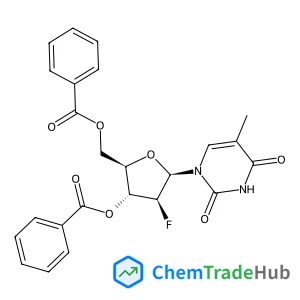
1-(3',5'-Di-O-benzoyl-2'-deoxy-2'-fluoro-b-D-arabinofuranosyl)thymine
CAS Number:
97614-47-6
Molecular Formula:
C24H21FN2O7
Chan-Mo Yu, Ji-Min Kim, Mi-Sook Shin, Mee-Ok Yoon
Catalytic enantioselective addition of 3-trimethylsilyl-2-propenylstannane to aldehydes promoted by BINOL–Ti(IV) catalyst along with synergistic reagent provides unusual 1,2-adducts with high levels of enantioselectivity.
DOI: 10.1039/B923700C
James P. R. Day, Paul D. A. Pudney, Colin D. Bain
DOI: 10.1039/B921887D
Iker del Rosal, Torsten Gutmann, Laurent Maron, Franck Jolibois, Bruno Chaudret, Bernadeta Walaszek, Hans-Heinrich Limbach, Romuald Poteau, Gerd Buntkowsky
DOI: 10.1039/B822150B
Rosa Becerra, J. Pat Cannady, Guy Dormer, Robin Walsh
DOI: 10.1039/B823109E
Frank Schönberger, Jochen Kerres, Herbert Dilger, Emil Roduner
DOI: 10.1039/B817070C
Karina Mathisen, David G. Nicholson
DOI: 10.1039/B902491C
L. F. Vieira Ferreira, A. M. Botelho do Rego, E. Sikorska, M. Sikorski
DOI: 10.1039/B903013A
Yang Yang, Weixing Song, Anhe Wang, Pengli Zhu, Jinbo Fei
DOI: 10.1039/B924370D
Tanja Pott, Philippe Méléard
DOI: 10.1039/B901582E
(3.beta.)-3-Hydroxy-N,N-dimethyl-chol-5-en-24-amide (CAS: 79066-03-8) is primari...
5-(Aminomethyl)-2-methoxyphenol (CAS: 89702-89-6) is classified under GHS as a s...
Thieno[2,3-c]pyridin-7(6H)-one (CAS: 28981-13-7) is a heterocyclic organic compo...
1-[(6-Methoxy-3-pyridinyl)methyl]-4-piperidinamine dihydrochloride is generally ...
[(2E)-3-Phenyl-2-propen-1-yl]phosphonic acid (CAS: 146404-58-2) is regulated und...
6-Bromo-7-methoxyquinoline (CAS: 1620515-86-7) falls under the scope of the Glob...
This compound is primarily used in the pharmaceutical industry for the developme...
1-Ethyl-7-[2-methyl-6-(4H-1,2,4-triazol-3-yl)-3-pyridinyl]-3,5-dihydropyrazino[2...
Alternative reagents such as 2-[(dimethylamino)methyl]phenylboronic acid or rela...
3-(Piperidin-4-yloxy)pyridine (CAS: 310881-48-2) is an organic compound with the...

ChemComm publishes urgent research which is of outstanding significance and interest to experts in the field, while also appealing to the journal’s broad chemistry readership. Our communication format is ideally suited to short, urgent studies that are of such importance that they require accelerated publication. Our scope covers all topics in chemistry, and research at the interface of chemistry and other disciplines (such as materials science, nanoscience, physics, engineering and biology) where there is a significant novelty in the chemistry aspects. Major topic areas covered include: Analytical Chemistry Catalysis Chemical Biology and medicinal chemistry Computational Chemistry and Machine Learning Energy and sustainable chemistry Environmental Chemistry Green Chemistry Inorganic Chemistry Materials Chemistry Nanoscience Organic Chemistry Physical Chemistry Polymer Chemistry Supramolecular Chemistry
![N-[(6-Bromo-3-pyridinyl)methyl]ethanamine structure](https://static.chemtradehub.com/structs/120/120740-05-8-ca55.webp "N-[(6-Bromo-3-pyridinyl)methyl]ethanamine structure")