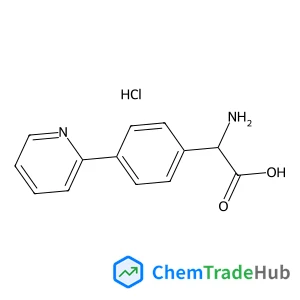
2-Amino-2-(4-(pyridin-2-YL)phenyl)acetic acid hydrochloride
CAS Number:
1135818-89-1
Molecular Formula:
C13H13ClN2O2
Simon J. A. Pope, Alan M. Kenwright, Sarah L. Heath, Stephen Faulkner
The complex Yb2L contains two DO3A units separated by a phenol bridging group and gives time-resolved luminescence spectra in solution consistent with the presence of two types of binding site.
Rajnish Budhwan, Suman Yadav, Sandip Murarka
DOI: 10.1039/C9OB00694J
Marlene L. Rothe, Ernesto Garibay, Shaun M. K. McKinnie
DOI: 10.1039/C8OB03109F
Leixia Mei, Ziran Zhai, Suyun He, Tingting Zhu
DOI: 10.1039/C9OB00046A
Katharina Schmölzer, Melanie Weingarten, Kai Baldenius
DOI: 10.1039/C9OB90088H
Paige Dickson, Thomas Kodadek
DOI: 10.1039/C9OB00581A
Taoufik Boubaker, Julien Roger
DOI: 10.1039/C9OB00806C
Jakub Iwanejko, Anna Brol, Bartłomiej M. Szyja, Marek Daszkiewicz, Elżbieta Wojaczyńska, Tomasz K. Olszewski
DOI: 10.1039/C9OB01346F
Anton S. Abel, Andrey V. Cheprakov, Vitaly A. Roznyatovsky, Franck Denat, Alla Bessmertnykh-Lemeune
DOI: 10.1039/C9OB00259F
Deepika Kathuria, Pankaj Gupta, Sumit S. Chourasiya, Subash C. Sahoo, Uwe Beifuss, Asit K. Chakraborti, Prasad V. Bharatam
DOI: 10.1039/C9OB00610A
(3.beta.)-3-Hydroxy-N,N-dimethyl-chol-5-en-24-amide (CAS: 79066-03-8) is primari...
5-(Aminomethyl)-2-methoxyphenol (CAS: 89702-89-6) is classified under GHS as a s...
Thieno[2,3-c]pyridin-7(6H)-one (CAS: 28981-13-7) is a heterocyclic organic compo...
1-[(6-Methoxy-3-pyridinyl)methyl]-4-piperidinamine dihydrochloride is generally ...
[(2E)-3-Phenyl-2-propen-1-yl]phosphonic acid (CAS: 146404-58-2) is regulated und...
6-Bromo-7-methoxyquinoline (CAS: 1620515-86-7) falls under the scope of the Glob...
This compound is primarily used in the pharmaceutical industry for the developme...
1-Ethyl-7-[2-methyl-6-(4H-1,2,4-triazol-3-yl)-3-pyridinyl]-3,5-dihydropyrazino[2...
Alternative reagents such as 2-[(dimethylamino)methyl]phenylboronic acid or rela...
3-(Piperidin-4-yloxy)pyridine (CAS: 310881-48-2) is an organic compound with the...

ChemComm publishes urgent research which is of outstanding significance and interest to experts in the field, while also appealing to the journal’s broad chemistry readership. Our communication format is ideally suited to short, urgent studies that are of such importance that they require accelerated publication. Our scope covers all topics in chemistry, and research at the interface of chemistry and other disciplines (such as materials science, nanoscience, physics, engineering and biology) where there is a significant novelty in the chemistry aspects. Major topic areas covered include: Analytical Chemistry Catalysis Chemical Biology and medicinal chemistry Computational Chemistry and Machine Learning Energy and sustainable chemistry Environmental Chemistry Green Chemistry Inorganic Chemistry Materials Chemistry Nanoscience Organic Chemistry Physical Chemistry Polymer Chemistry Supramolecular Chemistry
![N-[(6-Bromo-3-pyridinyl)methyl]ethanamine structure](https://static.chemtradehub.com/structs/120/120740-05-8-ca55.webp "N-[(6-Bromo-3-pyridinyl)methyl]ethanamine structure")