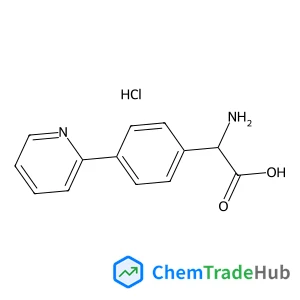
2-Amino-2-(4-(pyridin-2-YL)phenyl)acetic acid hydrochloride
CAS Number:
1135818-89-1
Molecular Formula:
C13H13ClN2O2
Karol Kacprzak, Jacek Gawronski
An equimolar mixture of two conformers of Cinchona alkaloid based triads containing an aromatic diimide spacer is transformed with high efficiency into the syn conformer in the presence of dicarboxylic acids or into the anti conformer in the presence of monocarboxylic acids. The recognition process is readily observed by 1H NMR spectroscopy.
Zhenjie Su, Zengyang Xie, Shan Wang, Naili Luo, Cunde Wang
DOI: 10.1039/C9OB01308C
DOI: 10.1039/C9OB00338J
Yogesh Jaiswal, Yogesh Kumar, Amit Kumar
DOI: 10.1039/C9OB01082C
Harry J. Shirley, Christopher D. Bray
DOI: 10.1039/C9OB00745H
Sagar Satpathi, Subrahmanyam Sappati, Konoya Das
DOI: 10.1039/C9OB01020C
Kaiqian Wang, Xiao Peng, Ping Wang, Feng Liang
DOI: 10.1039/C9OB00575G
Lin Qiu, Zhongqing Wen, Yuling Li, Kai Tian, Youchao Deng
DOI: 10.1039/C9OB00324J
(3.beta.)-3-Hydroxy-N,N-dimethyl-chol-5-en-24-amide (CAS: 79066-03-8) is primari...
5-(Aminomethyl)-2-methoxyphenol (CAS: 89702-89-6) is classified under GHS as a s...
Thieno[2,3-c]pyridin-7(6H)-one (CAS: 28981-13-7) is a heterocyclic organic compo...
1-[(6-Methoxy-3-pyridinyl)methyl]-4-piperidinamine dihydrochloride is generally ...
[(2E)-3-Phenyl-2-propen-1-yl]phosphonic acid (CAS: 146404-58-2) is regulated und...
6-Bromo-7-methoxyquinoline (CAS: 1620515-86-7) falls under the scope of the Glob...
This compound is primarily used in the pharmaceutical industry for the developme...
1-Ethyl-7-[2-methyl-6-(4H-1,2,4-triazol-3-yl)-3-pyridinyl]-3,5-dihydropyrazino[2...
Alternative reagents such as 2-[(dimethylamino)methyl]phenylboronic acid or rela...
3-(Piperidin-4-yloxy)pyridine (CAS: 310881-48-2) is an organic compound with the...

ChemComm publishes urgent research which is of outstanding significance and interest to experts in the field, while also appealing to the journal’s broad chemistry readership. Our communication format is ideally suited to short, urgent studies that are of such importance that they require accelerated publication. Our scope covers all topics in chemistry, and research at the interface of chemistry and other disciplines (such as materials science, nanoscience, physics, engineering and biology) where there is a significant novelty in the chemistry aspects. Major topic areas covered include: Analytical Chemistry Catalysis Chemical Biology and medicinal chemistry Computational Chemistry and Machine Learning Energy and sustainable chemistry Environmental Chemistry Green Chemistry Inorganic Chemistry Materials Chemistry Nanoscience Organic Chemistry Physical Chemistry Polymer Chemistry Supramolecular Chemistry
![N-[(6-Bromo-3-pyridinyl)methyl]ethanamine structure](https://static.chemtradehub.com/structs/120/120740-05-8-ca55.webp "N-[(6-Bromo-3-pyridinyl)methyl]ethanamine structure")
![4,4-Difluoro-2-methyl-1-{[(2-methyl-2-propanyl)oxy]carbonyl}-L-proline structure](https://static.chemtradehub.com/structs/119/1194032-23-9-f426.webp "4,4-Difluoro-2-methyl-1-{[(2-methyl-2-propanyl)oxy]carbonyl}-L-proline structure")