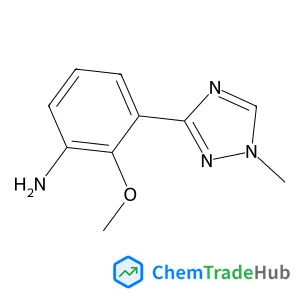
2-Methoxy-3-(1-methyl-1H-1,2,4-triazol-3-yl)aniline
CAS Number:
1609394-10-6
Molecular Formula:
C10H12N4O
The contributions of electrostatic forces to the second virial coefficient and thermodynamic functions of convex molecule fluids can be determined using the perturbation approach. Particular terms in the perturbation expansion are given by multi-fold integrals; these integrals can be expressed after factorization as a product of two parts–simple integrals in terms of variable distance and (at least) three-fold integrals in angular coordinates. The latter integrals (denoted as J integrals) characterize the effect of the shape of molecular cores on the electrostatic interactions. Within this paper, values of several J integrals were calculated for hard spherocylinders of different reduced lengths (or diameter) with six types of embedded electrostatic interactions: dipole–dipole, quadrupole–quadrupole, dipole–quadrupole, dipole–induced dipole, quadrupole–induced dipole and quadrupole–induced quadrupole. The different J integrals were determined as functions of shapes for (like and unlike) pairs of hard convex bodies and expressed in the form of rational functions. The theoretical predictions of the second virial coefficient are compared with the pseudo-experimental values determined in our laboratory; comparison indicates sufficiency of the suggested method to evaluate thermodynamic properties of polar compounds.
Apichart Linhananta, Kieran F. Lim
DOI: 10.1039/B109074G
Ch. Janzen, P. Imhof, K. Kleinermanns, M. S. de Vries
DOI: 10.1039/B107429F
P. Valentin
DOI: 10.1039/B109105K
Kathrin Winkler, Jörg Lindner, Vinod Subramaniam, Thomas M. Jovin, Peter Vöhringer
DOI: 10.1039/B108843B
A. H. A. Ayyad
DOI: 10.1039/B106242P
Begoña García, Rafael Alcalde, Santiago Aparicio, José M. Leal
DOI: 10.1039/B109709C
Hiroto Tachikawa
DOI: 10.1039/B109641A
DOI: 10.1039/B106017C
Leszek Lapinski, Maciej J. Nowak, Dariusz C. Bieńko, Danuta Michalska
DOI: 10.1039/B108702A
Osvaldo H. Scalise, Moises Silbert
DOI: 10.1039/B107990P
6-Bromo-2-methylimidazo[1,2-a]pyrimidine (CAS: 1111638-05-1) falls under various...
While there are no direct alternatives, similar compounds like 1-Pyrrolidineetha...
4-Methyl-2,6-bis(2-methyl-2-propanyl)phenyl methylcarbamate (CAS: 1918-11-2) is ...
2-(3-Bromo-4-fluorophenyl)-1,3-dioxolane (CAS: 77771-04-1) should be stored in a...
4,5,6,7-Tetrahydro-1H-indazole hydrochloride is a white crystalline solid with a...
(2R)-1-Methoxy-3-phenyl-2-propanamine is a chiral organic compound with the CAS ...
Ethyl 1-(1-phenylethyl)-1H-imidazole-5-carboxylate is used in various industries...
4-[(1E,3S)-1-(4-Hydroxyphenyl)-1,4-pentadien-3-yl]phenol (CAS: 17676-24-3) falls...
(S)-3-Amino-5-phenylpentanoic acid hydrochloride is primarily used in the pharma...
7-Methoxy-1-benzothiophene-2-carboxylic acid is typically synthesized by reactin...

Physical Chemistry Chemical Physics (PCCP) is an international journal co-owned by 19 physical chemistry and physics societies from around the world. This journal publishes original, cutting-edge research in physical chemistry, chemical physics and biophysical chemistry. To be suitable for publication in PCCP, articles must include significant innovation and/or insight into physical chemistry; this is the most important criterion that reviewers and Editors will judge against when evaluating submissions. The journal has a broad scope and welcomes contributions spanning experiment, theory, computation and data science. Topical coverage includes spectroscopy, dynamics, kinetics, statistical mechanics, thermodynamics, electrochemistry, catalysis, surface science, quantum mechanics, quantum computing and machine learning. Interdisciplinary research areas such as polymers and soft matter, materials, nanoscience, energy, surfaces/interfaces, and biophysical chemistry are welcomed if they demonstrate significant innovation and/or insight into physical chemistry. Joined experimental/theoretical studies are particularly appreciated when complementary and based on up-to-date approaches.