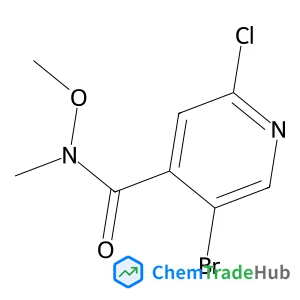
5-Bromo-2-chloro-N-methoxy-N-methylisonicotinamide
CAS Number:
1256790-08-5
Molecular Formula:
C8H8BrClN2O2
Hong-Zhe Sun, David Balcells, Feliu Maseras, Odile Eisenstein
[Cu4(μ-dppm)4(μ4-η1,η2-CC–)]2+ has been shown by 31P and 1H NMR studies to undergo two fluxional processes in solution, the oscillation of the CC2− unit inside the copper rectangle and the flipping of the diphosphines, and this has been supported by DFT(B3LYP) calculations.
Svemir Rudić, Jeremy M. Merritt, Roger E. Miller
DOI: 10.1039/B817484A
R. Devanathan, S. Thevuthasan, J. D. Gale
DOI: 10.1039/B902764E
Ron Siewertsen, Falk Renth, Friedrich Temps, Frank Sönnichsen
DOI: 10.1039/B821344E
Iker del Rosal, Torsten Gutmann, Laurent Maron, Franck Jolibois, Bruno Chaudret, Bernadeta Walaszek, Hans-Heinrich Limbach, Romuald Poteau, Gerd Buntkowsky
DOI: 10.1039/B822150B
Gabriel M. P. Just, Patrick Rupper, Terry A. Miller, W. Leo Meerts
DOI: 10.1039/B924323B
James P. R. Day, Paul D. A. Pudney, Colin D. Bain
DOI: 10.1039/B921887D
Erik I. Tellgren, Trygve Helgaker, Alessandro Soncini
DOI: 10.1039/B822262B
István Z. Kiss, Lindsey N. Pelster, Mahesh Wickramasinghe
DOI: 10.1039/B904650J
Yong-Hui Tian, Jingsong Huang, Miklos Kertesz
DOI: 10.1039/B925259B
(3.beta.)-3-Hydroxy-N,N-dimethyl-chol-5-en-24-amide (CAS: 79066-03-8) is primari...
5-(Aminomethyl)-2-methoxyphenol (CAS: 89702-89-6) is classified under GHS as a s...
Thieno[2,3-c]pyridin-7(6H)-one (CAS: 28981-13-7) is a heterocyclic organic compo...
1-[(6-Methoxy-3-pyridinyl)methyl]-4-piperidinamine dihydrochloride is generally ...
[(2E)-3-Phenyl-2-propen-1-yl]phosphonic acid (CAS: 146404-58-2) is regulated und...
6-Bromo-7-methoxyquinoline (CAS: 1620515-86-7) falls under the scope of the Glob...
This compound is primarily used in the pharmaceutical industry for the developme...
1-Ethyl-7-[2-methyl-6-(4H-1,2,4-triazol-3-yl)-3-pyridinyl]-3,5-dihydropyrazino[2...
Alternative reagents such as 2-[(dimethylamino)methyl]phenylboronic acid or rela...
3-(Piperidin-4-yloxy)pyridine (CAS: 310881-48-2) is an organic compound with the...

ChemComm publishes urgent research which is of outstanding significance and interest to experts in the field, while also appealing to the journal’s broad chemistry readership. Our communication format is ideally suited to short, urgent studies that are of such importance that they require accelerated publication. Our scope covers all topics in chemistry, and research at the interface of chemistry and other disciplines (such as materials science, nanoscience, physics, engineering and biology) where there is a significant novelty in the chemistry aspects. Major topic areas covered include: Analytical Chemistry Catalysis Chemical Biology and medicinal chemistry Computational Chemistry and Machine Learning Energy and sustainable chemistry Environmental Chemistry Green Chemistry Inorganic Chemistry Materials Chemistry Nanoscience Organic Chemistry Physical Chemistry Polymer Chemistry Supramolecular Chemistry
![N-[4-(Cyanoethynyl)phenyl]-16-oxo-4,7,10,13-tetraoxa-17-azahenicos-1-yn-21-amide structure](https://static.chemtradehub.com/structs/218/2183440-36-8-68cb.webp "N-[4-(Cyanoethynyl)phenyl]-16-oxo-4,7,10,13-tetraoxa-17-azahenicos-1-yn-21-amide structure")