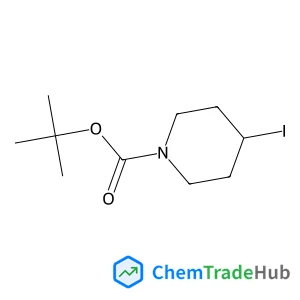
2-Methyl-2-propanyl 4-iodo-1-piperidinecarboxylate
CAS Number:
301673-14-3
Molecular Formula:
C10H18INO2
Dominique M. Roberge, Heike Hausmann, Wolfgang F. Hölderich
The influence of acid leaching on a commercial zeolite beta with concentrated solutions of HCl and HNO3 has been investigated. The parent and modified zeolites are characterized with ICP, BET, XRD, SEM, FTIR, and 27Al solid-state NMR, with conventional MAS, CP/MAS and two-dimensional multiple-quantum MAS (MQMAS) techniques. The first advantage to submitting zeolite beta to an acid leaching procedure is to remove or passivate all kinds of extra-framework impurities from aluminium clusters to silica–alumina debris. These impurities have been shown to be to some extent acidic. However, the most important effect of acid leaching with concentrated acid solutions is to remove selectively framework aluminium from positions close to defect sites and on the external surface area. Thus, the acid treatments markedly reduce the relative activity of the high external surface area so that the intrinsic properties of the beta microporous structure come into effect. The alkylation of biphenyl with propene transforms afterwards into a shape-selective process.
Katsuhiko Tsunoda, Hideyuki Otsuka
DOI: 10.1039/D3LP00112A
Bing-Hao Wang, Guang-Hui Chen, Biao Hu, Xiong Wang, Sheng Tian, Xing-Sheng Hu, Yang Li, Chao Peng
DOI: 10.1039/D3EY00191A
Stefano Carnati, Andrea Pozzi, Davide Spanu, Damiano Monticelli, Roberta Bettinetti, Ginevra Boldrocchi
DOI: 10.1039/D3VA00254C
Sun Hwa Park, Ki Chang Kwon, Jong Hun Kang, Min Sang Kwon
DOI: 10.1039/D3EY00165B
Geoffrey S. Siemering, Francisco J. Arriaga, Sarah L. Naatz
DOI: 10.1039/D3VA00064H
Ella T. Williams, Nathan Lazarus
DOI: 10.1039/D3LP00109A
Xue Zhang, Qianhong Gao, Dadong Shao
DOI: 10.1039/D3VA00179B
Waste containing (6-Bromo-2-naphthyl)oxy](dimethyl)(2-methyl-2-propanyl)silane (...
7-Fluoro-4-isoquinolinecarboxylic acid can be synthesized via a multi-step proce...
2,3,5,6-Tetrabromothieno[3,2-b]thiophene is a crystalline compound with a high m...
1-[4-(Benzylamino)-7,8-dihydro-5H-pyrano[4,3-d]pyrimidin-2-yl]-2-methyl-1H-indol...
The market for imidazo[5,1-d]-1,2,3,5-tetrazine-8-carboxylic acid, 3,4-dihydro-3...
3-(Triisopropylsilyl)propiolaldehyde is a synthetic organic compound with the CA...
6-Nitro-2H-1,4-benzoxazin-3(4H)-one (CAS: 81721-87-1) is subject to various regu...
Waste containing (3-Fluorophenyl)(4-{[(2-methyl-2-propanyl)oxy]carbonyl}-1-piper...
N,N'-4,4'-Biphenyldiyldiisonicotinamide is a white crystalline solid with a mole...
6-Bromo-8-fluoro-2-quinazolinol is primarily used in the pharmaceutical industry...

Physical Chemistry Chemical Physics (PCCP) is an international journal co-owned by 19 physical chemistry and physics societies from around the world. This journal publishes original, cutting-edge research in physical chemistry, chemical physics and biophysical chemistry. To be suitable for publication in PCCP, articles must include significant innovation and/or insight into physical chemistry; this is the most important criterion that reviewers and Editors will judge against when evaluating submissions. The journal has a broad scope and welcomes contributions spanning experiment, theory, computation and data science. Topical coverage includes spectroscopy, dynamics, kinetics, statistical mechanics, thermodynamics, electrochemistry, catalysis, surface science, quantum mechanics, quantum computing and machine learning. Interdisciplinary research areas such as polymers and soft matter, materials, nanoscience, energy, surfaces/interfaces, and biophysical chemistry are welcomed if they demonstrate significant innovation and/or insight into physical chemistry. Joined experimental/theoretical studies are particularly appreciated when complementary and based on up-to-date approaches.
![2,9-Dichloro-5,12-dihydroquinolino[2,3-b]acridine-7,14-dione structure](https://static.chemtradehub.com/structs/308/3089-17-6-750b.webp "2,9-Dichloro-5,12-dihydroquinolino[2,3-b]acridine-7,14-dione structure")