












Raman structural study of thymine and its 2′-deoxy-ribosyl derivatives in solid state, aqueous solution and when adsorbed on silver nanoparticles
Literature Information
Publication Date
2002-04-16
DOI
10.1039/B110564G
Impact Factor
3.676
Authors
Laura Rivas, Santiago Sánchez-Cortés, José V. García-Ramos
View Original
Abstract
The structures of thymine, 2′-deoxythymidine (dT), 5′-thymidinemonophosphate (TMP) and the anti-HIV drug 3′-azido-3′-deoxythymidine (AZT) are studied in this work in solid state, aqueous solution and when these molecules are adsorbed on Ag colloids by means of Raman and surface-enhanced Raman spectroscopy (SERS). The presence of a ribosyl group in the thymine N(1) position induces a change in the electrodynamical properties of the corresponding nucleosides and nucleotides of this base resulting in a different adsorption on the metal. In addition, the presence of substituents such as phosphate in TMP and azido group in AZT influences significantly the conformation of these molecules in solid state, in aqueous solution and adsorbed on the metal surface, as well as the orientation that they adopt on the metal. The molecular conformation of these thymine derivatives has an important significance because of the relationship existing between structure and biological activity.
Recommended Journals
Related Literature
Unexpected formation of [5]helicenes from hexaarylbenzenes containing pyrrole moieties
Felix Ammon, Stephanie Theresia Sauer, Rainer Lippert, Dominik Lungerich, David Reger, Frank Hampel, Norbert Jux
2017-03-23
Research Article
DOI: 10.1039/C7QO00112F
Additive-free regio- and diastereoselective construction of fully-substituted isoxazolidines employing diazo compounds
Ekta Gupta, Mohd Khalid Zaheer, Ruchir Kant
2019-02-21
Research Article
DOI: 10.1039/C8QO01421C
An efficient synthesis of fluoro-neplanocin A analogs using electrophilic fluorination and palladium-catalyzed dehydrosilylation
Dnyandev B. Jarhad, Min Hwan Jang, Young Sup Shin, Hong-Rae Kim, Young Eum Hyun, Ji-seong Yoon, Lak Shin Jeong
2019-02-12
Research Article
DOI: 10.1039/C9QO00099B
Enynone-enabled migratory insertion and Schmittel cyclization cascade for the synthesis of furan-fused fluorenes
He Zhang, Tongxiang Cao, Hejiang Luo, Lianfen Chen, Shifa Zhu
2019-02-21
Research Article
DOI: 10.1039/C9QO00045C
The direct decarboxylative allylation of N-arylglycine derivatives by photoredox catalysis
Yingqian Duan, Muliang Zhang, Rehanguli Ruzi, Zhongkai Wu
2016-12-26
Research Article
DOI: 10.1039/C6QO00711B
Functionalization of pentacene-5,7,12,14-tetraone with geminal enediyne and 1,3-dithiole groups
Eyad A. Younes, Yuming Zhao
2017-03-21
Research Article
DOI: 10.1039/C7QO00041C
Silver-catalyzed geminal aminofluorination of diazoketones with anilines and N-fluorobenzenesulphonimide
Jun Huang, Linyong Li, Haoguo Chen, Tiebo Xiao, Yuwei He, Lei Zhou
2017-01-12
Research Article
DOI: 10.1039/C6QO00813E
Dimerization of substituted 4-aryl-1,3-diacetylenes – quantum chemical calculations and kinetic studies
Alexandra Janiszewski, Jonas Fax, Gebhard Haberhauer
2019-02-26
Research Article
DOI: 10.1039/C9QO00119K
Enantioselective synthesis of naturally occurring isoquinoline alkaloids: (S)-(−)-trolline and (R)-(+)-oleracein E
Weilong Lin
2017-03-06
Research Article
DOI: 10.1039/C7QO00062F
Palladium-catalyzed β-selective C(sp2)–H carboxamidation of enamides by isocyanide insertion: synthesis of N-acyl enamine amides
Zhuang Xiong, Dongdong Liang, Shuang Luo
2017-02-27
Research Article
DOI: 10.1039/C7QO00049A
You might also like
Compound Q&A
What precautions should be taken when handling 4-Methyl-6-(trifluoromethyl)quinoline (CAS: 40716-16-3)?
When handling 4-Methyl-6-(trifluoromethyl)quinoline (CAS: 40716-16-3), safety go...
40716-16-34-Methyl-6-(trifluor...
Compound Q&A
What is 4-(3,5-Difluorophenyl)aniline (CAS: 405058-00-6)?
4-(3,5-Difluorophenyl)aniline is an aromatic organic compound with the CAS numbe...
405058-00-64-(3,5-Difluoropheny...
Compound Q&A
How is 5-{[4-(Trifluoromethyl)phenyl]sulfanyl}-1,2,3-thiadiazole-4-carboxylic acid (CAS: 338982-07-3) typically synthesized?
5-{[4-(Trifluoromethyl)phenyl]sulfanyl}-1,2,3-thiadiazole-4-carboxylic acid can ...
338982-07-35-{[4-(Trifluorometh...
Compound Q&A
What is the market or research trend for 4-Benzylaniline hydrochloride (CAS: 6317-57-3)?
The market for 4-Benzylaniline hydrochloride (CAS: 6317-57-3) is steadily growin...
6317-57-34-Benzylaniline hydr...
Compound Q&A
Is [3-(Diethylsulfamoyl)phenyl]boronic acid (CAS: 871329-58-7) safe?
[3-(Diethylsulfamoyl)phenyl]boronic acid is generally considered safe when handl...
871329-58-7[3-(Diethylsulfamoyl...
Compound Q&A
What are the main uses of 3-Bromo-2,5-dimethoxyaniline (CAS: 115929-62-9)?
3-Bromo-2,5-dimethoxyaniline is mainly used in the pharmaceutical and chemical i...
115929-62-93-Bromo-2,5-dimethox...
Compound Q&A
What regulatory guidelines apply to N-Methyl-1-(5-methyl-1H-indol-3-yl)methanamine (CAS: 915922-67-7)?
N-Methyl-1-(5-methyl-1H-indol-3-yl)methanamine (CAS: 915922-67-7) is subject to ...
915922-67-7N-Methyl-1-(5-methyl...
Compound Q&A
What industries use Carbamic acid, N-[(5S)-5,6-diamino-6-oxohexyl]-, 1,1-dimethylethyl ester (CAS: 24828-96-4)?
This compound is primarily used in the pharmaceutical industry for the synthesis...
24828-96-4Carbamic acid, N-[(5...
Compound Q&A
How should 2-Methyl-2-propanyl [(1S,3R)-3-aminocyclohexyl]carbamate (CAS: 1298101-47-9) be stored?
2-Methyl-2-propanyl [(1S,3R)-3-aminocyclohexyl]carbamate (CAS: 1298101-47-9) sho...
1298101-47-92-Methyl-2-propanyl ...
Compound Q&A
What industries use Ethyl 2-bromo-4,4,4-trifluorobutanoate (CAS: 367-33-9)?
Ethyl 2-bromo-4,4,4-trifluorobutanoate (CAS: 367-33-9) is utilized in the pharma...
367-33-9Ethyl 2-bromo-4,4,4-...
Source Journal
Physical Chemistry Chemical Physics

CiteScore:
5.5
Self-citation Rate:
10.3%
Articles per Year:
3036
Physical Chemistry Chemical Physics (PCCP) is an international journal co-owned by 19 physical chemistry and physics societies from around the world. This journal publishes original, cutting-edge research in physical chemistry, chemical physics and biophysical chemistry. To be suitable for publication in PCCP, articles must include significant innovation and/or insight into physical chemistry; this is the most important criterion that reviewers and Editors will judge against when evaluating submissions. The journal has a broad scope and welcomes contributions spanning experiment, theory, computation and data science. Topical coverage includes spectroscopy, dynamics, kinetics, statistical mechanics, thermodynamics, electrochemistry, catalysis, surface science, quantum mechanics, quantum computing and machine learning. Interdisciplinary research areas such as polymers and soft matter, materials, nanoscience, energy, surfaces/interfaces, and biophysical chemistry are welcomed if they demonstrate significant innovation and/or insight into physical chemistry. Joined experimental/theoretical studies are particularly appreciated when complementary and based on up-to-date approaches.
Recommended Compounds
![Imidazo[1,2-c]pyrimidine structure](https://static.chemtradehub.com/structs/274/274-78-2-8b4c.webp "Imidazo[1,2-c]pyrimidine structure")
![6-Bromo-3-ethyl-3H-imidazo[4,5-b]pyridine structure](https://static.chemtradehub.com/structs/103/1033202-59-3-2a8f.webp "6-Bromo-3-ethyl-3H-imidazo[4,5-b]pyridine structure")
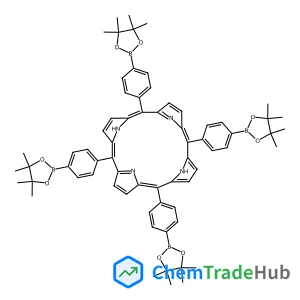
5,10,15,20-tetrakis(4-boronic acid pinacol ester phenyl) porphyrin
CAS Number:
1332748-00-1
Molecular Formula:
C68H74B4N4O8
Recommended Suppliers






Disclaimer
This page provides academic journal information for reference and research purposes only. We are not affiliated with any journal publishers and do not handle publication submissions. For publication-related inquiries, please contact the respective journal publishers directly.
If you notice any inaccuracies in the information displayed, please contact us at support@chemtradehub.com. We will promptly review and address your concerns.