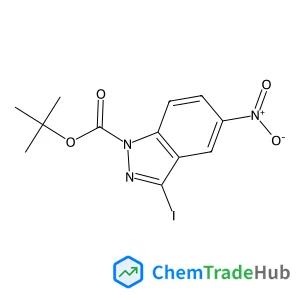
Tert-butyl 3-iodo-5-nitro-1H-indazole-1-carboxylate
CAS Number:
459133-69-8
Molecular Formula:
C12H12IN3O4
Sture Nordholm, Hongrei Li
The collisional energy transfer between a palladium cluster and a rarified inert gas medium has been studied by molecular dynamics simulation and interpreted by statistical theory. The cluster is Pd13 and the inert gas may be composed of helium, neon, argon or krypton. The cluster–inert gas collision cross section and the average energy transferred per collision are determined by following the collisions by classical trajectory calculations. Special attention is placed on the development of rigorous sampling techniques such that the average energy transfer vanishes when cluster and gas are at the same initial temperature. The dependence of the energy transfer on impact parameter is found to display an inner region of prevalent excitation and an outer region of prevalent deexcitation of the cluster. The energy transfer efficiencies observed fall a factor of between 0.05 and 0.4 below the ergodic collision limit with the heaviest gas atoms most efficient. The PEMET model explains the observed efficiencies in terms of an increased number of atom–atom encounters with increasing strength of attraction between atom and cluster and with lower temperature.
Sarina Sarina, Eric R. Waclawik, Huaiyong Zhu
DOI: 10.1039/C3GC40450A
Go Hamasaka, Takao Osako, Yoichi M. A. Yamada, Chao-Jun Li, Audrey Moores
DOI: 10.1039/C3GC40789F
Nageswara N. Rao, Smita Masid
DOI: 10.1039/C3GC40759D
Donald J. Darensbourg, Andrew D. Yeung, Sheng-Hsuan Wei
DOI: 10.1039/C3GC40475G
Tao Pan, Jin Deng, Qing Xu, Yang Xu, Qing-Xiang Guo, Yao Fu
DOI: 10.1039/C3GC40927A
Qing Jiang, Cancheng Guo
DOI: 10.1039/C3GC40515J
Shaoyan Zhang, Guoli Fan, Feng Li
DOI: 10.1039/C3GC40658J
Qin Wang, Di Zhang, Xiangliang Yang, Huibi Xu, Amy Q. Shen, Yajiang Yang
DOI: 10.1039/C3GC40728D
Carlos Vila, Magnus Rueping
DOI: 10.1039/C3GC40587G
When handling 4-Methyl-6-(trifluoromethyl)quinoline (CAS: 40716-16-3), safety go...
4-(3,5-Difluorophenyl)aniline is an aromatic organic compound with the CAS numbe...
5-{[4-(Trifluoromethyl)phenyl]sulfanyl}-1,2,3-thiadiazole-4-carboxylic acid can ...
The market for 4-Benzylaniline hydrochloride (CAS: 6317-57-3) is steadily growin...
[3-(Diethylsulfamoyl)phenyl]boronic acid is generally considered safe when handl...
3-Bromo-2,5-dimethoxyaniline is mainly used in the pharmaceutical and chemical i...
N-Methyl-1-(5-methyl-1H-indol-3-yl)methanamine (CAS: 915922-67-7) is subject to ...
This compound is primarily used in the pharmaceutical industry for the synthesis...
2-Methyl-2-propanyl [(1S,3R)-3-aminocyclohexyl]carbamate (CAS: 1298101-47-9) sho...
Ethyl 2-bromo-4,4,4-trifluorobutanoate (CAS: 367-33-9) is utilized in the pharma...

Physical Chemistry Chemical Physics (PCCP) is an international journal co-owned by 19 physical chemistry and physics societies from around the world. This journal publishes original, cutting-edge research in physical chemistry, chemical physics and biophysical chemistry. To be suitable for publication in PCCP, articles must include significant innovation and/or insight into physical chemistry; this is the most important criterion that reviewers and Editors will judge against when evaluating submissions. The journal has a broad scope and welcomes contributions spanning experiment, theory, computation and data science. Topical coverage includes spectroscopy, dynamics, kinetics, statistical mechanics, thermodynamics, electrochemistry, catalysis, surface science, quantum mechanics, quantum computing and machine learning. Interdisciplinary research areas such as polymers and soft matter, materials, nanoscience, energy, surfaces/interfaces, and biophysical chemistry are welcomed if they demonstrate significant innovation and/or insight into physical chemistry. Joined experimental/theoretical studies are particularly appreciated when complementary and based on up-to-date approaches.